Thursday, August 5, 2010

Lana Turner: Birth of a Starlet, Part 2


Note: The first part of this two part article can be found here.

As far as party girls go, Lindsay Lohan had nothing on Lana Turner in the early 1940’s (well, accept arrests and rehab time). With her perky nose, dancing dimples and honey blonde hair, the gorgeous “Sweater Girl” was on the top of the Hollywood heap, both socially and professionally. Although she was still technically a starlet, her career was on the rise, which only heated up her love life all the more.

Her wild woman reputation would only be enhanced by her whirlwind four month marriage to bandleader Artie Shaw (pictured below), a notorious ladies man, who jilted both Betty Grable and a young and impressionable Judy Garland for Turner. Eloping after their first date, the 29 year-old lothario and the sweater girl (who had just turned 19 earlier that week) had a tumultuous time of it and Lana famously called her tenure with Shaw her “college education.” The irony is that Turner claims that she married Shaw on the rebound from yet another infamous Hollywood wolf, attorney Greg Bautzer. Bautzer ditched her for Joan Crawford (Bautzer would be portrayed by actor Steve Forrest in 1981’s Mommie Dearest). He would not only represent her in her divorce from Shaw, but also in her split from second husband, restaurateur Stephen Crane. And so goes the fast and furious Hollywood sexual Merry-Go-Round.


With her divorce came a new crop of men and nightclub rounds. Victor Mature and singer Tony Martin were just a few who squired the blonde beauty around town. MGM took the opportunity of Turner’s burgeoning notoriety to cast her in Ziegfeld Girl (1941) with fellow studio beauty Hedy Lamarr and fellow studio cutie Garland. As Sheila Hale, top banana in a sea of legs and sequins that only the great showman Florenz Ziegfeld could display properly, Lana tumbled and stumbled in yet another kind of sea…..booze and men. The hit film played as a precursor of sorts to 1967’s Valley of the Dolls, and allowed Turner melodramatic training which, not only boosted her career at the time, but would hold her in good stead twenty some odd years later in her middle aged diva stage (ie: Peyton Place (1957), Imitation of Life (1959) and Madame X (1966)).

Her next picture was the big budget remake of Dr. Jekyll and Mr. Hyde, which placed her at third billing after Spencer Tracy and Ingrid Bergman. Originally slated to play the slutty victim of Mr. Hyde, she was cast as the good girl in love with Dr. Jekyll, when Miss Bergman, set to play that role, wanted a change of pace and requested their parts be switched. With the success of Ziegfeld Girl, Metro cast her with the studio’s top male star, the King himself, Clark Gable, in a western/romance called Honky Tonk (1941). Mrs. Gable, aka Carole Lombard, reportedly didn’t like the film pairing, believing the kisses during the fade out might linger after the cameras stopped rolling. Rumors swirled to that notion, though Turner stated, both in a Ladies Home Journal article, as well as her autobiography, that no such affair took place.


Yet another case of alleged extramarital cuddling occurred during the filming of Johnny Eager (1942) with another MGM heavyweight heartthrob, Robert Taylor. The films promotional ads read: "Taylor's Johnny, Turner's eager." Married to actress Barbara Stanwyck at the time, Taylor reportedly was so smitten with Turner that he asked Stanwyck for a divorce. As with the rumored Gable affair, Lana also denied any wrongdoing with Bob Taylor. The onscreen chemistry was definitely there, as it was with Gable and tongues continued to wag when she and Gable were cast yet again in Somewhere I’ll Find You (1942), and it was during the filming of this picture that Carole Lombard was killed in a plane crash while on a war bond selling tour. The following year, Turner starred in a picture called Slightly Dangerous.

By the end of the war, Lana Turner was a hot property, both on and off screen. No film could display this sexy femme fatale persona better than the one for which the actress would become most famous, The Postman Always Rings Twice (1946). As a tanned and tempting married waitress on the make, she would forever brand her image, wearing a stark white two piece short set and matching turban. She would have several more husbands in the next 25 years and many other big roles, but this part defined her sex goddess persona for the rest of the decade and most of the next one. The starlet had become a star.

Monday, July 26, 2010

The Hard Way (1943): Forgotten Gem


The Hard Way could be a description of actress Ida Lupino’s career. Called by some a “poor man’s Bette Davis (a moniker shared by Susan Hayward), Lupino was a star in her own right, possessing a very distinctive style and consistently giving top notch performances. However, attaining her major success at Warner Brothers in the early and mid 1940’s, she was sometimes required to take some of Davis’ cast off roles, Bette being the queen of the Warner’s lot during this period. One such Davis hand-me-down was the meaty lead character of Helen Chernen in The Hard Way (1943), which Lupino deftly handled. She gave a tour de force portrayal and gained much acclaim including the New York Film Critics Circle Award for Best Actress of 1943.

Helen Chernen is a woman living in near poverty in a lifeless, stifling, dirty coal mining town. Trapped in a loveless marriage to boot, her only ray of hope is her teen-aged sister, Katie (Joan Leslie). Helen sees an opportunity for the moderately talented Katie, when the youngster catches the eye of a traveling vaudevillian, Albert Runkel (Jack Carson), who is passing through the shabby little burg with his show biz partner, Paul Collins (Dennis Morgan). The elder sister pushes for their marriage, then slowly integrates Katie into the Runkel/Collins act until bigger fish come along to fry. Katie becomes a huge success leaving the lovelorn Albert behind, but success via her sister Helen, she finds, isn’t so sweet when you go about it the hard way, or should I say the wrong way.


The film, written by famed playwright and author Irving Shaw, is reportedly based loosely on the early life of actress Ginger Rogers, specifically her relationships with her stage mother Lela and her first husband, vaudeville performer Jack Pepper. The movie even makes reference to Rogers by name and when the character of Katie makes big in her first Broadway show, the production is called “Boy Crazy” (as opposed to Ginger’s first successful foray, “Girl Crazy”).

Ida Lupino is superb as Helen. Underrated and often overlooked in the annals of Hollywood history, the actress displays in The Hard Way, as well as other films, an inner toughness and resolve, to get her way, whatever the cost. She is not alone in contributing a fine performance however, with the entire cast turning in solid work. Jack Carson gives perhaps his finest dramatic display as the good hearted but ill-treated Albert. He and Dennis Morgan would co-star in several other Warners features, but none so artistically successful as this. Not to say this is high art. It is basically what was known at the time as a “woman’s picture” with hints of film noir, very similar in many ways to Mildred Pierce, also produced at Warner Brothers two years later. In fact, producer Jerry Wald used the opening sequence of Ida Lupino dressed to the nines and jumping into the bay as the basis for the opening in Pierce.


Aside from Miss Lupino, the two second lady roles went to the afore mentioned Miss Leslie and veteran actress Gladys George, who was a staple at Warners and other studios in bedraggled dame roles or the moll with the heart of gold. Gladys’ characters had lived a lot of life and seen a lot of sadness. Her role here, as a has-been stage actress who drowns her sorrows in a bottle of whatever is at hand, is no different. Joan Leslie is the only proverbial fly in the ointment in The Hard Way. Not that she doesn’t do an adequate job, but one finds it extremely hard to believe that, as Katherine Blaine, she is a great shining beacon on the New York stage. Her Katherine can be downright lackluster at times, especially beside the scenery chewing Lupino! However, with the help of make up guru Perc Westmore and gowns and get-ups by designer Orry-Kelly, she goes from small town gum chewer to sophisticated stage star quite smoothly, and considering her youth (Leslie was only seventeen at the time of filming), she keeps her head above water with the stalwart Warner Brothers stock company. The entire ensemble is really good, but Ida Lupino is the one you can’t take your eyes off, and shouldn’t, as you might find a knife in your back.

Want to know more?
Here are some recommendations regarding the article above:
Ida Lupino: A Biography by William Donati

If you are interested in this or any other merchandise, please help support this blog by purchasing them through the Amazon portal at the top of this page. By accessing Amazon through this site, you help me maintain resource material and continue to share my love of classic film. Thank you very much.

Sunday, July 18, 2010

Beauty and the Beast (1946): Enter Cocteau's Dream


To put it simply, director Jean Cocteau’s 1946 version of Beauty and the Beast (La Belle et la Bête) is sheer genius. The film is a masterpiece of celluloid and no other fairy tale put to film is as artistically stunning (The Wizard of Oz may be an exception, but Cocteau’s French chef d'oeuvre has an ethereal quality that even Oz can’t touch). It is exquisite in every detail, visually sumptuous with an equally impressive and lavish musical score by composer Georges Auric. Cocteau, a highly intelligent and creative individual, who cavorted with the likes of Pablo Picasso and Edith Piaf, pulled out all the stops to actualize the famed fairy tale. His dreamlike classic would inspire the Walt Disney animated version of the same name 45 years later.

The story revolves around the characters of Belle, a beautiful, kind and humble French girl and The Beast, a magical, physically hideous creature. When Belle’s father gets lost in the forest while on a journey, he happens upon an other worldly like estate, a chateau of mystical essence. After partaking of the hospitality of an invisible host, the man wakes the next morning to wander the grounds looking for his horse and continue homeward. In the garden of the estate, he finds a magnificent rose and plucks said flower for his daughter. This gesture of affection awakens the rage of his host, now making his presence known as the Beast. For this infraction, the Beast commands that he shall have to pay with his life, unless one of his daughters come in his stead. Of his four children, the old man has a shiftless, irresponsible son named Ludevic and two vain and abrasive daughters, Felicie and Adelaide. His third daughter is the lovely and selfless Belle, for whom he picked the rose. The last of the characters in Cocteau’s version is the handsome but erratic Avenant, who is in love with Belle.


When the father arrives back home, fatigued and ill, he tells his tale to his amazed family. Belle, wishing to save her father from any potential harm, sneaks out and rides the magic horse which was provided by the Beast, as the means for return to his world. Once she has reached her strange destination, Belle is both frightened and astonished at the fantastical residence. When she meets the beast face to face, she is horrified by his countenance. The Beast on the other hand is enchanted by Belle’s beauty and asks her to marry him. Initially repelled by the offer, as her time in the Beast’s company progresses, she befriends him and persuades him to allow her to return to her father, who she discovers is deathly ill. The Beast reluctantly agrees, on the terms that his beloved return within a week, on her honor. He informs her that should she fail to come back, he will die of grief.

As both the film's director and writer, Cocteau’s vision is brought vividly to life onscreen long before high tech special effects were even considered in film making. The gallery of living candelabras, Belle’s diamond tears, her enchanted mirror and the fireplace mantle carved with faces whose eyes watch every movement around them are just a few of the fascinating examples of the director’s creativity come to life. His use of quick cutting between scenes, abruptly ending one scene and immediate entrance into the next, as opposed to a slow fade out, enhances the surreal effect of the picture. As an American watching the film, the French language, fluid and alien to me except for a few scattered words, also lends to the hypnotic production. Famed French designer Christian Bérard, was in charge of production design and acclaimed cinematographer Henri Alekan the gorgeous black and white photography.


As both the Beast and Avenant, French matinee idol Jean Marais does a wonderful job projecting the pathos of the Beast, as well as the pompous virility of Avenant. Marais met director Jean Cocteau in 1937. The two became lovers and Marais, Cocteau’s protegee. The director guided the young actor to become one of France’s most popular stars in the 1940’s and 50’s, with their best collaborations, being this film, as well as Orpheus (1949). French actress Josette Day is luminous as Belle. Each of her shots accentuate her beauty and elegance on film and she displays the grace of a ballet dancer, whether in her scenes at the family’s provincial homestead or the Beast’s palace. Unfortunately for the French movie industry, Day retired from films only 4 years after La Belle et la Bête at the age of 36. As for the supporting cast, mention must be made for the performances of Mila Parély and Nane Germon as Belle’s viperous and hateful sisters. These two nasty wenches could give Cinderella’s step siblings a major run for their money.

Beauty and the Beast is a masterwork indeed. But be warned, there is no Ma and Pa Kettle Go to the Fair here. It is a work of supremely skilled artistry with both style and substance, and excellence from all involved. For a foreign film novice, it’s a perfect foray into the genre and a delight to all who make the leap.


Want to know more?
Here are some recommendations regarding the article above:
Beauty and the Beast ~ The Criterion Collection (DVD)

If you are interested in these or any other merchandise, please help support this blog by purchasing them through the Amazon portal at the top of this page. By accessing Amazon through this site, you help me maintain resource material and continue to share my love of classic film. Thank you very much.

Wednesday, July 14, 2010

Pre-Code Barbara Stanwyck: You've Got the Cutest Little "Baby Face"


Raw, gutsy and independent, Barbara Stanwyck was a “brawd” in the truest sense of the word and one of the best examples that Hollywood had to offer. This tough dame persona, which ran rampant in classics like Double Indemnity (1944), The Strange Love of Martha Ivers (1946) and a variety of westerns in the 1950’s, found its roots in the actress’ pre-code movies of the early 1930’s. While many of her contemporaries tried to speak with a pseudo-British accent, a common trait as part of actor's film diction training by various studios (MGM was the worst), Stanwyck not only spoke in her native Brooklyn-ese, but wore it as a badge of honor. Among other things it made her stand out from the pack of young actresses who seemed bound for stardom in the early days of talkies.

In the period of Hollywood history known as the pre-code era (the time in the early 1930’s before the Production Censorship Code was put into strict enforcement), Stanwyck’s roles stood out as some of the most notable and brazen. Along with Mae West’s early cinematic romps, Stanwyck’s racy Baby Face (1933), helped pave the way for a tighter hold by Hollywood censors later in the decade. Her husky, knowing voice not only betrayed her Brooklyn roots, but revealed in her roles of this period, an earthy, wanton past. Her characters had been around the block, and if they hadn’t, they wanted to.


Her screen image in the Thirties was that of a self-sacrificing mother or a tramp, either with a heart of gold or cold and hard, with the capacity of redemption. Some of her film’s plots during this interval were contrived and hard to swallow, such as The Purchase Price (1932) and Ladies They Talk About (1933), but Stanwyck’s performance always shined and made otherwise unbelievable situations extremely entertaining. She possessed similar screen traits to one of her screen peers at MGM during the same time, Joan Crawford. Like Crawford, she was often cast as a lower class young woman scraping her way in a man’s world. Just as Joan was the eternal shopworn shopgirl in her pre-code films, Barbara actually starred in a film titled Shopworn (1932). But unlike Crawford, Stanwyck was more hard boiled. She could play not only a gangster’s moll but the gangster, and she had no qualms when it came to revenge. Also unlike Crawford, who was, and wanted to be, iron clad contracted with her studio, Stanwyck had non-exclusive contracts with both Columbia AND Warner Brothers during a time when the studio ruled. Talk about gutsy.

Barbara Stanwyck’s real life past lent a certain credence to her onscreen performances. Born in Brooklyn in 1907 as Ruby Stevens, she was orphaned at a very young age and was cast about in several foster homes until eventually hitting the stage as a teen and becoming a chorus girl. Mind you, a chorus girl in the 1920’s was not exactly a Little Bo Peep existence. She met and married Frank Fay, a popular vaudeville star and followed him to Hollywood, where she got a less than auspicious start in movies. Her first two features were duds, and discouraged and distraught, she went, on recommendation of Columbia Studio boss Harry Cohn, to see director Frank Capra about a picture he was casting called Ladies of Leisure (1930). Capra thought Stanwyck “sullen” and she left the interview prematurely. But after viewing a test she had made for another film, the director wanted her in his picture and the two became great friends with Capra saying of the actress in his autobiography, “In a Hollywood popularity contest, she would win first prize hands down.” A notion shared my many in the film community for years to come.

In Ladies of Leisure, the actress plays a “party girl”. In her next film, Illicit (1930), as if the title wasn’t titillating enough, she plays a girl who wants to live with her lover outside of marriage (this is 1930 we’re talking here). Forbidden (1932), shows her as a sexually repressed librarian who throws caution to the wind and becomes the mistress of a married man, even having his child out of wedlock. Ladies They Talk About (1933), she winds up in a women’s prison. These kinds of roles and ones similar to them, were a prevailing theme in Stanwyck’s early work. Bouncing back and forth between Columbia with roles in early Capra films and Warner Brothers, the actress made great career strides eventually gaining full fledged stardom. The culmination of this bad girl image arguably came in the form of Baby Face, the deliciously decadent diatribe which helped push Hollywood censors over the edge.

Baby Face features Stanwyck as Lily Powers, product of a grimy factory town where her bootlegging father has been pimping her out since she was 14. When he is killed she heads for the big city to make her mark. Starting from the ground floor, she literally sleeps her way to the top in a large metro bank, where she eventually becomes the mistress of the vice president then marries the banks newly elected president (George Brent). The film’s imagery of Stanwyck’s ascent to material wealth is priceless. With each corporate conquest (one of which is played by young pre-stardom John Wayne, pictured above), the camera pans further upward the exterior of a New York skyscraper, which represents the bank in which she intends to prevail, all to the sound of St. Louis Blues on the saxophone. How pre-code is that.
Even in her more tame film efforts after the enforcement of the censorship code, Barbara Stanwyck’s tenacity and vitality shined through. She went on to make better known and glossier pictures, but the seed had been planted in her early days. In these pre-code offerings of sin, seduction and self-sacrifice, Stanwyck showed she not only had what it took, but knew exactly how to use it.
If you are interested in these or any other merchandise, please help support this blog by purchasing them through the Amazon portal at the top of this page. By accessing Amazon through this site, you help me maintain resource material and continue to share my love of classic film. Thank you very much.

Sunday, July 11, 2010

The 39 Steps (1935): Hitchcock Breaks Through


“If it's a good movie, the sound could go off and the audience would still have a perfectly clear idea of what was going on.” ~ Alfred Hitchcock

This statement by Hitchcock sums up perfectly his attitude about directing the film that really made the public sit up and take notice of his talent, both in England and the United States. It is the inspiration for his creative, yet very straightforward direction of The 39 Steps (1935), a movie still revered today for its masterful style and pacing. It’s been remade more than once, but none have begun to touch the Hitchcock bravura.

As the film begins, in an English music hall, the mood is very raucous and lighthearted, and one wonders where the trademark Alfred Hitchcock suspense will enter in. That alone makes it exciting, because you know it will, just not where and how. But enter it does and with both a vengeance and the director’s panache. The featured act at the theater is a novelty called “Mr. Memory”, a fellow who is a walking encyclopedia and as he is spouting his wisdom to the jeering crowd a shot is heard, leading to mass hysteria. Richard Hannay (Robert Donat) is a Canadian visiting London, who gets caught up in the frantic hustle bustle to find an exit. In all the pandemonium, he meets a mysterious foreign lady who nervously persuades him to take her back to his lodging. Turns out Miss Mata Hari is a secret agent, being sought out by a couple of nasties who are scoping out Hannay’s building. Our hero Hannay thinks she’s not exactly on the up and up at first, but quickly sees which way the wind is blowing when the spy falls upon him in the night with a knife in her back. With a dead body in his place and knowledge passed on to him by the mysterious mademoiselle, he takes it on the lamb with both the police and foreign agents on his tail.

He goes from one scrape to another, and eventually meets up with a blonde maiden fair (Madeleine Carroll), who, thinking him the murdering monster he has been painted by the newspapers, holds only contempt for him, and when they become handcuffed by “the bad guys”, Hannay has a hard time, keeping one step away from capture while trying to keep the wild beauty from surrendering him.


The success of Hitchcock’s previous release, his original version of The Man Who Knew Too Much (1934) allowed him more freedom in his next cinematic venture. The 39 Steps was based on a spy yarn from 1915 by Scotsman John Buchan, though the director made the story his own. For film buffs and historians, the picture marks the first of a few oft used Hitchcockian themes, the most relevant being that of the “innocent man on the run” which was duplicated again in Saboteur (1942) and North by Northwest (1959), among others. Another is his casting of Madeleine Carroll, a beautiful and cool blonde leading lady, and a precursor to icy fair hairs Grace Kelly and Tippi Hedren in several of his 50’s and 60’s films. Carroll’s character, Pamela, wasn’t actually in the original novel and both the character and the potential romantic element she brings to the story were successfully added by the formidable director.

The film offers Hitch a chance to display his mastery of his craft, as well as the creative use of the camera. He claimed that with The 39 Steps, he wanted each scene to be like a short film unto itself and indeed he achieved quite the effect to culminate the whole as a quick and smoothly paced film. Upon finding the body of the initial female spy in Hannay’s flat, an elderly charwoman screams in close-up, her scream not from her own vocal chords, but the sound of a train whistle which is segued into the next scene of a railway. It is a three second spot, but very chilling and effective.

A well known episode from the film is that of Hannay making his way to a remote farm while on the run and asking the farmer to put him up for the night. The farmer, a strict and extremely pious old coot has a much younger wife, who finds the handsome and urbane Hannay attractive, and helps him escape when the police track him to the farm. This is yet another scene which was absent from the original book but developed for the screen. The vignette, although pertinent to the rest of the movie, is a short story in itself.


Carroll’s casting as Pamela is perfectly complemented by Robert Donat’s Hannay. The actor had just hit it big the previous year in The Count of Monte Cristo and had become fondly known as “the Monte Cristo man”. The 39 Steps added to his growing repertoire of quality films, and led him to MGM in the States to make The Citadel (1938) and Goodbye, Mr. Chips (1939), the latter for which he won an Academy Award. The suave Brit exudes just the right amount of energy, humor and intelligence to make him a very worthy Hitchcockian hero. With fine support by Lucie Mannheim, Godfrey Tearle and Peggy Ashcroft, the film is superbly cast.

Atmospheric, humorous and exciting, The 39 Steps is definitely a must-see. There is a lot to transpire in the movies 86 minutes, with suspense and fun aplenty, which is the least to be expected from an Alfred Hitchcock feature. Oh, and if you get a chance to view this classic, see if you can spy the director in his trademark cameo….cheers!


Want to know more?
Here are some recommendations regarding the article above:
The 39 Steps (1935) Criterion Collection
Hitchcock By Truffaut. The Definitive Study of Alfred Hitchcock By Francois Truffaut
If you are interested in these or any other merchandise, please help support this blog by purchasing them through the Amazon portal at the top of this page. By accessing Amazon through this site, you help me maintain resource material and continue to share my love of classic film. Thank you very much.

Thursday, July 1, 2010

Happy 94th, Olivia de Havilland!


Born during the first World War, the legendary Olivia de Havilland turned 94 on July 1, 2010. One of the last stars of the golden age, de Havilland has one of the most incredible careers in film history.


Independent Woman published a wonderful interview with O de H last year. I'd like to share it to help celebrate her special day. Check it out by way of the link below.
Happy Birthday Olivia!

http://www.independent.ie/lifestyle/independent-woman/olivia-de-havilland-i-was-a-star-but-also-a-slave-1821397.html


Tuesday, June 29, 2010

The Wicked Lady (1945): Or Cleavage and the Crafty Wench


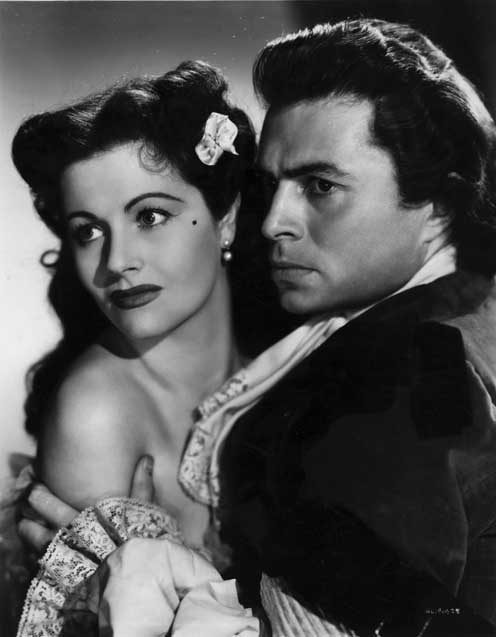
In November 2004, the British Film Institute compiled a list of the all-time most popular films ever shown in England, not just those made in Great Britain but across the globe. This list wasn't created by opinion polls or statistics, but by the most accurate data available....the number of tickets sold. Not ticket sales, which can change dramatically over decades due to inflation, but actual tickets sold to viewers. What a novel idea! And of the tens of thousands of movies shown in Britain, number nine on the list was The Wicked Lady (1945), a lush and lusty historical potboiler made in England and starring the ravishing Margaret Lockwood and the rakish James Mason. You may have heard of it but chances are the average modern classic film fan hasn't and yet it beat out Jaws, the Harry Potter series and even each individual installment of the Lord of the Rings trilogy, none of which even made it into the top ten. What? How could an obscure little swashbuckler made just after the war, with a running time of only 104 minutes, sell more tickets than these blockbuster heavyweights?

The Wicked Lady, released in December 1945, just so happened to be England's highest earning film for 1946. The British box office coffers fairly exploded with the bodice ripping tale, set during the Restoration. Critics thought very little of it but the public couldn't get enough. Based on a novel by Magdalen King-Hall called The Life and Death of the Wicked Lady Skelton, the story apparently has its roots in real life events of the life of Lady Katherine Ferrers (pictured right), an heiress and wife of prominent landowner Thomas Fanshawe, in 17th century England. The conniving female of the film's title is Lady Barbara Skelton (Lockwood), who has been invited to the wedding of her childhood friend, Caroline (played by the lovely Patricia Roc). Upon arrival, the beautiful and scheming Barbara charms and bewitches bridegroom-to-be Sir Ralph Skelton (Griffith Jones), a wealthy, albeit uninspiring landowner. She marries the unassuming Ralph and becomes lady of the manor, a grand Jacobian mansion called Maryiot Cells (the huge estate is actually Blicking House in Norfolk, now a property of the National Trust). Bored with what she considers a dull life as a country lady, she dons a mask and men's clothes and becomes a highwayman, a rogue in days of old who worked as armed robbers of passing carriages on remote highways. She meets up with another thief of the same order, the infamous Jerry Jackson (Mason) and, as bored with her her husband as she is with domestic life, she and Jackson become lovers. Wicked doesn't begin to describe our lass, as her shenanigans multiply, eventually leading to murder, as well as yet another man floating about in the background to raise her temperature (Michael Rennie).

The Wicked Lady was a product of Gainsborough Pictures, a film studio in Islington, London, which was a part of the Rank empire, the leading movie production company in Britain. Gainsborough gave rise to a small group of up and coming actors which included Stewart Granger and Phyllis Calvert, as well as Lockwood, Mason and Roc, and specialized in interchanging these players in various historical, as well as contemporary dramas. Lady is a perfect example of the Gainsborough formula and by far the most commercially successful. One simple reason for the film's popularity was the fact that risque Restoration romance was all the rage in 1945. American author Kathleen Windsor had just released her debut novel Forever Amber the previous year to enormous success, with a film version in the works by 1946. The Wicked Lady was very similar to Amber in atmosphere and theme and was a better representation of the genre for a fraction of the cost its American counterpart would incur. The fiery melodrama made no pretense of being high art, instead embracing its dime store romance novel status with sumptuous interior decor and lavish costumes given exquisite attention to detail.

When it came to U.S. distribution of the film, the costumes became a huge bone of contention. American motion picture censors considered Margaret Lockwood's cleavage much too prominent to be allowed on Yankee movie screens and costly reshooting was required in order for the picture to be shown this side of the Atlantic. There was also no lack of innuendo and racy dialogue. Upon meeting the dark and daring Jerry, who has no qualms about wrapping his hands around Barbara's nibble worthy neck, she asks: "Do you always take women by the throat?", to which the sensual thief wantonly answers, "No, I just take them."


Lockwood is without doubt the star of the show. She had already made a name for herself nearly a decade earlier as the female lead in Alfred Hitchcock's The Lady Vanishes (1938). By the time she played Lady Skelton, she was one of England's most popular movie actresses. Bearing a striking resemblance to American film star Joan Bennett, Lockwood runs dramatically amok in The Wicked Lady. She is a cross between Jezebel and Lucretia Borgia, definitely the stronger character next to her weaker male film counterparts. When all is said and done, number nine on Brits top list is just good dirty fun.

Sunday, June 20, 2010

Bette vs. Miriam, Bout of the Divas: Meow


About a year ago, I wrote a short piece on the legendary feud of two legendary Hollywood actresses, Bette Davis and Miriam Hopkins. Since then, I have expanded this forum and also, delved deeper into the abyss that was the Davis/Hopkins relationship. Bette was infamous for her battles with certain co-stars, male (paging Mr. Flynn! Mr. Errol Flynn!) as well as female (calling Joan Crawford!), but they seemed to pale in comparison to her feeling for Miriam Hopkins. Their’s was a deep seeded, long standing rivalry, which began even before either woman made a single movie.

Round 1
In 1928 both young actresses were in a stage production on the east coast called Excess Baggage. Both were part of a repertory acting company headed by director George Cukor, although at this point, unlike their future film pairings, Miriam, not Bette, was the big cheese. Hopkins also made leading lady status in Hollywood long before Davis, with star turns in Dr. Jekyll and Mr. Hyde (1931) and Design for Living (1933), among other notable films of the early 30’s.


Round 2
In 1933, Hopkins starred in Jezebel on Broadway. It was the story of a tempestuous Southern belle (a part tailor made for the real life Southern spitfire) in the era before the Civil War, ala Scarlett O’Hara. The play was unsuccessful, running only a few dozen performances and closing after a month. Not only did Miriam star in the play, but she was part owner of the rights to it. When Warner Brothers studio showed interest in the story as a vehicle for its rising star, none other than Miss Bette Davis, Hopkins balked, refusing to sell the rights unless the deal included her in the lead role of Julie, which she had originated. In order to obtain the rights, she was given the impression that she would be cast, so when top brass gave the plum part to Davis, Miriam was livid. To add insult to injury, Bette won her second Oscar for her performance in Jezebel. The story goes that Miriam cried.

Round 3
In late 1938, with her career in somewhat limbo, Hopkins signed a two picture deal with Warner Brothers. The first film under her new contract was the historical melodrama The Old Maid (1939), based on an Edith Wharton story. In the film, she played second lead to guess who….Bette Davis, Warners reigning queen supreme. But neither actress was a shrinking violet and there was tension aplenty on the set, with director Edmund Goulding at the helm. A studio memo summed up the stressful situation when it relayed, “…Goulding has a tough job on this picture with these two girls. Not that they want to cause him any trouble or worry, but each one is fighting for a scene when they go into it…”

Davis had fought hard with the studio to get where she was professionally, and she wasn’t about to take guff from her rival. But Miriam certainly tried to get a rise out of her at any opportunity. On her first day on the set, Hopkins wore an exact duplicate of the dress Davis had worn in Jezebel. Davis reflected on this time with Hopkins in her autobiography with the following observations: “Miriam used and, I must give her credit, knew every trick in the book. I became fascinated watching them appear one by one…When she was supposed to be listening to me, her eyes would wander off into some other world in which she was the sweetest of them all. Her restless little spirit was impatiently awaiting her next line, her golden curls quivering with expectancy."


Warner Brothers publicity department took full advantage of the dueling divas and played up their feud to boost ticket sales for the upcoming film. They even went as far as to circulate a photo of the actresses in full costume with boxing gloves on, ready to duke it out, with director Goulding looking resigned between them. (above)

Round 4
During the making of The Old Maid, Hopkins was married to director Anatole Litvak. Litvak had directed Bette Davis in her follow up film to Jezebel called The Sisters (1938), and Miriam suspected the two were having an affair, but Davis was too taken with her Jezebel director, William Wyler, at the time to look at Litvak. However, reportedly Litvak and Davis DID have a short affair during the filming of All This and Heaven Too in 1940, but by that time the director and Hopkins had already divorced.

The Old Maid was excellent box office, and Warners signed Miriam on for another spin with her nemesis in 1943 to make Old Acquaintance, the story of two childhood friends/rivals who spar incessantly over men, career, and a child. The romantic yarn was perfect for the pair, but wasn’t without its backstage fireworks. Edmund Goulding was again slated to direct but had a heart attack shortly into the production. Knowing the emotional state of the set and the stress Goulding had been under with the two high maintenance queens, studio head Jack Warner jokingly accused him of having the heart attack on purpose. At 40, the dew was off the lily for Miriam, and when production wrapped on Old Acquaintance, she sold her house in California, packed her bags and went back east to the stage. When she returned to Hollywood, it would be in character roles over half a decade later.

Sunday, June 6, 2010

SUMMERTIME!


With the passing of Memorial Day, the unofficial start of the summer season is upon us and the sultry heat and lush atmosphere of the approaching solstice is sumptiously displayed in a few photos from heatwaves of the past, featuring some of Hollywood's most gorgeous female players. Above, buxom brunette bombshell Ava Gardner showed she knew what fun in the sun was all about, and looked amazing doing it. This picture was made about the time she was married to Mickey Rooney.....lucky boy, that Mick.


Beautiful Linda Darnell was no stranger to the cheesecake department. Her raven haired exotic beauty made her one of the most popular stars at 20th Century Fox in the 1940's.


Blonde and leggy Betty Grable is taking in the sun, surf and sand while catching up on her news........or checking out the most recent racing form.


Lovely Jeanne Crain, poolside, showing off her curves aplenty. Hard to believe this woman ended up having seven children.


Screwball cutie Carole Lombard, aka Mrs. William Powell AND Clark Gable, is reclined and refined. Not the typical swimsuit model type, Lombard had a face and figure to match even the most well known pin-ups.


One of Hollywood's coolest cucumbers in the 1940's, comely Gene Tierney is the picture of summer glamour in this fantastic shot. No wonder JFK and half of Hollywood fell for her.


Marvelously mellow Marilyn Monroe is ripe and luscious as a any summer fruit in her white one piece. Stunning.

Monday, May 24, 2010

Katharine Hepburn starring in “Box Office Poison”


1932. Making her film debut with the legendary John Barrymore in A Bill of Divorcement, Connecticut born and bred Katharine Hepburn was set on a path for screen stardom. Within a year of her auspicious Hollywood entrée, she starred in the first of her four Academy Award winning roles (Morning Glory) as well as one of the most recognized and popular films of the decade (Little Women). She was the darling of her home studio, RKO, and her continued success seemed inevitable. But unlike her contemporaries, she refused to play the Tinsel Town game. She abhorred interviews and rebuffed reporters (when asked by one newsperson if she and then husband Ludlow Ogden Smith had any children, her unorthodox reply was: “Two white and three colored”). Her disdain for makeup and wearing of pants and masculine attire was seen as too independent for public taste and she was tagged by some with the moniker “Katharine of Arrogance“. She went back to the stage on her native East coast, for the not very well received The Lake. When she returned to Hollywood, RKO cast her in Alice Adams (1935) for which she received yet another Oscar nomination, but the accolades were short lived.

In 1936, Hepburn made Sylvia Scarlett with Cary Grant and Brian Aherne, in which the non-stereotypical actress played a woman who is disguised as a young man. The RKO oddity cost Kate a big chunk of her reputation and the studio a big chunk of change (The film lost a whopping $363,000 in Depression-era dollars). Her period costume dramas of the mid-30’s, including Mary of Scotland, A Woman Rebels (both 1936) and Quality Street (1937), were flops as well, the latter two losing almost a quarter of a million dollars each at the box office. The public was staying away from Hepburn pictures in droves.


There seemed to be a ray of hope with the modest success of Stage Door (1937). The film paired the haughty Hepburn with Ginger Rogers, who, commercially, was a much more popular star and lucrative commodity for the studio. As Hepburn’s status at RKO plummeted, Rogers’ simultaneous skyrocketed. Still, the sparkling and intelligent comedy based on the Edna Ferber - George S. Kauffman hit play, didn’t hit the mark RKO execs had aimed for, bringing in only $81,000 in profits.


Desperate for a Hepburn hit and with fingers crossed, the studio cast her in a comedy, based on the humble financial success of Stage Door. Again paired with Cary Grant, who had just made a comic breakthrough of his own with The Awful Truth, the actress starred in Bringing Up Baby, the story of a man, a woman and a leopard named Baby. As inane as it sounded, that was the stuff of screwball comedies in the 1930’s. In retrospect, Bringing Up Baby is considered by some, one of the premiere classic comedies of its time (an opinion not personally shared by this blogger, but that is for another post), but in 1938 it was a box office disaster, losing $365,000, and when RKO slated Hepburn’s next film to be the standard programmer Mother Carey’s Chickens, the actress saw the writing on the wall. She bought out her contract for just over $200,000 and left the studio, with whom she had become synonymous.

Then the final blow was dealt. On May 3, 1938, a full page ad appeared in The Hollywood Reporter from the Independent Theater Owners of America lambasting studios and producers for promoting stars “whose public appeal is negligible ~ receiving tremendous salaries necessitated by contractual obligations”. Along with Garbo, Marlene Dietrich, Mae West, Kay Francis and Joan Crawford, Katharine Hepburn made this list. The statement went on to label those mentioned as “box office poison”. On that very day, RKO made the public announcement that it had parted ways with Kate Hepburn.

In the heart of the “box office poison” fiasco, two significant career factors occurred. The first film released since the Reporter ad, Holiday (1938), paired her yet again with Cary Grant. It had been made before she left RKO, on loan-out to Columbia, where Grant had seen his enormous success with Irene Dunne in The Awful Truth. Disappointment again hit home, as Holiday, although liked by critics, sank with the masses. The public was just tired of Katharine Hepburn. Then there was talk of the actress as a strong contender for the role of Scarlett O’Hara in the upcoming filmization of Margaret Mitchell’s hugely popular novel Gone With The Wind. Supposedly, Hepburn offered herself as a last minute replacement should the film’s producer, David O. Selznick, not have the part cast in time, but according to one of Selznick’s infamous memos, Kate’s box office standing and lack of sufficient sex appeal did little for the advancement of her cause. Says Selznick: “…because I think Hepburn has two strikes against her ~ first, the unquestionable and very wide-spread intense public dislike of her at the moment, and second, the fact that she is yet to demonstrate that she possesses the sex qualities which are probably the most important of all the many requisites of Scarlett….”


Heading back east, the frustrated actress spent the summer of 1938 in Connecticut with her family. Later that year, playwright Philip Barry approached Hepburn with a play he’d written with her in mind. It was called The Philadelphia Story and it was tailor-made for the cool actress. Retaining the film rights to the play (via her paramour Howard Hughes), she made a huge comeback in Hollywood in 1940 when MGM bought the rights to The Philadelphia Story (along with Miss Hepburn’s services, thank you). She remained a major star for the rest of her life, but she was never to forget her time as “box office poison” either.

LinkWithin

Related Posts with Thumbnails