Today, Frances Gumm, or Judy Garland as she is better known, would have been 87 years old. So much has been written about her life, films, songs, marriages, addictions and death. Volumes have been written about The Wizard of Oz (1939), her most famous film, alone. But the time in Garland's life just before she became a superstar, just before she hit the big time in Oz, is the one most fascinating to this blogger.
Garland joined the MGM family as contract player in 1935. Before that she was "Baby" Frances, the youngest member of a singing vaudeville act with her two sisters called The Gumm Sisters, which had been performing since the mid 1920's. After changing their name to The Garland Sisters (supposedly by famed comedian George Jessel) and Baby Frances to Judy (supposedly after a Hoagy Carmichael song), the group started to wind down by the mid 30's and Garland's mother, Ethel, a notorious stage parent, focused all of her attention on her youngest child, who was by far the most talented. After several auditions at various studios in Hollywood, Judy sang "Zing Went the Strings of My Heart" for MGM head Louis B. Mayer and was signed by that studio in September 1935, to a contract that paid her $100 per week. Her excitement was short lived when her father, Frank, died in November. Judy was heartbroken, having been closer to her father than anyone else. She and Frank would be separated for long periods of time when Ethel would take the singing trio on the road to tour.
Though a contract player at the biggest studio in town, MGM was at odds as to how best to fit the 13 year old into its stable of stars. She wasn't a child and she wasn't a woman. She wasn't even a child/woman like her
peer Lana Turner, who would join the studio two years later. With nothing set for her at Metro, Judy made her feature film debut on loan-out to 20th Century-Fox for a football folly called
Pigskin Parade (1936). When she returned to her home studio, she was scheduled to sing "
You Made Me Love You" to
Clark Gable for his 36th birthday party, given to him at the studio. A special version of the song had been reworked by Garland's MGM mentor, musical arranger Roger Edens, as "
Dear Mr. Gable." The performance and song were such a hit, a segment was integrated into the film
Broadway Melody of 1938 (1937) with Judy singing the song to a framed photograph of the heartthrob.
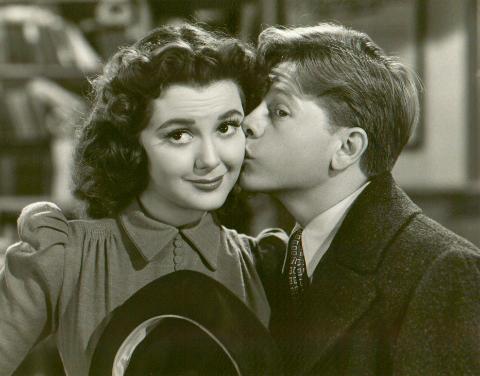
Next she was teamed for the first time with child actor Mickey Rooney, who would become her frequent co-star and lifelong friend. The film was Thoroughbreds Don't Cry (1937) and sparked a certain on screen chemistry between the two youngsters that would be expanded on by the studio for several years. They were first re-teamed the next year in Love Finds Andy Hardy, one of the best installments of the family oriented Andy Hardy series. As her popularity and work schedule grew, medication began being prescribed for all aspects of her life. Uppers to wake her up for long and laborious days on the set, downers to help her sleep at night and amphetamines to control her tendency for weight gain. Louis B. Mayer would call the poorly postured, chubby and awkward teenager, "my little hunchback." All this went on with the approval and full cooperation of Ethel who wasn't going to rock the boat (in later years, Garland would call her mother the "real Wicked Witch of the West"). It was the impetus to her lifelong dependence on drugs and alcohol.
Garland's on screen persona became the plain and dumpy girl next door, the heartsick teen whose crush on a boy could be mortifyingly painful. Not exactly star making qualities. But when she opened her mouth to sing, which she inevitably did in most all her films, that was when the screen came to life and what MGM wanted to cash in on with the right film project. The soul wrenching voice which emanated such vulnerability and pathos, would wow audiences every time and the electrifying talent that was Judy Garland was on it way.
In 1937, Metro had bought the film rights to The Wizard of Oz, a children's story by L. Frank Baum. As pre production began, the top studio brass was set on getting child star Shirley Temple to play the heroine Dorothy for the $2 million + production. Temple, who was under contract to rival 20th Century-Fox, had been the #1 box office star in 1935, 1936 and 1937. It would have been quite a coup for MGM to be able to borrow her, but Fox refused. It wasn't going to share the bounty of its top star. So Metro went with its plan B: Judy Garland. Much more mature physically than Temple (at pre production, Temple was 9, Garland 16), Judy's budding breasts were bound with tape, her hair pigtailed and her make up very minimal, in an attempt to make her younger looking for the role of the Kansas farm girl.
Though not an immediate financial success (it would be many years before the film would recoup its production costs), The Wizard of Oz was a classic and made Garland a star. The film's Academy Award winning song "Over the Rainbow" would forever be associated with the actress. With all the trials and tribulations she would face in her tumultuous life, Judy Garland continued to sing and along with her massive repertoire of songs, she would always be remembered as Dorothy.