Showing posts with label Michael Rennie. Show all posts

Tuesday, July 30, 2013

Dangerous Crossing (1953): Jeanne Crain Goes Crazy.... Or Does She?


Folks who follow this blog and its corresponding page on Facebook know what a fan I am of 1940's/50's cutie Jeanne Crain.  She never made it into the really big time but she had quite a run at 20th Century-Fox while it lasted.  Well, in 1953 that run ended and one of her last vehicles at the studio which had been her cinematic home for a decade, was Dangerous Crossing, a low(er) budget mystery-suspenser that did little to furthur her career or the careers of anyone associated with it.  However, it was the very first Jeanne Crain film I ever saw as a youngster and, though not very plausible at times, it really is a fun and suspenseful potboiler.

Based on a 1943 radio play called "B-13" by noted mystery writer John Dixon Carr, Dangerous Crossing follows the they're-crazy-as-a-bat, they-claim-their-relative-vanished-but-they-were-never-there-in-the-first-place plotline.  This style of mystery had been filmed several times before and would be afterward.  Besides Hitchcock's The Lady Vanishes, one notable version of the theme was So Long at the Fair (1950), a British historical mystery with Jean Simmons.  Dangerous Crossing was actually remade as a TV movie in the 90's called Treacherous Crossing with Lindsay Wagner.

Ruth Bowman (maiden name Stanton) is a wealthy and beautiful yet emotionally unstable (or so it would appear) young bride (or so she says).  Okay, okay, I know I'm being vague here so I'll just get to it.  Ruth is on a passenger ship bound for England on her honeymoon.  We see her.  We see her groom, John.  The thing is, no one else sees them together on the ship and he up and disappears, making beautiful, confused Ruth seem off her rocker.  It's no wonder, as she is listed on the passenger list as Ruth Stanton and there is no Bowman listed.  To make matters worse when her past is looked into, she seems to have had some emotional issues regarding her father's death.

She interacts with various passengers and crew members as the puzzle just gets more and more tangled.  Among those trying to help her, either solve her mystery or just keep her sedated, is the handsome ship's doctor, Paul Manning (Michael Rennie; you knew he wouldn't be a troll, didn't you?).  As frustrated as she is with her situation, she can't help but be attracted to the tall doctor who is genuinely trying to help her.  So where's her husband?  Or did he even really exist?

As stated above, I love Jeanne Crain.  Her beauty and elegance are top notch in my book and she brought some fine performances to the table when challenged.  This, however, wasn't one of the most challenging ones.  She races around the ship with wide eyes expecting to see Frankenstein's monster at every turn.  When she's happy she's ecstatic and when she's stressed (which is often here) she takes the wide-eyed approach.  She's still lovely though and the movie is still fun.

Besides Crain and Rennie, the cast is scattered with various character actors of the day.  Longtime supporting actress Mary Anderson is on board (couldn't help the pun) as a stewardess who seems to know more than she should.  Casey Adams (aka Max Showalter), a Fox regular, oogles, respectfully of course, Crain as the ships Second Officer, and as the long lost hubby is Carl Betz, betz...uh, er best known as Dr. Alex Stone on the 1950's television comedy "The Donna Reed Show."  Also notable is a friendly and attractive passenger who befriends Ruth, Kay Prentiss, played by Marjorie Hoshelle, who just happened to be Mrs. Jeff Chandler in real life.

When she decided to leave 20th Century-Fox after ten years there, Crain said:  "Fox was wonderful to me but I wasn't happy for the last few years.  I wasn't permitted to go to other studios on loan-outs, and lost the leads in Quo Vadis and Carrie.  Other girls were signed for the roles I wantedat my own studio.  I asked for singing and dancing roles, but the answer was always 'no.'  Now, after ten years, maybe I'll get my big chance."  She didn't.  Nonetheless, she DID get to try a few different characterizations, as with Man Without a Star as a redheaded tough, yet glamorous, ranch owner, out to tame Kirk Douglas and The Joker is Wild (1957) with Frank Sinatra.  When she and Betty Grable, who left Fox shortly after, ended their tenure at the studio, their portraits in the Fox commissary were replaced by images of Terry Moore and Jean Peters.

Tuesday, June 29, 2010

The Wicked Lady (1945): Or Cleavage and the Crafty Wench


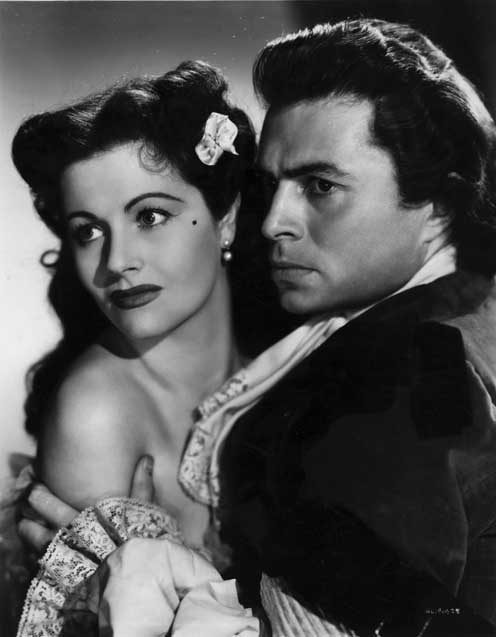
In November 2004, the British Film Institute compiled a list of the all-time most popular films ever shown in England, not just those made in Great Britain but across the globe. This list wasn't created by opinion polls or statistics, but by the most accurate data available....the number of tickets sold. Not ticket sales, which can change dramatically over decades due to inflation, but actual tickets sold to viewers. What a novel idea! And of the tens of thousands of movies shown in Britain, number nine on the list was The Wicked Lady (1945), a lush and lusty historical potboiler made in England and starring the ravishing Margaret Lockwood and the rakish James Mason. You may have heard of it but chances are the average modern classic film fan hasn't and yet it beat out Jaws, the Harry Potter series and even each individual installment of the Lord of the Rings trilogy, none of which even made it into the top ten. What? How could an obscure little swashbuckler made just after the war, with a running time of only 104 minutes, sell more tickets than these blockbuster heavyweights?

The Wicked Lady, released in December 1945, just so happened to be England's highest earning film for 1946. The British box office coffers fairly exploded with the bodice ripping tale, set during the Restoration. Critics thought very little of it but the public couldn't get enough. Based on a novel by Magdalen King-Hall called The Life and Death of the Wicked Lady Skelton, the story apparently has its roots in real life events of the life of Lady Katherine Ferrers (pictured right), an heiress and wife of prominent landowner Thomas Fanshawe, in 17th century England. The conniving female of the film's title is Lady Barbara Skelton (Lockwood), who has been invited to the wedding of her childhood friend, Caroline (played by the lovely Patricia Roc). Upon arrival, the beautiful and scheming Barbara charms and bewitches bridegroom-to-be Sir Ralph Skelton (Griffith Jones), a wealthy, albeit uninspiring landowner. She marries the unassuming Ralph and becomes lady of the manor, a grand Jacobian mansion called Maryiot Cells (the huge estate is actually Blicking House in Norfolk, now a property of the National Trust). Bored with what she considers a dull life as a country lady, she dons a mask and men's clothes and becomes a highwayman, a rogue in days of old who worked as armed robbers of passing carriages on remote highways. She meets up with another thief of the same order, the infamous Jerry Jackson (Mason) and, as bored with her her husband as she is with domestic life, she and Jackson become lovers. Wicked doesn't begin to describe our lass, as her shenanigans multiply, eventually leading to murder, as well as yet another man floating about in the background to raise her temperature (Michael Rennie).

The Wicked Lady was a product of Gainsborough Pictures, a film studio in Islington, London, which was a part of the Rank empire, the leading movie production company in Britain. Gainsborough gave rise to a small group of up and coming actors which included Stewart Granger and Phyllis Calvert, as well as Lockwood, Mason and Roc, and specialized in interchanging these players in various historical, as well as contemporary dramas. Lady is a perfect example of the Gainsborough formula and by far the most commercially successful. One simple reason for the film's popularity was the fact that risque Restoration romance was all the rage in 1945. American author Kathleen Windsor had just released her debut novel Forever Amber the previous year to enormous success, with a film version in the works by 1946. The Wicked Lady was very similar to Amber in atmosphere and theme and was a better representation of the genre for a fraction of the cost its American counterpart would incur. The fiery melodrama made no pretense of being high art, instead embracing its dime store romance novel status with sumptuous interior decor and lavish costumes given exquisite attention to detail.

When it came to U.S. distribution of the film, the costumes became a huge bone of contention. American motion picture censors considered Margaret Lockwood's cleavage much too prominent to be allowed on Yankee movie screens and costly reshooting was required in order for the picture to be shown this side of the Atlantic. There was also no lack of innuendo and racy dialogue. Upon meeting the dark and daring Jerry, who has no qualms about wrapping his hands around Barbara's nibble worthy neck, she asks: "Do you always take women by the throat?", to which the sensual thief wantonly answers, "No, I just take them."


Lockwood is without doubt the star of the show. She had already made a name for herself nearly a decade earlier as the female lead in Alfred Hitchcock's The Lady Vanishes (1938). By the time she played Lady Skelton, she was one of England's most popular movie actresses. Bearing a striking resemblance to American film star Joan Bennett, Lockwood runs dramatically amok in The Wicked Lady. She is a cross between Jezebel and Lucretia Borgia, definitely the stronger character next to her weaker male film counterparts. When all is said and done, number nine on Brits top list is just good dirty fun.

LinkWithin

Related Posts with Thumbnails