Showing posts with label MGM. Show all posts

Tuesday, April 23, 2013

The Harvey Girls (1946) Judy Garland Takes on the Wild, Glossy West


"Always please the cranks: Anything which suits a finicky customer is bound to be more than satisfactory to the great run of folks who take what is handed them without complaint."  This is one of the 12 points listed in an employee directive for the famed Harvey House restaurants which dotted the mid-west and western landscapes of late 19th and early 20th century America.  Developed by entrepreneur Fred Harvey, the chain of restaurants and lunch counters became the subject of a 1946 hit musical starring Judy Garland and sported a lively soundtrack which included the Oscar winning tune, On the Atchison, Topeka and the Santa Fe.

The Harvey Girls centers on Susan Bradley (Garland), a young Ohio lass who is traveling via the Atchison, Topeka & Sante Fe rail line to Sandrock, Arizona to marry H. H. Hartsey, with whom she has a shared correspondence for "lonelyhearts."  She finds his letters of the utmost in romance and poetry.  En route on the train she meets the "Harvey Girls," a group of fresh-faced young women from the east who are headed west to wait table in the Harvey House restaurant.


When Susan arrives in Sandrock (to much musical fanfare....it IS MGM you know), she finds Mr. Hartsey (Chill Wills) is far from the romantic figure she imagined by way of their poetic epistles.  In fact, she discovers that he didn't even write them and their original author was none other than Ned Trent, handsome owner of the local saloon and love interest of Sandrock's head "bad girl" Em (Angela Lansbury, gorgeous in full Technicolor).  She breaks her "engagement" (in a mutual understanding), tells off Ned Trent and joins up with the Harvey girls.  The rest is colorful, glorious musical hokem.

Based on a novel by Samuel Hopkins Adams, The Harvey Girls was originally meant to be a straight dramatic picture starring studio blondie Lana Turner (be interesting to see how that would have turned out).  Roger Edens, an associate producer at MGM and a mentor of Judy Garland, wanted to change the venue after viewing a performance of the then popular stage show Oklahoma!  The angle was turned into a western themed musical comedy and Garland, after her success the previous year in Meet Me in St. Louis, was the natural choice to star.

She didn't want to do it, preferring to work with Fred Astaire in Yolanda and the Thief, which her soon to be husband, Vincent Minnelli, was directing.  She was persuaded to take on the Harvey project and in turn created one of the biggest hits of the year (Yolanda on the other hand lost money).  But it wasn't without problems on the set.  Judy was late almost 40 times and was absent 11 total days during production.  Deadpan comedienne Virginia O'Brien, who played Harvey girl Alma, was pregnant and the sense of urgency to get her scenes completed was eroded by Garland's absences, causing O'Brien to virtually vanish from the film's second half.


John Hodiak played Ned Trent, a role that was originally considered for Clark Gable, who had just returned from military service in World War II.  Aside from O'Brien, who did a splendid job as the man-hungry Alma, the top notch supporting cast included Ray Bolger, Cyd Charisse, in her first speaking role (though she did plenty of her signature dancing as well), the always entertaining Marjorie Main and the lovely young Lansbury as the tough talkin', hard livin' Em. (A press release from December 1944 proclaimed Garland, Hodiak and Ann Sothern as the film's stars, the latter in the role of Em.  Lucille Ball was also discussed for this role.)

But The Harvey Girls was first and foremost a musical and the musical numbers were a lively grouping of rousing ditties by Harry Warren and the great Johnny Mercer.  Rising to the top of the heap was the afore-mentioned On the Atchison, Topeka and the Santa Fe, an energetic extravaganza of muslin, lipstick and tobacco juice. Several versions of the hit tune were recorded, including one by Garland.  The one to become the biggest hit however, featured the song's lyricist Johnny Mercer along with the Pied Pipers.  Just as full of pep are the numbers The Train Must Be Fed, and The Wild, Wild West featuring O'Brien's career defining deadpan.

Critic Bosley Crowther wrote in January 1946:  "Miss Garland, of course, is at the center of most of the activity and handles herself in pleasing fashion, up to and including the high notes. John Hodiak acts rather surly as the saloon proprietor and Angela Lansbury, pouty and pomaded, looks dazzling as the queen of the den. Everyone else enters lightly into this beefsteak and hors d'oeuvre opera. It may be a rather lofty tribute to Fred Harvey's girls, but it's a show."  And a show indeed it was.

Tuesday, February 12, 2013

No Man of Her Own (1932): Gable & Lombard, Love [NOT] at First Sight


The love story of screen stars Clark Gable and Carole Lombard is legendary. A physically beautiful couple, who fell in love and married at the peak of their careers, reigned as one of Hollywood's highest profile couples and eventually met with tragedy upon Lombard's death in a 1942 plane crash at the age of 33. No Man of Her Own, filmed and released in late 1932, is famous as the only film in which the appealing duo starred together. Yet the irony is that they weren't a couple at the time, nor did they want to be.

Getting the film onto the screen was a story in itself. The original script was based on a bestselling 1932 pulp novel, written by none other than RKO horror producer Val Lewton, when he was a struggling commercial hack. It was called No Bed of Her Own and bought by Paramount Pictures as a potential vehicle for studio newbie George Raft and its reigning diva Miriam Hopkins. With loose living and prostitution as some of the general themes in No Bed of Her Own, an adaption to film was problematic, even in pre-Code years, and Paramount decided to keep the title but go with a completely different story written by Edmund Goulding and Benjamin Glazer. By the time the proverbial dust settled the title was also found unpassable to the Will Hays office and it too was changed, albeit only slightly, to No Man of Her Own.

Who would have thought that fate would have chosen Marion Davies, film star wannabe and mistress of multi-gazillionaire William Randolph Hearst, to bring about the only screen pairing of Gable and Lombard (sources say they were extras in at least one picture during the 1920's). Davies was making a picture for MGM eventually called Going Hollywood and wanted the number one box office crooner at the time, Bing Crosby, as her co-star. Hearst persuaded studio boss Louis B. Mayer to make a trade with Paramount, where Crosby was under contract. For this illustrious switcheroo Mayer had to offer up big ticket star power and after 1932's Red Dust with Jean Harlow and Strange Interlude with Norma Shearer, Clark Gable was MGM's male star on the rise.


Meanwhile, back over at Paramount, Miriam Hopkins would have no part of the film if Gable received top billing (which was part of the deal) and Carole Lombard, a member of the studio's stable of up and coming stars was cast instead. Although he had been quite chummy with Crawford and Harlow back home at MGM, Gable was relatively indifferent to Lombard during filming and she reciprocated the feeling. She was still very much married to big man on campus William Powell and Gable to wealthy/older/less attractive Rhea Langham (not that that fact had hindered earlier indiscretions).  When the film wrapped, Clark gave his blond co-star a pair of ballerina slippers with a note reading, "To a true primadonna." Carole, not to be outdone, presented him with a packaged ham with his photograph plastered on the front. It was all in good fun and caught on camera for everyone to see.

In this serio-comic pre-Code Gable plays Jerry "Babe" Stewart, a hot shot gambling cheat who can turn a card as well as a lady's head. When the law gets too close to his shenanigans, he lays low in podunk where he meets the local librarian, Connie Randall (Lombard). Connie has the small town blues and an itchin' to see what's out there. They get married on the flip of a coin and Connie goes back to the big city with her groom, unaware of his shady dealings (pardon the pun) and instead believing he works on Wall Street. Trouble steps in when the blonde bride discovers Babe's secret and tampers with his deck of cards. You know the old saying, lucky at cards unlucky in love. Well count it here in spades (pardon again).


Filmed in late 1932, more than a year before the Will Hays office would enforce tougher censorship restrictions, No Man of Her Own offered several opportunities for the risque in its dialogue. When his recent paramour clings to him like a vine on a tree, Gable's Babe responds, "Listen kid, that thing you've got on is pretty thin but I've got tough skin, see, and I don't feel it." Whew!

After filming was complete Gable went back to MGM and Lombard stayed on at Paramount for a while, her reputation as a gorgeous comedienne skyrocketing with each passing year. It wouldn't be until the mid to late 1930's until they began the affair that would eventually lead them to marriage and super couple status in Tinsel Town. As Clark Gable once said, "It is an extra dividend when you like the girl you've fallen in love with." No Man Of Her Own here.

Friday, January 11, 2013

Paid (1930): Joan Goes to Jail


One of the first names that comes to mind when thinking of classic Hollywood is Joan Crawford.  Her amazing career spanned six decades and the longer she made films, the more iconic she became.  As an icon, she sometimes morphed into a caricature of her own screen image.  The eyes bulging under uber heavy, arched brows and lips painted deep crimson, twisted into a melodramatic snarl.  But long before she was Mildred Pierce, Harriet Craig or even Crystal Allen, displaying her learned screen affectations and perfect diction, she was a burgeoning MGM starlet, a movie queen in training.  Her pre-code shop girl was a box office bonanza.  In 1930, after years of being everyone's favorite flapper, Joan made the film Paid, her first real dramatic attempt and it was both a personal and professional success, ranking her in the top tier at Metro.

In Paid, Crawford plays Mary Turner, a young shop clerk who is falsely accused of theft by her department store boss.  As she is literally dragged off to prison, she dramatically declares vengeance against her heartless oppressor.  While in the pokey, she studies law books and meets up with a tough talkin' toots named Agnes Lynch (Marie Prevost).  Upon her release she joins up with "Aggie", who introduces her to Joe Garson (Robert Armstrong), a longtime crook with a smart mouth.  With these two seedy characters, Mary uses what she learned in jail and plans a scam called the "heart balm" racket, where unsuspecting older men are sued for breach of promise, a legal form of blackmail.  The bitter lass carries her revenge even further and closer to home by marrying the son of her former boss, who was responsible for her imprisonment.

Directed by Sam Wood, who had joined MGM just a few years earlier, the movie was based on the play Within the Law by Bayard Veiller.  It was originally slated to star Norma Shearer, the queen of the Metro lot, but when she became pregnant, the role was open.  Crawford pleaded with her bosses to give her the part and Irving Thalberg (Shearer's husband and second in command at the studio) gave her the chance she needed to put her "Dancing Daughter" days behind her.

Paid was a hit and to show his gratitude, head honcho Louis B. Mayer gave Joan a financial boost.  She received a $10,000 bonus with a note that read:  "In appreciation of the co-operation and excellent services rendered by you, we take great pleasure in handing you your check made payable to your order in the amount of $10,000...this does not affect the terms of your contract dated November 2, 1928."  Not bad for a shopgirl.


The film also marked the debut of Douglass Montgomery, billed here as Kent Douglass, who played Bob, the innocent who Mary Turner weds to get her ultimate revenge.  It's fun to watch Crawford here, honing her craft and giving a good performance before she would ultimately become JOAN CRAWFORD.  She and co-star Marie Prevost would become friends during the filming of Paid and remain so until Prevost's untimely death in 1937 of acute alcoholism.  Among a collection of empty liquor bottles detectives found a promisory note of $110 to Crawford and it was reported that it was Joan who paid for the funeral.

Friday, January 6, 2012

The Women (1939): Color It “Jungle Red”


Start with one highly seasoned Norma Shearer. Next, add a fairly hard boiled Joan Crawford (she will toughen even more during cooking). Take one second string star, Rosalind Russell, just waiting to blossom. Mix in a couple of fresh faces with fresh figures, preferably Paulette Goddard and Joan Fontaine. Then sprinkle the whole thing with colorful supporting players like Marjorie Main, Mary Boland and Lucile Watson. Serve up with art direction by Cedric Gibbons and couture by Adrian (no last name necessary) and you’ve got a recipe for cinematic success known far and wide simply as, The Women (1939).

With a cast largely consisting of discarded Scarlett O’Hara wannabes, The Women was produced the same year as Gone with the Wind and was second only to that gargantuan film in profits for its studio, MGM, in 1939. Director George Cukor was signed on to tame these lipsticked lionesses after also being discarded as director from the Civil War epic, when the films’ star, Clark Gable, complained that he was giving too much attention to the female leads. Cukor said of The Women: “ At the time it probably wasn’t as silly as it seems now, because it came from a different world. ‘Kept women’ and marital break ups were big moral questions then. Now, of course, everybody would be screwing everybody, and everybody would know about it. Crystal wouldn’t be a kept woman, she’d be carrying on with another girl.” But Cukor’s deft and skillful directing aside, the classic comedy belonged entirely to its title characters.
The plot is indeed as Cukor described it about ‘kept women’ and marital break ups, in a gossipy modern high society circle of “friends” in NYC. Based on the hit Broadway play by Clare Booth Luce, it ran 666 performances on the Great White Way in 1936. In a nutshell, wealthy and elegant socialite Mary Haines (Shearer) goes through her privileged tasteful life in bliss with her handsome, engineer husband, Stephen and their daughter, Little Mary (it must be noted that nary a man steps in front of the camera during the two plus hours of celluloid. They are merely referenced….A LOT!). Her happy existence is threatened big time with the onset of Crystal Allen (Crawford, pictured here with her signature designer Adrian), shopgirl, home wrecker and floosie supreme. Enter Sylvia Fowler (Russell), et al, Mary’s dearest “friends” who verbally and maliciously take her (and each other) apart piece by piece.

Most, if not all, of the movie’s stars were in some sort of career shift. Norma Shearer, whose MGM high-up honcho husband, Irving Thalberg had died two years earlier, was in a state of dated star decline, holding her own basically because she was also holding substantial MGM stock left to her by her dear departed spouse. Joan Crawford was also on the verge of “has been” status after a string of flops at Metro. Pop columnist Sheila Graham noted in early 1939, “After three misses in a row, if Joan Crawford doesn’t come up with a hit picture soon, she will be joining Luise Rainer in the Hall of Forgotten Stars at Metro.” Never any love lost between Shearer and Crawford, the two divas had an long standing feud over who was the female powerhouse at MGM. Crawford always felt that Norma got the choice roles at the studio, merely because she was sleeping with the boss and was fond of calling her “Miss Lotta Miles”, a moniker Shearer had worn back in the 20’s as a model for a tire manufacturer. Their attempts to one up each other on the set were legendary, including Crawford’s clacking knitting needles during many of Shearer’s scenes.

Rosalind Russell had been at MGM for half a decade, relegated to second tier status for most of that time with a few exceptions, most notably on loan out to Columbia for Craig’s Wife (1936). With the success of The Women, Russell’s talents as a comedic gem had been discovered and utilized. Like Russell, both Paulette Goddard and Joan Fontaine were actresses who were just on the verge of stardom. Goddard had actually been a hair’s length away from winning the coveted role of Scarlett in GWTW before losing out to Vivien Leigh. On loan out from producer David O. Selznick for The Women, she would leave the showman’s employ later that year to enter a long term, very successful run at Paramount where her star would shine. Fontaine would also shoot to stardom in 1940, when Alfred Hitchcock cast her as the second Mrs. deWinter in his classic Rebecca. Not as high profile as most of the other females on the Women set, Fontaine had up until that time, fell mostly in the shadow of her more successful, higher profile sister, Olivia de Havilland. In “Joan Crawford: The Essential Biography” the star praises Cukor and most of her cast mates (except Shearer, of course!) with the noted exception of Fontaine. “I think the only one I could have done without was Joan Fontaine. She wasn’t a bitch, she wasn’t nasty - there was just something about her. She had the smallest part of all of us and maybe she was just a little jealous."

Marjorie Main presented a trial run of her Ma Kettle character ten years early and it suited her Lucy character in The Women to a tee. Comedy veteran Mary Boland spouted her faith in “l’amour” throughout the film, cracking many hilarious one-liners along the way and in a small but fun part, luscious Virginia Grey, as one of Crawford’s department store co-workers, makes one wonder why Stephen Haines didn’t sniff around HER end of the perfume counter instead of the world weary Crystal’s.
Above, MGM boss Louis B. Mayer, with Paulette Goddard and director George Cukor at The Women premiere

The Women was an enormous hit. It’s premise was successful enough to warrant not one but two remakes, albeit sad disappointments, both. First in 1956 with The Opposite Sex starring June Allyson and Joan Collins, then again over 50 years later under the original title with Meg Ryan and Annette Benning. Neither even came close to the sparkling wit and vicious bite of the original film. It’s phenomenal ensemble may never be duplicated under such circumstances again.

Wednesday, November 30, 2011

Meet Me In St. Louis (1944): Have Yourself a Charming Little Movie

You like splashy color? With Meet Me In St. Louis (1944) you got splashy color! You also have one of the most charming, enduring and elegant classic musicals ever put to film. Developed by the MGM musical powerhouse of producer Arthur Freed and director Vincent Minnelli, it showcased the fragile songbird Judy Garland at the height of her fame and talent and became a box office bonanza for the mega studio in the winter of 1944-45.

Set in the Missouri burg of the title in 1903, the film centers on the Smith family, middle class and ready to see and celebrate the coming Louisiana Exposition of 1904 but instead of a straight narrative, St. Louis is really a set of colorful, sentimental vignettes set to some of the catchiest tunes and loveliest melodies to come from Hollywood in the 1940’s, with Garland of course taking on the bulk of the lilting tones. Along with “The Boy Next Door” and “Under the Bamboo Tree” with the precocious moppet Margaret O’Brien, Judy and gang belt out one of the most glorious four minute interludes of musical magic known to the golden age of American cinema with “The Trolley Song”. Written by Hugh Martin and Ralph Blane, “The Trolley Song” was not only nominated for an Academy Award as the year’s Best Song (it lost out to “Swinging on a Star” from Going My Way) but had several very popular renditions that hit the airwaves during the decade. The most enduring song to come from the St. Louis musical resume however, was Judy’s poignant holiday signature, “Have Yourself a Merry Little Christmas”. Hauntingly beautiful in its delivery both visually and audibly, “Christmas” has become a standard on Yuletide play lists.


In an auburn wig with very heavy bangs, Garland had shed the “baby fat” much discussed by her studio boss Louis B. Mayer, but her trimmer figure could still pack a vocal wallop and did so. She is handsomely supported by a superlative array of MGM talent including the above mentioned O’Brien, Lucille Bremer, Mary Astor, Leon Ames, Marjorie Main, Harry Davenport and Tom Drake, as the “boy next door”. The entire cast charms its way from scene to scene evoking the feel and sound of turn of the century Americana via the MGM backlot.
 
Off-screen the film’s star found her own “boy next door” in director Minnelli. A confusing and tumultuous relationship, the two were married and begat Liza with a Z. However, whatever problems their future held, the two created a film musical masterpiece and the biggest financial hit MGM released since Gone With The Wind. There were many nostalgic period copy cats (Summer Holiday and Fox’s Centennial Summer) but none even came close to this jewel.

Friday, August 5, 2011

Lucille Ball at 100: We Love You Lucy!


People from 5 to 105 love Lucy. Who? You know who, even if you aren’t one of the millions who DO love Lucy, you know who she is. She is the zany redhead we have watched since childhood on the hilarious 1950‘s comedy “I Love Lucy“. (We know she is a redhead because, well, just because we do. It’s not because we see her on her world famous T.V. show with red hair since it is in black and white). August 6th is the 100th anniversary of her birth in Jamestown, New York and much hoopla will be made in her honor, as well it should be.

Although she is known across the globe for her comedic genius, she got her start in none other than classic movies, first at RKO, then later as a Technicolor queen at Metro-Goldwyn-Mayer. Many forget her dramatic film roots (pardon the hair coloring related pun, as she herself made quite joke of it often on her show) and it’s a part of “Lucy” history which should be brought to light for those who may not be aware of a pretty darn impressive career.

This post isn’t going to be a deep retrospective, as so many and so much has been written about this great performer, but just a gentle reminder of a few of her more interesting film roles. If you haven’t seen them, you might want to check them out. You might be surprised.

Stage Door (1937) ~ Ball shares the screen with some RKO heavyweights, Katharine Hepburn and Ginger Rogers and tosses a few verbal punches in as well. Early Lucy.

Dance Girl, Dance (1940) ~ Although Maureen O’Hara is the technical star of this show, Lucy comes out ahead most of the time. As Bubbles, exotic dancer, she is brassy and sassy and extremely attractive (pictured below). Early Dramatic Lucy.


The Big Street (1942) ~ The first time I saw this film I couldn’t believe I was watching the fun and loving star of one of my favorite comedy shows! Ball is cold and callous as a nightclub performer who treats her mousy admirer (Henry Fonda) like something scraped off her dog’s paw, she shows a whole different side to our favorite redhead.

The Dark Corner (1946) ~ Lucy as a “girl Friday” in an intriguing film noir at the peak of the genres popularity. Can’t miss. Suspenseful Lucy.

Then there are the fun and frivolous musical comedy confections she made when she moved over to MGM. DuBarry Was a Lady, Best Foot Forward and others. These performances, along with her great television work, built a career than spanned over 50 years and showed just why so many “loved Lucy”.


Lead graphic by illustrator Glen Hanson
http://www.glenhanson.com/

Sunday, October 31, 2010

Ann Rutherford: Polly Benedict and MORE!


“There was a quality about Metro-Goldwyn-Mayer that was so special . . . it was just the most exciting studio in the world. They looked after their people so perfectly. And then to go to a place [20th Century-Fox] where you don't know anybody and they don't know you and they don't give a rip, it was not a happy time. I got so ticked off, I got married!” ~ Ann Rutherford

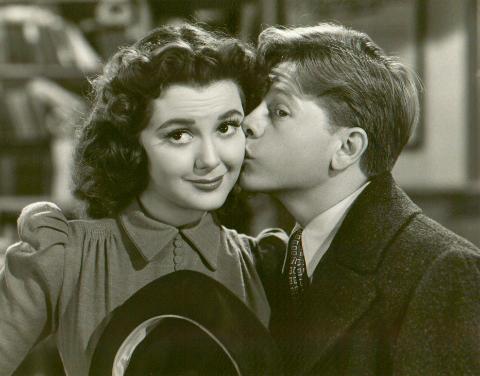
Ann Rutherford will be 90 on Tuesday! An elegant dark haired beauty who graced many classic movies from Hollywood’s hey day, Ann was a prime example of the old Hollywood star system. Making her first film at the age of twenty, she soon was signed to MGM, the glittering super studio of Hollywood at the time. Groomed as one of its prime starlets, she appeared as the Ghost of Christmas Past in Metro’s holiday favorite, A Christmas Carol alongside Reginald Owen and Gene Lockhart. But it was as Polly Benedict in the studio’s wildly popular “Andy Hardy” series, that she became famous and steadily employed for nearly half a decade. As Polly, Andy’s (Mickey Rooney) best girlfriend, Ann had to often share Andy, and screen time, with other up and coming starlets who were being promoted by the studio. These comely lasses included Lana Turner, Esther Williams, Kathryn Grayson and Donna Reed.


Landing juicy roles in youth oriented films at MGM in the late 30’s (most noticeably Dramatic School (1938) and These Glamour Girls (1939), Rutherford was cast by David O. Selznick in his mega hit, Gone with the Wind (1939), as Scarlett O’Hara’s baby sister Careen. The role was briefly considered to be offered to teen-aged Judy Garland, but her light was about to shine very brightly in The Wizard of Oz later that same year.


In the early 1940’s, Rutherford left Metro and worked as a freelance actress, with some success at 20th Century-Fox. In Orchestra Wives (1942), she played Connie, who falls in love and marries trumpet player Bill Abbott (George Montgomery) much to the chagrin of his fellow band member and lead singer Jaynie (the lovely and ever conniving Lynn Bari). She went on to even more memorable roles particularly in the “Whistling” series with Red Skelton back at MGM and as Danny Kaye’s fiancee in The Secret Life of Walter Mitty (1947), but retired from films in 1950. She returned in the 1970’s for a couple more big screen roles and was considered for the role of older Rose in James Cameron’s huge cinematic spectacle Titanic (1997), a role that eventually was played by Gloria Stuart.

Thursday, August 5, 2010

Lana Turner: Birth of a Starlet, Part 2


Note: The first part of this two part article can be found here.

As far as party girls go, Lindsay Lohan had nothing on Lana Turner in the early 1940’s (well, accept arrests and rehab time). With her perky nose, dancing dimples and honey blonde hair, the gorgeous “Sweater Girl” was on the top of the Hollywood heap, both socially and professionally. Although she was still technically a starlet, her career was on the rise, which only heated up her love life all the more.

Her wild woman reputation would only be enhanced by her whirlwind four month marriage to bandleader Artie Shaw (pictured below), a notorious ladies man, who jilted both Betty Grable and a young and impressionable Judy Garland for Turner. Eloping after their first date, the 29 year-old lothario and the sweater girl (who had just turned 19 earlier that week) had a tumultuous time of it and Lana famously called her tenure with Shaw her “college education.” The irony is that Turner claims that she married Shaw on the rebound from yet another infamous Hollywood wolf, attorney Greg Bautzer. Bautzer ditched her for Joan Crawford (Bautzer would be portrayed by actor Steve Forrest in 1981’s Mommie Dearest). He would not only represent her in her divorce from Shaw, but also in her split from second husband, restaurateur Stephen Crane. And so goes the fast and furious Hollywood sexual Merry-Go-Round.


With her divorce came a new crop of men and nightclub rounds. Victor Mature and singer Tony Martin were just a few who squired the blonde beauty around town. MGM took the opportunity of Turner’s burgeoning notoriety to cast her in Ziegfeld Girl (1941) with fellow studio beauty Hedy Lamarr and fellow studio cutie Garland. As Sheila Hale, top banana in a sea of legs and sequins that only the great showman Florenz Ziegfeld could display properly, Lana tumbled and stumbled in yet another kind of sea…..booze and men. The hit film played as a precursor of sorts to 1967’s Valley of the Dolls, and allowed Turner melodramatic training which, not only boosted her career at the time, but would hold her in good stead twenty some odd years later in her middle aged diva stage (ie: Peyton Place (1957), Imitation of Life (1959) and Madame X (1966)).

Her next picture was the big budget remake of Dr. Jekyll and Mr. Hyde, which placed her at third billing after Spencer Tracy and Ingrid Bergman. Originally slated to play the slutty victim of Mr. Hyde, she was cast as the good girl in love with Dr. Jekyll, when Miss Bergman, set to play that role, wanted a change of pace and requested their parts be switched. With the success of Ziegfeld Girl, Metro cast her with the studio’s top male star, the King himself, Clark Gable, in a western/romance called Honky Tonk (1941). Mrs. Gable, aka Carole Lombard, reportedly didn’t like the film pairing, believing the kisses during the fade out might linger after the cameras stopped rolling. Rumors swirled to that notion, though Turner stated, both in a Ladies Home Journal article, as well as her autobiography, that no such affair took place.


Yet another case of alleged extramarital cuddling occurred during the filming of Johnny Eager (1942) with another MGM heavyweight heartthrob, Robert Taylor. The films promotional ads read: "Taylor's Johnny, Turner's eager." Married to actress Barbara Stanwyck at the time, Taylor reportedly was so smitten with Turner that he asked Stanwyck for a divorce. As with the rumored Gable affair, Lana also denied any wrongdoing with Bob Taylor. The onscreen chemistry was definitely there, as it was with Gable and tongues continued to wag when she and Gable were cast yet again in Somewhere I’ll Find You (1942), and it was during the filming of this picture that Carole Lombard was killed in a plane crash while on a war bond selling tour. The following year, Turner starred in a picture called Slightly Dangerous.

By the end of the war, Lana Turner was a hot property, both on and off screen. No film could display this sexy femme fatale persona better than the one for which the actress would become most famous, The Postman Always Rings Twice (1946). As a tanned and tempting married waitress on the make, she would forever brand her image, wearing a stark white two piece short set and matching turban. She would have several more husbands in the next 25 years and many other big roles, but this part defined her sex goddess persona for the rest of the decade and most of the next one. The starlet had become a star.

Sunday, May 2, 2010

Random Harvest (1942): Rule Britannia…On the MGM Lot


English novelist James Hilton was building quite a following with the movie going set in the early 1940’s. Two of his books, Lost Horizon and Goodbye, Mr. Chips, were both filmed, very successfully, in the late 30’s, so when his Random Harvest was published in 1941, Hollywood was very quick to beckon. With the film rights going to MGM, one could be sure that the sentimental tale, based during World War I, would get the full gloss treatment, with all stops pulled, and it did just that.

Ronald Colman plays “John Smith”, an amnesiac in World War I England. A victim of shell shock, a pathetic, practically mute case study, who is housed in a county asylum with no home to speak of, no family to call his own. Upon his escape (actually, he merely wanders away into the fog), he drifts into the local town, where he happens upon a pretty dance hall girl named Paula (Greer Garson), who takes a fancy to him. Throwing caution to the wind, she quits her job and takes “Smithy”, the endearing moniker she gives Colman, to live in the country, where he can rest, recuperate and get his bearings. With still no memory of his former life, he falls in love with Paula, marries her and has a child.


Finding he has a knack for writing, he begins to make a little money to support his small brood with articles written for a Liverpool publication. When he is offered a writing job, he heads for Liverpool to discuss the particulars, leaving Paula and Junior in their country cottage. As he arrives in the city, Smithy is struck down by a vehicle. Although physically unharmed, his mental capacity returns to its original state and we find that he is Charles Ranier, a a confident, independent gentleman of wealthy birth. But he now has no memory of his life since he was struck by a shell during the war, several years back. What is to become of Paula and their baby? Where will his life lead from here?
Predictability is definitely not an element of Random Harvest. There are enough plot twists to make Alfred Hitchcock blush, and it is these twists and turns of fate that take this movie beyond merely a sugar coated three hankie tear jerker. That and the great performances by its two leads. Colman, who had started out the decade with less than a bang cinematically, jumped back to the top of the career heap in 1942, with both this picture and Columbia’s The Talk of the Town. He had already successfully treaded water in the James Hilton pond, as had his co-star, he in Lost Horizon (1937) and Garson in Goodbye, Mr. Chips (1939). Their pairing in Random Harvest seemed quite natural, though the role of Smithy/Charles Ranier was originally slated for MGM contract star Spencer Tracy. When it was discovered that Colman was available for the part, he was immediately cast.


Young Metro hopeful Susan Peters is showcased as Colman’s youthful admirer, Kitty. Her character goes from a 15 year old schoolgirl to a young lady of the world. Although Peters was nominated for an Oscar for her role in this film, she didn’t seem to have the oomph of some of her MGM ingenue contemporaries , ala Lana Turner or Donna Reed. She seems more comfortable as the naïve schoolgirl than as the more sophisticated young socialite. In real life, her story was an unfortunate one. In January, 1945, little more than a year after her marriage to actor Richard Quine, she was accidentally shot on a hunting trip with her husband. Paralyzed from the waist down, she continued to act but her career never regained momentum and she died at age 31.

As some in Hollywood phrased it, 1942 was the “Year of Greer”. The English actress not only won great acclaim for her role in Random Harvest but won an Academy Award for another of her releases that year, Mrs. Miniver, a role for which she was always identified. With these two performances and her regal and elegant persona, she secured her place as MGM’s Queen of the Lot throughout most of the 1940’s.
With Colman and Garson on hand, MGM had one of the most British films this side of the Atlantic. They were a perfect complement for each other and gave great class to a schmaltzy but completely lovable film. They make this totally unbelievable tale fascinating to watch, and a first rate weepie for sure.

Friday, February 12, 2010

Red Dust (1932): Sex in the Tropics


Sex. It permeates almost every frame of the pre-Code classic Red Dust (1932), and why shouldn't it? It starred Clark Gable and Jean Harlow, both at their physical peak and professionally, well, this film shot them to superstardom. It was raw, it was wanton and, if audience attendance was any indicator, it was extremely entertaining. In the world of pre-Code Hollywood (the time before the Hollywood censors would banish any naughty behaviour onscreen), Red Dust fairly reeks of sex with nary a nude scene or onscreen intercourse. Who needed these things with Gable's virile masculinity and Harlow's open sensuality coming together with a charged electricity that crackles in front of the camera (and if rumour is correct, behind it as well).


Set on a rubber plantation in Indochina, Red Dust smells of rugged machismo, Gable and his cronies out in the middle of nowhere, cultivating raw rubber "so some old lady somewhere can take a hot water bottle to bed with her". Enter stage left, Harlow as Vantine, a fun loving harlot on the run from officials in Saigon, who shows plenty of leg, along with everything else. Just as she and Denny (Gable) are getting cosy, enter stage right, Gene Raymond (usually the partner to Ann Sothern in a series of lighthearted romps) and Mary Astor as Gary and Barbara "Babs" Willis, the plantation's new surveyor and his prim, proper and quite pulsating new wife. Gary is immediately stricken with malaria, giving Denny and Babs a chance to ignite a few sparks of their own. Vantine, not the kind of gal who takes a back seat quietly (not alone anyway), lashes out with wisecracks aplenty, making some of the snappiest dialogue this side of the Hays office.


Dialogue was one of the best ~and most brazen~ assets the film had going for it, second to its zesty stars. When Harlow's Vantine first encounters Gable's Denny and his male assistant, she playfully asks them, "What else do you do besides work? Do you play any games?". As her constant chatter irritates a grumpy Denny, he finally shouts, "Do you want me to slap you out of this room?", to which she retorts, "You and what man's army?", and of course this verbal sparring leads to eventual laughter and a seductive fade out. Harlow is ready for Gable. He manhandles her just the way she likes to be manhandled.


The film is not the typical fare produced by MGM at the time. The mega studio had no glamorous backdrop to present its stars and yet, it was immensely popular with the public. The film's director, Victor Fleming, was a "man's man" and a close friend to the macho Gable. Red Dust was the kind of film Fleming thrived on (he also directed Gable in 1939's Gone with the Wind). Gable's role as Denny was originally thought to be filled by silent film star John Gilbert, but studio politics and boss Louis B. Mayer nixed the idea and Gable came away famous.


The movie's tropical setting only adds to the heat already generated by its cast. As Barbara, Mary Astor is even more unwillingly libertine in her adulterous lust for Gable's Denny when one knows the background of the actress' torrid and infamous real life amours. The fireworks are in their scenes together as well. Early on when Astor slaps Gable hard for a verbal offense, he enjoys it, grinning that Gable grin from ear to ear. Then she can barely conceal her growing desire for him as she watches the strong, dark and commanding Denny hold her fair and weak husband, nursing him back to health from the fever. The comparison of the two is indeed notable to the tingly Astor. Then in the scene immediately following, Vantine happily and boldly watches Denny undress for bed, only to be told to go to her own, which she does in disappointment. These two ladies have it bad. The wise-cracking, off color dialogue continues when a disgruntled Harlow proclaims to the parrot, whose cage she is cleaning: "What you been eatin', cement?" The steamy shenanigans culminate in a carnal wrestling match between Denny and Vantine, which ends with our anti-hero being shot in the torso by a jealous Babs.


Jean Harlow was only 21 when Red Dust was released but her erotic, world wise persona is decades older. MGM slated their new cash cow couple into several popular money makers over the next five years. Harlow's last film before her untimely death in 1937 was Saratoga, again with Gable.

Friday, September 18, 2009

Fury (1936): Fritz Lang Comes to America


Although made at Metro Goldwyn Mayer in 1936, Fury is a very unlikely production for the highly prestigious studio, famous for its glitz, glamour and witty repartee. It is the kind of project they made over at Warner Brothers, dark and brooding social dramas with an emotional punch and a message to hit home. In turn, Fury's director, Fritz Lang, was very unlike any of MGM's in-house directors at the time (no Clarence Brown or W. S. Van Dyke here). It was Lang's American movie debut, and in it the German film maker injected a stark, pull-no-punches complexity rarely seen by Depression audiences in the United States.


The film stars Spencer Tracy as Joe Wilson, a regular "Joe", hard working, happy go lucky, upstanding citizen, who's head over heels for his girl, Katherine (Sylvia Sidney). In the opening reels, Katherine is leaving to take a better paying job in another city, so that she and Joe can save money faster to be able to marry. Joe pools all his cash and with his two brothers opens a service station. After several months, he has enough shekels saved up to collect and marry his betrothed and live the American dream happily ever after. However, en route to fetch Katherine, our happy hero is stopped by the law in Podunk, USA, and being a stranger in them there parts, is suspected as an infamous local kidnapper who has been on the loose. As word spreads of a suspect in custody for the crime, momentum builds throughout the community, by way of gossip and bias against a "foreigner", that leads to the unfair conclusion in the town's collective mind of Joe's guilt.


Like a snowball down a mountain, the outraged townsfolk swells into an angry mob that stops rolling at the front door of the jail where Joe is being held. They demand the turnover of the prisoner for lynching. When the hick sheriff refuses, the excited throng burns down the jail and Joe in it. So they think. After the fact, the real kidnapper is discovered and the realization hits the community that an innocent man was burned to death. As the populace whispers excuses among themselves to ease their guilt, Joe reappears to his brothers and explains how he escaped the inferno. He also explains that he wants to remain "dead" and through them bring the mob participants to trial for murder according to the law. Now bitter and enraged, he seeks ultimate vengeance and justice for his suffering

.


Fury is a taut, gripping drama. It's a fascinating study of society under mob rule and also how political ploying can affect society under such conditions. This would be Sylvia Sidney's only film at MGM. At the peak of her career, she gives an extremely moving performance as Katherine. Her face exudes the angst and emotional stress as she does so well in other roles with similar characteristics, such as Trina in Dead End in 1937. Bruce Cabot is fine as the nasty, belligerent instigator of the pack as is Edward Ellis (the actual "thin man" in the series of films by that name) as the gruff small town sheriff. As usual, Walter Abel gives great support as the district attorney. Fury is, however, Spencer Tracy's film. Having just signed on with Metro the previous year, performances like the one he gives in this movie kept him there for 20 years. Through the course of the film, we see Tracy's dramatic metamorphosis from a kind, jovial lover of life, to a callous, embittered shell filled only with overwhelming hatred and vengeance. His emotional, as well as physical transition mark an ominous foreshadowing of his Dr. Jekyll and Mr. Hyde made five years later.


Never a spoiler this blog, suffice it to say MGM and director Lang had differences about the films ending. Despite that, Lang created a more than memorable film and began an impressive career in the U.S. Arguably one of Tracy's best early films, Fury is solid through and through.

Thursday, September 10, 2009

A Woman's Face (1941): A Crawford Classic


The 1941 classic A Woman's Face is not just about any woman's face but Joan Crawford's, and what a face! Crawford was in a career slump when she made the film and would leave her longtime home studio, MGM, within two years of its release, but her role in A Woman's Face proved she could still give a powerhouse performance. The film's title is a near perfect one for a Joan Crawford movie, and in this instance, the cinematography showcases the star's face with various lighting and camera angles, making the most of her features and famous bone structure.

Joan plays Anna Holm, a Swedish woman with a huge chip on her shoulder due to a huge scar on her face (she is actually disfigured on the right side of her face due to burns suffered in her childhood). Anna is the leader of a blackmail ring, and through these shady activities, she meets the shady Torsten Barring (Conrad Veidt), who shows her the first romantic attention she's ever received but he has ulterior motives for his charms. In the meantime, during a rendezvous between Anna and one of her blackmail victims (Osa Massen), the adulterous woman's husband (Melvyn Douglas) comes home and lo and behold, he's the top plastic surgeon in Sweden! How convenient. After multiple operations, taa daa, he fixes Crawford's face, good as new. Back to darkly suave Torsten Barring. His plans for his newly refurbished partner in crime Crawford include her taking a post as governess to his young nephew, who stands to inherit a large fortune. Should anything happen to the tyke, the entire fortune would revert to the sly Barring. And he wants our Joan to be the boy's governess....hmmm.

First filmed in Sweden in 1938 as En Kvinnas Ansikte with Ingrid Bergman, this version is given the full MGM gloss and offers Joan Crawford one of her best roles. The star's performance is at least equivalent to her Oscar winning turn in Mildred Pierce four years later, if not perhaps a little more subtle, especially in the first half of the movie. Director of A Woman's Face, George Cukor, was also a friend of its star. Always known as a "woman's director," Cukor knew how best to handle Joan and get the most out of her performance, as he had in The Women (1939).

Melvyn Douglas, as Dr. Gustav Segert, the plastic surgeon who literally fixes Crawford's face, has a nice change of pace here in comparison to the string of comedies he'd starred in the few years prior to making A Woman's Face. Famous for making Greta Garbo laugh in 1939's Ninotchka, Douglas gives a very credible performance opposite Crawford. As the suave villain, German born Conrad Veidt is devilishly despicable. Veidt had been involved with another scar film earlier in his career as The Man Who Laughs (1928), in which he played a nobleman's son who has a permanent smile carved into his face (think per-cursor to Batman's Joker). Veidt's over the top performance at the end of the picture doesn't balance with his understated cad in the first portion.

A great cast of supporting players make excellent contributions including Marjorie Main (she's a hoot as usual, but I just don't realistically see her as the Swedish housekeeper of a large estate), Reginald Owen, Connie Gilcrist (Swedish performance via the Bronx) and Donald Meek. As little Lars Eric, moppet nephew of the evil Torsten, child actor Richard Nichols is nothing if not professional. He is so cute you can almost forgive his southern drawl in the middle of Scandinavia ("Grand-daaaddy"). He pulled similar shenanigans with dialect the previous year in the French based Bette Davis vehicle All This and Heaven Too ("Of course, Maam'selle).

So much of Joan Crawford's personal life and later campier movies get the limelight in the modern world, but roles like Anna helped bring credibility to the actress' career. As far as her time at MGM, her efforts in this film may have been too little too late, but as an installment to her filmography, A Woman's Face is grade A.

Friday, July 31, 2009

The Mortal Storm (1940): Hollywood Steps on Hitler's Toes


Based on a 1938 novel by British authoress Phyllis Bottom, The Mortal Storm was the first major American film to address Nazism in Germany head on. A powerful film with a top drawer cast, Storm was released in June 1940, a full year and a half before the United States' entry into the war. The story pulls no punches when dealing with the Fuhrer or the wave of political shift in Germany.

The film doesn't name the country of setting except at the very beginning in a short written prelude, which also lets us know that the date is January 1933. The camera pans in on an idyllic Bavarian city, with snow, mountains and warm lighting (think Heidi Goes to Town or Courier & Ives meets Thomas Kinkade). But amidst this beautiful Swiss Miss setting lies the Nazi movement on the verge of eruption. It is here that Professor Viktor Roth (Frank Morgan) lives peacefully and comfortably with his wife Amelie (Irene Rich), his college age daughter, Freya (Margaret Sullavan), his teenaged son Rudi (Gene Reynolds) and his step-sons, Otto (Robert Stack) and Erich (William T. Orr), young men both. Though the word "jew" is never used, it is made very clear throughout the film that Professor Roth is "non-Aryan", a term and state of being which eventually haunts the kind and popular university scholar.

When Hitler is named Chancellor of the state, the Roth family becomes torn in its loyalties. Otto and Erich, excited and enthusiastic about the new political climate become members of the Hitler Youth. Freya becomes engaged to Fritz (Robert Young), who is also gung-ho for the new order, but as his loyalties become dangerous and unyielding, the fair fraulein begins to see more of longtime friend Martin (James Stewart), a pacifist farmer. Tensions are high all around and political lines are drawn in the sand between family members and friends. Freya and Martin find they have fallen in love just as the world they live in has decided to pull them apart. Martin is forced to take refuge in neighboring Austria after he helps a Nazi battered comrade escape from their homeland. Professor Roth is taken to a concentration camp when he refuses to dispel scientific facts about race and bloodlines that aren't in keeping with the new regime. Mrs. Roth, Freya and young Rudi seek safety in Austria with Martin when Freya is detained at the border when a politically questionable manuscript written by her father is found in her luggage. Martin risks life and limb to go back for Freya and....whew, I'll stop there.

The cast of The Mortal Storm is superb, though Stewart is much too apple pie American to convincingly portray the German farmer, Martin. However, he brings such compassion and dignity to the character, that his lack of nationality can be overlooked. He and real life friend Margaret Sullavan complement each other beautifully, Sullavan actually coming across very effectively as the intelligent and educated Bavarian, Freya. This was the couple's fourth and final film together. In one of his very early parts, Robert Stack does a fine job as the zealous Otto. Future film song and dance man, Dan Dailey (billed here as Dan Dailey, Jr.) makes his movie debut as the nasty, smirking Youth Party leader who wreaks havoc on anyone without a heil in his Hitler! Bonita Granville, Maria Ouspenskaya and Ward Bond all give excellent support in their roles. Finally, in what is arguably his best dramatic role is Frank Morgan as Professor Roth. Best known as The Wizard/Professor Marvel in the previous year's The Wizard of Oz, Morgan gives a poignant and sensitive performance as the good hearted, fair minded educator. His range from cheery optimism in early scenes to careworn concern in his concentration camp episode is marvelous.

Though MGM made the effort by not naming "jews" in its film or not constantly repeating the name of the country in question per se, its status of neutrality was shattered. Angered by the "propaganda" the film put forth, Germany banned all MGM productions from its theaters for the duration. The Mortal Storm is a strong film both artistically and emotionally particularly since its influence came before an official American involvement in World War II.

Wednesday, June 10, 2009

Judy Garland: Before the Yellow Brick Road


Today, Frances Gumm, or Judy Garland as she is better known, would have been 87 years old. So much has been written about her life, films, songs, marriages, addictions and death. Volumes have been written about The Wizard of Oz (1939), her most famous film, alone. But the time in Garland's life just before she became a superstar, just before she hit the big time in Oz, is the one most fascinating to this blogger.

Garland joined the MGM family as contract player in 1935. Before that she was "Baby" Frances, the youngest member of a singing vaudeville act with her two sisters called The Gumm Sisters, which had been performing since the mid 1920's. After changing their name to The Garland Sisters (supposedly by famed comedian George Jessel) and Baby Frances to Judy (supposedly after a Hoagy Carmichael song), the group started to wind down by the mid 30's and Garland's mother, Ethel, a notorious stage parent, focused all of her attention on her youngest child, who was by far the most talented. After several auditions at various studios in Hollywood, Judy sang "Zing Went the Strings of My Heart" for MGM head Louis B. Mayer and was signed by that studio in September 1935, to a contract that paid her $100 per week. Her excitement was short lived when her father, Frank, died in November. Judy was heartbroken, having been closer to her father than anyone else. She and Frank would be separated for long periods of time when Ethel would take the singing trio on the road to tour.

Though a contract player at the biggest studio in town, MGM was at odds as to how best to fit the 13 year old into its stable of stars. She wasn't a child and she wasn't a woman. She wasn't even a child/woman like her peer Lana Turner, who would join the studio two years later. With nothing set for her at Metro, Judy made her feature film debut on loan-out to 20th Century-Fox for a football folly called Pigskin Parade (1936). When she returned to her home studio, she was scheduled to sing "You Made Me Love You" to Clark Gable for his 36th birthday party, given to him at the studio. A special version of the song had been reworked by Garland's MGM mentor, musical arranger Roger Edens, as "Dear Mr. Gable." The performance and song were such a hit, a segment was integrated into the film Broadway Melody of 1938 (1937) with Judy singing the song to a framed photograph of the heartthrob.

Next she was teamed for the first time with child actor Mickey Rooney, who would become her frequent co-star and lifelong friend. The film was Thoroughbreds Don't Cry (1937) and sparked a certain on screen chemistry between the two youngsters that would be expanded on by the studio for several years. They were first re-teamed the next year in Love Finds Andy Hardy, one of the best installments of the family oriented Andy Hardy series. As her popularity and work schedule grew, medication began being prescribed for all aspects of her life. Uppers to wake her up for long and laborious days on the set, downers to help her sleep at night and amphetamines to control her tendency for weight gain. Louis B. Mayer would call the poorly postured, chubby and awkward teenager, "my little hunchback." All this went on with the approval and full cooperation of Ethel who wasn't going to rock the boat (in later years, Garland would call her mother the "real Wicked Witch of the West"). It was the impetus to her lifelong dependence on drugs and alcohol.

Garland's on screen persona became the plain and dumpy girl next door, the heartsick teen whose crush on a boy could be mortifyingly painful. Not exactly star making qualities. But when she opened her mouth to sing, which she inevitably did in most all her films, that was when the screen came to life and what MGM wanted to cash in on with the right film project. The soul wrenching voice which emanated such vulnerability and pathos, would wow audiences every time and the electrifying talent that was Judy Garland was on it way.

In 1937, Metro had bought the film rights to The Wizard of Oz, a children's story by L. Frank Baum. As pre production began, the top studio brass was set on getting child star Shirley Temple to play the heroine Dorothy for the $2 million + production. Temple, who was under contract to rival 20th Century-Fox, had been the #1 box office star in 1935, 1936 and 1937. It would have been quite a coup for MGM to be able to borrow her, but Fox refused. It wasn't going to share the bounty of its top star. So Metro went with its plan B: Judy Garland. Much more mature physically than Temple (at pre production, Temple was 9, Garland 16), Judy's budding breasts were bound with tape, her hair pigtailed and her make up very minimal, in an attempt to make her younger looking for the role of the Kansas farm girl.

Though not an immediate financial success (it would be many years before the film would recoup its production costs), The Wizard of Oz was a classic and made Garland a star. The film's Academy Award winning song "Over the Rainbow" would forever be associated with the actress. With all the trials and tribulations she would face in her tumultuous life, Judy Garland continued to sing and along with her massive repertoire of songs, she would always be remembered as Dorothy.

Wednesday, June 3, 2009

Notes on Norma: The Royal Thalbergs


In its heyday, Metro Goldwyn Mayer claimed its studio had "more stars than there are in heaven" due to the number of top quality, extremely popular actors and actresses it had under contract at any given time. Other studios had a handful of really big A-list stars but MGM had its stable full. Groomed from the time a contract was signed, its actors were pampered, supported, baby sat (you don't think they were all mature acting adults do you?), and trained to act, sing, dance or speak correctly. Overseeing all this regalia was the studio's head honcho, Louis B. Mayer but his production chief, the head creative administrator, was a frail, Brooklyn born genius named Irving Thalberg.

Due to problems with his heart, Thalberg was a very sickly and weak child and wasn't expected by doctor's to live past age thirty. While still a teenager, he started his career as an assistant to Carl Laemmle, who ran Universal studios. After a few years and a falling out with Laemmle, the young executive moved to head creative production as vice president to Mayer at what would become MGM in 1923. He was meticulous in his craft, personally overseeing every Metro production from 1924 to 1932. His perfectionism and high level of quality film making at such a young age (he was under 25) earned him the title "Boy Wonder" in Hollywood. In 1923, he met a young actress named Norma Shearer.
Born in Canada, Norma Shearer made her way to Hollywood via New York City, where she had been working as a model and had been rejected by impresario Florenz Ziegfeld for his acclaimed Follies. Besides modeling, Shearer would also play occasional bit parts in New York based films. In one such film, The Stealers (1920), she was spotted by Irving Thalberg and brought to Hollywood as star potential. Signed by MGM to a long term contract, she was groomed for stardom by Thalberg personally. In September 1927, the two were married in a lavish spectacle at the home of actress and mistress of publisher William Randolph Hearst, Marion Davies in Beverly Hills. The marriage cemented Norma's place at Metro and she even began being billed by the studio as "The First Lady of the Screen." Under Thalberg's watchful eye, she had the choicest roles and directors at the studio. It was a point in later years that didn't go unnoticed by fellow MGM contractee Joan Crawford. The rivalry between Crawford and Shearer was well known around the set. Crawford, having clawed her way to stardom, resented Norma's position as "Queen of the Lot" at Metro. The feud culminated in grand performances by both as marital rivals in the classic comedy The Women (1939). A humorous side note, when Shearer was a young model in New York she was known as "Miss Lotta Miles" in an advertising campaign for Springfield Tires. Years later Crawford would throw jabs at her fellow diva by calling her "Miss Lotta Miles."
Although being married to the boss didn't hurt, Thalberg's guidance wasn't Shearer's only asset. Not classically beautiful, the actress had a graceful elegance, poise, and talent enough to rack up six Academy Award nominations, including a win for The Divorcee, all by 1938. As well as being at their peak professionally, the Thalbergs shared a glittering social life as toast of the Hollywood set. One of their weekend parties was the basis for the F. Scott Fitzgerald story "Crazy Sunday." But the pressure of such a demanding schedule took its toll on Irving. In 1932 he suffered a major heart attack. He and Shearer went to Europe for his convalescence. Louis B. Mayer had grown resentful of the power and stature obtained by his "right hand" and took Thalberg's absence as an opportunity to strip him of some of his responsibilities at the studio. When Irving returned to work at MGM in mid 1933, he returned merely as a unit producer, quite a step down from his previous lofty position. Nevertheless, he was instrumental in the creation of many classic films in the next few years.
Even after his illness, Thalberg was a very dominant force in the direction of his wife's career. After seeing a New York staging of Shakespeare's Romeo and Juliet, he set about a filmization with Norma as Juliet. The film was released in August 1936, and three weeks after its New York premiere, Thalberg died of pneumonia. Even after his death, his hand was guiding Shearer's roles. He had begun work on her next project, Marie Antoinette, before he died, though it wouldn't be completed until 1938. Without her husband's influence and discretion in helping her choose appropriate parts, Shearer's career floundered. She would finish out the decade with two high profile films, Idiot's Delight and The Women but the tides had turned. Younger actresses were taking the torch from the carry overs from the silent days. She, along with Joan Crawford and Greta Garbo were being pushed to the background by newcomers like Judy Garland, Lana Turner and Greer Garson. After a few more films at MGM in the early 1940's Shearer retired, married a ski instructor several years her junior and enjoyed the luxurious lifestyle of Old Hollywood aristocracy. As a power couple in Hollywood circa 1930's the Thalbergs had no match. There's was a world of privilege and achievement and though Shearer may not have the notoriety today of some of her much ballyhooed counterparts, in her day, she was queen of the lot.

Sunday, May 10, 2009

Lana Turner, Birth of a Starlet, Part 1


Lana Turner became one of the most glamorous, most talked about, most married and most courted stars ever to hit Hollywood. The killing of her then boyfriend, Johnny Stompanato in 1958, by her daughter was one of the most sensational stories of the entire decade. It was the kind of story that fit perfectly into Lana Turner's very colorful and eventful life. Her persona was one of smouldering sex appeal, both on screen and off. But the life and career that exuded so much glamour and fame began quite differently.

It is Hollywood legend how Lana Turner was "discovered" by a talent scout inside Schwab's drugstore in Hollywood in the mid 1930's. As a matter of fact, Schwab's would become synonymous with Turner as a result of the famed fable. Although the legend is similar to the real events that led to Lana Turner's discovery, it was not Schwab's, but the Top Hat Cafe where the future star was sitting that fateful day.

Julia Jean Mildred Frances Turner was born in Wallace, Idaho on February 8, 1921 (although many sources say 1920, Turner in her autobiography claims this is a mistake and she was actually born a year later). Her father was a gambler and sometimes bootlegger. Her mother, practically a child bride. The family moved to San Francisco when little Judy, as she was called, was still very young. In 1930, when she was nine, her father was murdered and robbed after winning big in a crap game. Her mother, Mildred, unable to give her daughter full time care, put her with several foster families. Mildred found work as a hairdresser and she and Judy eventually moved back in together. When Judy was fifteen, mother and daughter moved south to Los Angeles. There the already developed teenager enrolled at Hollywood High School, which was located across the street from the Top Hat Cafe and that was where fate smiled on young Judy Turner.

Cutting a typing class at Hollywood High, the precocious teen was sipping a Coke at the Top Hat soda fountain when she was spotted by Billy Wilkerson, publisher of the Hollywood Reporter, who noted her pretty face and shapely figure. He referred her to comedian cum agent Zeppo Marx (the fourth Marx Brother), which in turn led to a meeting with director Mervyn LeRoy. LeRoy signed Turner to a personal contract and placed his new protege in his upcoming film They Won't Forget (1937). at Warner Brothers. She had the small but pivotal role of Mary Clay, the young victim, who sashays down the street of a small southern town in a tight sweater which showcases her natural endowments. The role earned her the moniker of "The Sweater Girl", a title she kept well into the war years. She and LeRoy decided to change her name to the more glamorous Lana and the legend was born. She was loaned out to Samuel Goldwyn to play an Oriental handmaiden in the epic The Adventures of Marco Polo (1938), starring Gary Cooper. The role required that the starlet's eyebrows be shaved and a higher arch be drawn in by the makeup department. They never grew back and she would have to draw them in for the rest of her life.

When her mentor, LeRoy, moved from Warners to Metro Goldwyn Mayer, Turner followed, signing a contract with the top rate studio in early 1938 for $100 per week. Still a teenager, she joined fellow contract juveniles Mickey Rooney and Judy Garland in Metro's famed Little Red School House where they were tutored on the set. Early on she was given the glamour build up, despite her young age. Even among her contemporaries in her first film at MGM, Love Finds Andy Hardy (1938), it is Lana who is given the role of the glamorous teen aged vamp. Under LeRoy's tutelage she thrived at her new studio. She also thrived socially. Besides Rooney and Garland, her circle included young MGM hopefuls Robert Stack and Ann Rutherford. It also included handsome young men aplenty. Columnist began calling her the "Nightclub Queen". Out late and up early on the set, the underage starlet was burning the candle at both ends. It got to the point that a concerned Louis B. Mayer, head of MGM, called a meeting with Turner and her mother. The meeting climaxed with Mayer shouting, "The only thing you're interested in is....", as he pointed to his crotch.

The whirlwind of men and nightlife would finally culminate in the first of her seven marriages and numerous affairs. On February 8, 1940, her nineteenth birthday, she and bandleader Artie Shaw eloped on their first date. They would divorce four months later.

LinkWithin

Related Posts with Thumbnails