Showing posts with label 20th Century-Fox. Show all posts

Tuesday, July 30, 2013

Dangerous Crossing (1953): Jeanne Crain Goes Crazy.... Or Does She?


Folks who follow this blog and its corresponding page on Facebook know what a fan I am of 1940's/50's cutie Jeanne Crain.  She never made it into the really big time but she had quite a run at 20th Century-Fox while it lasted.  Well, in 1953 that run ended and one of her last vehicles at the studio which had been her cinematic home for a decade, was Dangerous Crossing, a low(er) budget mystery-suspenser that did little to furthur her career or the careers of anyone associated with it.  However, it was the very first Jeanne Crain film I ever saw as a youngster and, though not very plausible at times, it really is a fun and suspenseful potboiler.

Based on a 1943 radio play called "B-13" by noted mystery writer John Dixon Carr, Dangerous Crossing follows the they're-crazy-as-a-bat, they-claim-their-relative-vanished-but-they-were-never-there-in-the-first-place plotline.  This style of mystery had been filmed several times before and would be afterward.  Besides Hitchcock's The Lady Vanishes, one notable version of the theme was So Long at the Fair (1950), a British historical mystery with Jean Simmons.  Dangerous Crossing was actually remade as a TV movie in the 90's called Treacherous Crossing with Lindsay Wagner.

Ruth Bowman (maiden name Stanton) is a wealthy and beautiful yet emotionally unstable (or so it would appear) young bride (or so she says).  Okay, okay, I know I'm being vague here so I'll just get to it.  Ruth is on a passenger ship bound for England on her honeymoon.  We see her.  We see her groom, John.  The thing is, no one else sees them together on the ship and he up and disappears, making beautiful, confused Ruth seem off her rocker.  It's no wonder, as she is listed on the passenger list as Ruth Stanton and there is no Bowman listed.  To make matters worse when her past is looked into, she seems to have had some emotional issues regarding her father's death.

She interacts with various passengers and crew members as the puzzle just gets more and more tangled.  Among those trying to help her, either solve her mystery or just keep her sedated, is the handsome ship's doctor, Paul Manning (Michael Rennie; you knew he wouldn't be a troll, didn't you?).  As frustrated as she is with her situation, she can't help but be attracted to the tall doctor who is genuinely trying to help her.  So where's her husband?  Or did he even really exist?

As stated above, I love Jeanne Crain.  Her beauty and elegance are top notch in my book and she brought some fine performances to the table when challenged.  This, however, wasn't one of the most challenging ones.  She races around the ship with wide eyes expecting to see Frankenstein's monster at every turn.  When she's happy she's ecstatic and when she's stressed (which is often here) she takes the wide-eyed approach.  She's still lovely though and the movie is still fun.

Besides Crain and Rennie, the cast is scattered with various character actors of the day.  Longtime supporting actress Mary Anderson is on board (couldn't help the pun) as a stewardess who seems to know more than she should.  Casey Adams (aka Max Showalter), a Fox regular, oogles, respectfully of course, Crain as the ships Second Officer, and as the long lost hubby is Carl Betz, betz...uh, er best known as Dr. Alex Stone on the 1950's television comedy "The Donna Reed Show."  Also notable is a friendly and attractive passenger who befriends Ruth, Kay Prentiss, played by Marjorie Hoshelle, who just happened to be Mrs. Jeff Chandler in real life.

When she decided to leave 20th Century-Fox after ten years there, Crain said:  "Fox was wonderful to me but I wasn't happy for the last few years.  I wasn't permitted to go to other studios on loan-outs, and lost the leads in Quo Vadis and Carrie.  Other girls were signed for the roles I wantedat my own studio.  I asked for singing and dancing roles, but the answer was always 'no.'  Now, after ten years, maybe I'll get my big chance."  She didn't.  Nonetheless, she DID get to try a few different characterizations, as with Man Without a Star as a redheaded tough, yet glamorous, ranch owner, out to tame Kirk Douglas and The Joker is Wild (1957) with Frank Sinatra.  When she and Betty Grable, who left Fox shortly after, ended their tenure at the studio, their portraits in the Fox commissary were replaced by images of Terry Moore and Jean Peters.

Sunday, February 17, 2013

The Man I Married (1940) Joan Bennett Says 'Nazi Go Home'


1940 saw an increasing tide of anti-Nazi sentiment in Hollywood and though the United States wasn't officially involved in the European war, studios were walking a fine line between creating films denouncing German leader Adolf Hitler and trying to keep a neutral stance. Producer and head of 20th Century-Fox Darryl F. Zanuck took the plunge in the anti-Nazi arena with an underrated melodrama called The Man I Married. On the face of it, the movie seemed to be a tabloid feature with an alternative/ working title of I Married a Nazi, with matching melodramatic poster art promising a flick wrought with sensationalism. But to dig a little deeper, filmgoers found a movie presenting an apt description of Germany at the time just before World War II.

Joan Bennett plays Carol Hoffman, a chic New York art critic who is married to German born Eric (Francis Lederer). The couple, along with their small son Ricky, travel back to Eric's homeland in 1938 to attend to family business. Germany is going through major changes with the Fuhrer at the helm and Eric quickly falls under the spell of the Third Reich, with help from an attractive uber Nazi female (Anna Sten). The fanatacism of the Nazi movement in the late 30's is deftly illustrated. Propaganda, huge political rallies and martial law are all on board, including a disturbing scene where Czech citizens living in Berlin are forced to pick up garbage in the street while armed soldiers watch and mock them.

The Man I Married was Bennett's first film for 20th Century-Fox under her new non-exclusive contract with the studio. The actress had ended her professional involvement with producer Walter Wanger while extending her personal one (the couple married in early 1940 after a long term affair). She was just embarking on the second, more interesting season of her career, as a brunette. After years as a blonde, immersed in ingenue roles, she changed her hair color to a sultry dark shade and saw a vast improvement in her choice of film parts.

Critics ran the gamut on Joan's performance in The Man I Married. A Variety review claimed: "Bennett is excellent as the educated American wife who sees through the schemes of Nazism," while New York Times reviewer Bosley Crowther wrote that Joan "might have brought more vitality and internal conflict to her role; as it is, she does little more than model dresses and express incredulity." He definitely was correct about modeling dresses as Travis Banton, the coutour master at Paramount during the early and mid-Thirties, outfitted Miss Bennett in the top 1940 vogue. It is also true that the actress' dramatic range was limited but her presence was surefire.

Fox contract player Lloyd Nolan plays an amicable war correspondent named Kenneth Delane, who opens Carol's eyes to the dangers and horrors of the Nazi regime. Austrian born Francis Lederer does a good job taking Eric Hoffman from affable, charming German-American to enraptured Nazi zombie. George Sanders was originally cast for the part but was still tied up on the set of Hitchcock's Foreign Correspondent and was unable to commit. One wonders what the suave yet snide Sanders could have made of this role. Otto Kruger, Maria Ouspenskaya and moppet Johnny Russell round out the cast.

A slick, glossy movie, The Man I Married is, nonetheless, worthy of its period in film timeline. The actors give fine performances and the script is fun (perturbed Bennett to newly ordained Nazi husband: "Heil heel!"). By the way, watch for that ending which I'll bet you don't see coming for a mile away. Danke Schoen.

Thursday, December 22, 2011

Heidi (1937): Shirley Temple Climbs a Mountain


During the 1930’s in Hollywood, the top brass at 20th Century-Fox knew a good thing when they saw it and they saw it in a little tyke named Shirley Temple. Depression weary audiences flocked to the movies of the grammer school cupie-doll in droves, allowing her to single-handedly save her home studio from bankruptcy. Already the top box office draw in America for two years running, Temple was starting to age by 1937 (she was all of 9 years-old) and Fox studio boss Darryl F. Zanuck handed over the newest Temple vehicle, Heidi, to director Allan Dwan to see what he could do with it. It would be the first of three film collaborations for Dwan and Temple and the most successful, being a perfect vehicle for the star and keeping her at the top of the box office for a third year in a row.

Based on the classic children’s story by Joanna Spyri, Heidi is a little orphan girl, thrust upon her brusque and bitter grandfather by a mercenary and unloving aunt in the Swiss Alps. Cold and indifferent at first, the Grandfather (Jean Hersholt) warms quickly to the natural and loving child and the two become very attached. Enter evil aunt Dete again, whisking Heidi away to sell her into servitude to a wealthy aristocrat. While the Grandfather searches high and low for his beloved grandchild, Heidi begs to be taken back to her Alpine haven, only to be told she must stay in the opulent household to entertain a sad crippled girl named Klara (Marcia Mae Jones). All this is overseen by Klara’s sinister governess Fraulein Rottenmeier (Mary Nash).


Temple could have easily taken this to the saccharine, and some may say she did, but her natural charm and good humor shines through and makes for a highly entertaining family film. The fake snow proved a problem though when little Shirley accidentally swallowed some and had to be off the set for a day or two to recuperate. But if the snow was phony the settings are authentic in look and feel and that is mostly attributed to the fact that much of the outdoors was shot at Lake Arrowhead in San Bernardino County, California.

A musical number, “In Our Little Wooden Shoes” was inserted in the middle of the picture, much influenced by the miniature star herself. As a personal observation, the scene seems tacked on. It’s actually a dream sequence but lends nothing at all to the story. However, it is a cute way to interject Shirley in a few ornate costumes.

Heidi is a favorite around the holiday season. The snow, the classic story for children, the curmudgeonly Santa look-alike in the Grandfather all come together to give a Christmas aura (plus, the film climaxes on Christmas Eve). I know I first saw it as a kid on Christmas break from school. It was actually the first Shirley Temple movie I ever saw and for anyone who hasn’t seen one and wonders what she’s all about, it is a good film to get started.

Thursday, September 9, 2010

Fallen Angel (1945): Fox Film Noir


With Laura (1944), 20th-Century Fox had a certified hit, both commercially and critically. Stylish and sexy, it also certified full fledged stardom for it’s leading lady, Gene Tierney, and propelled the status of it’s director, Otto Preminger. As always in Hollywood, the studio was eager to build on and duplicate the success of a film by using similar elements to potentially create a new one. This was the case with Fallen Angel, produced the year after the Tierney success. Laura’s male star, Dana Andrews was cast in the lead and Preminger assigned as it’s director.

Unlike Laura, the characters in Fallen Angel aren’t glamorous and wealthy eastern urbanites with razor sharp wit. They are denizens of a small podunk hamlet on the California coast. Although the characters reside on both sides of the tracks, the main focus is on the seedier “wrong” side. Down on his luck drifter Eric Stanton (Andrews) is kicked off a night bus bound for San Francisco, for lack of payment, landing in the burg of Walton, population 23 (an exaggeration, but it is a small, slow moving town). Drowning his sorrows in a cuppa joe at a late night diner, he happens upon Stella (luscious Linda Darnell); waitress, leggy lovely and local slut. As mercenary as she is beautiful, Stella, as Eric discovers within ten minutes of film footage, has a penchant for picking up admirers as quickly and handily as she does the day’s blue plate special.

Impetuous boy that Eric is, 24 hours later, he finds that he’s fallen head over heels with our girl Stella. She on the other hand has other plans. Being burned by Johnny-Come-Latelys before, she wants more than a chop suey dinner and a good time. Determined to give the sultry hash slinger the material possessions she craves, Eric sets his sights on local spinster June Mills (Alice Faye), attractive and financially well off. The plan: Marry June, grab her dough and take off with his viperous vixen. But when Stella is found murdered, Eric finds a target on his back.

Not only was Fallen Angel supposed to follow in the successful, noir-ish footsteps of Laura, but it was also supposed to be the dramatic debut of film songstress, Alice Faye. Longtime Fox musical star, Faye wanted to take her career in a different direction and was excited when her boss, head of Fox, Darryl F. Zanuck, chose this for her dramatic break-out (Olivia de Havilland and new Fox lovely Jeanne Crain were also considered for the role. DeHavilland specifically might have done well in it, as she successfully played a similar role in Paramount’s Hold Back the Dawn, two years earlier). Although not a flop, the film didn’t come close to the box-office powerhouse, Laura had been, and Faye was very unhappy with the way the film had been edited. After visiting the screening room to see the final product, she reportedly left the studio and retired from films (she would return to both films and Fox in 1962 for a remake of State Fair, in a secondary mother role).

Dana Andrews was riding a career high, starring in the aforementioned Laura, the hugely popular ‘45 version of State Fair, and headlined the following year’s Oscar winning Best Picture, The Best Years of Our Lives. But the big winner in Fallen Angel was Linda Darnell. Based on her strong performance in Hangover Square, also released in 1945, she was cast yet again as a dark vamp and the persona suited her. Her early roles had consisted of very young and virginal ingenue parts, but as the middle of the decade approached, she began being cast as naughty girls and her dark good looks only enhanced her burgeoning sexpot image. Stella can actually be viewed as a precursor to her acclaimed role as beautiful gold-digger, Lora Mae Hollingsway in the highly successful A Letter to Three Wives (1949). According to Darnell biographer Ronald L. Davis, there was even talk about an Oscar nomination for her performance in Angel.

Famed playwright Tennessee Williams recommended the movie, albeit denouncing the “awful” title, but the overall impression was that it just didn’t live up to it’s expectations. The fast pace of the relationships were inane, with Andrew’s character falling madly in love with a loose woman, meeting and marrying an upstanding lady and attempting to bilk her of her fortune, all in a very small town, and all in less than a week. But the noir elements, overall good performances by not only the three principals but also fine character actors, Charles Bickford, Anne Revere, Bruce Cabot and Percy Kilbride, and striking cinematography by Joseph LaShelle, make for a film from the golden age that can be enjoyed, if not wholly believed.
Want to know more?

Monday, April 26, 2010

The Mark of Zorro (1940): Robin Hood, Spanish Style


Picking up where Warner Brothers left off in the swashbuckling department with The Adventures of Robin Hood (1938), 20th Century-Fox produced the extremely popular The Mark of Zorro in 1940, casting its biggest male star at the time, Tyrone Power in the lead. The top rate production was directed by Rouben Mamoulian, a visual and stylistic master of his craft. His images of Old California, though sparse are still romantic and visually decadent. The story, originally published in 1919, as The Curse of Capistrano by Johnston McCulley, had been filmed to much fanfare in 1920 with the infamous silent film adventurer, Douglas Fairbanks, Sr. Power, although not as naturally athletic in the role of the masked avenger, was much younger than Fairbanks and with his matinee idol looks, made a more romantic lead.

Taking a page from the Robin Hood legend and even mixing in a dash of the Scarlet Pimpernel, the film begins in Madrid, Spain, where the daring and physically accomplished Don Diego Vega, a young aristocrat who is skilled with both a horse and a sword, is called home to California by his father, Alcalde (Governor) Don Alejandro Vega. The elder Vega has been replaced as leader of the region by a fat, conniving new Alcalde, Don Luis Quintero (J. Edward Bromberg), and his sinister henchman, Captain Pasquale (Basil Rathbone). Also in the new Alcalde’s household is his shallow and vain wife Inez (Gale Sondergaard) and his beautiful and innocent niece, Lolita (Linda Darnell).


When young Vega arrives home, he is confused at the frightened way he is greeted, being the son of the Alcalde, and when he realizes the tyranny and cruelty going on with the new regime, he hides behind the façade of a pompous fop, so as to do the real work that needs to be done in order to clean up the corruption. For this he takes on the persona of Zorro, the masked avenger, who rides through the shadows, dressed in black, robbing from the rich and callous to dispense to the poor and oppressed.

Fox head Darryl Zanuck began developing the Zorro film in the late 1930’s. According to Memo from Darryl F. Zanuck: The Golden Years at Twentieth Century-Fox by Rudy Behlmer, instead of having just the standard love interest, which he felt was too static, he reworked the romance angle to have two females interested in Power’s character(s). Lolita, played by Darnell, would be the Alcalde’s niece and the new story addition would be his daughter (in the end, the flirtatious character would be the Alcalde’s wife, played by Gale Sondergaard).


In a December 1940 edition of “Hollywood” magazine, it was reported that over $7,000 was spent to create in Darnell, a Spanish senorita for the film, with 38 tests for hairstyle, make up and wardrobe combined. This also included Spanish lessons, to ensure correct pronunciation of the Spanish words, which cost $400 alone. Also included in the cost was $1,200 for her Spanish dances with Power. Darnell had many gorgeous close up shots and her fresh, virginal beauty was taken at its full advantage. Being a part of such an extravagant film directed by the prestigious Mamoulian only enhanced the starlet’s standing both at Fox and in Hollywood The pretty youngster, only sixteen at the time of filming, had made her film debut the previous year, as well as the first of her many movies with Ty Power. In his biography of Darnell, Hollywood Beauty: Linda Darnell and the American Dream, Ronald L. Davis relates Linda’s feelings on being so young, even still attending school classes on the Fox lot while filming romantic scenes. “I would be kissing Tyrone Power and the school teacher would come and tell me it was time for my history lesson. I never before or since have been so embarrassed”


Apparently, Tyrone Power could buckle the swash as adroitly as his cinematic rival over at Warners, Errol Flynn. According to the incomparable Basil Rathbone, who was a skilled swordsman in his own right, “Power was the most agile man with a sword I’ve ever faced before the camera. Tyrone could have fenced Errol Flynn into a cocked hat.” Fred Cavens, master fencer supreme, choreographed the sword fighting segments to a tee, and with such specimens as Power and Rathbone to bring the action to life, his work was a pleasure to watch. However, it could be argued that as appealing as Power was onscreen, he was no match for Flynn’s devil may care personality in such a similar role. Flynn wore his sarcasm and mischievous grin as a second skin, on Power it looked slightly smug.

Composer Alfred Newman’s zealous score was nominated for an Academy Award, and Arthur Miller’s black and white cinematography was fantastic. It is also worthy to note the performance of Gale Sondergaard. Always fun to watch, Sondergaard, never a raving beauty, has striking and interesting features and as she usually does, slinks and slithers in a most glamorously sinister way. Eugene Pallette basically reprises his Friar Tuck role from Robin Hood, as Frey Filipe, the padre with the pot belly.

Friday, April 23, 2010

Happy Birthday, Shirley Temple!


“I stopped believing in Santa Claus when I was six. Mother took me to see him in a department store and he asked for my autograph.” ~ Shirley Temple Black

That’s how famous this little girl was in 1934, and her fame and popularity would only grow over the next few years during the Great Depression. By 1935, she was Hollywood’s top box office draw, beating out film stalwarts Clark Gable, Greta Garbo, Myrna Loy and Joan Crawford, and her perch on top of the Hollywood heap would continue for the following three years.


Born in California in 1928, the tiny tot signed on at 20th Century-Fox in early 1934 at the ripe old age of five. Fame and accolades soon followed, with Temple receiving a special Oscar in 1935 for her contribution to film the previous year (pictured above with fellow Oscar recipient Claudette Colbert). But as her pre-teen years approached, her popularity waned and Fox dropped her like a hot potato.


She made a comeback of sorts under contract to famed producer David O. Selznick in the mid-1940’s, appearing in the well received Since You Went Away (1944), I’ll Be Seeing You (1944) and The Bachelor and the Bobby Soxer (1947, pictured below), but a string of lukewarm showings did nothing to excite the public and Temple never retained a shred of her former glory.


Married and divorced from actor John Agar, Temple married businessman Charles Black in 1950 raised a family and eventually became a United States ambassador. Quite a ride on the Good Ship Lollipop.
If you'd like to see more of the curly top cutie, click the link below.

Sunday, March 28, 2010

Dragonwyck (1946): Gothic Suspense, Fox Style


According to actress Gene Tierney, in her autobiography, Self Portrait, the thing most remembered by her during the filming of Dragonwyck, was her initial meeting of young John F. Kennedy, just home from his service in the South Pacific. “I turned and found myself staring into what I thought were the most perfect blue eyes I had ever seen on a man. He was standing near the camera, wearing a navy lieutenant’s uniform. He smiled at me.” It was the beginning of what would become a heartbreaking romance for the star. But there was certainly much more to remember about the actual film than the off-screen pairing of two very attractive young celebrities. Dragonwyck is a wonderful example of the Gothic suspense genre of films, written and produced in the tradition of Rebecca and Jane Eyre.

Based on Anya Seton’s 1944 novel, Dragonwyck is the name of an enormous estate in the Hudson Valley of New York state in the mid-nineteenth century, owned by patroon Nicholas Van Ryn (Vincent Price). Under the Dutch patroon system, a landholder held rights to large tracts of land in the seventeenth century colony of New Netherland (later New York), which were worked by small farmers for a portion of what they produced (think early sharecropping). Van Ryn invites his “cousin” Miranda Wells, a young country lass from Connecticut, to be governess to his young daughter. When she arrives at Dragonwyck, she senses strange goings on and when Van Ryn’s wife mysteriously dies, he asks Miranda to marry him. All is fine until their firstborn, a male child so desperately wanted by its father, dies shortly after his birth.


Tierney is breathtaking as always. One of the biggest non musical stars at 20th Century-Fox during the mid 40’s, her cool glamour is apparent as it is in so many roles she played during the period. She had just reached a career high the previous year with her Oscar nomination for her starring role in Leave Her to Heaven, and the plum dramatic roles on the Fox lot were being offered to her. Co-star Vincent Price, though not billed above the title, garnered one of his rare starring parts during his tenure at Fox, though the role of Nicholas Van Ryn was first slated for newcomer Gregory Peck, but Peck bowed out and eventually, Price was cast. His creepy, eerily manipulative Van Ryn is a foreshadowing of the definitive characters for which he would become famous in later life.

One important note about the movie is that it marks the directorial debut of intelligent screenwriter Joseph L. Mankiewicz, who would go on to win Oscars for A Letter to Three Wives and All About Eve , both also at 20th Century-Fox. Already writing the script for Dragonwyck, he was called on to direct when scheduled director Ernst Lubitsch became ill. Atmospheric and rich in historic texture, it is a respectable first effort and a memorable film. Excellent support comes in the form of Glenn Langan, as a handsome doctor who falls in love with Gene, Walter Huston and Anne Revere as Tierney’s God-fearing parents, Spring Byington as the wise but giddy housekeeper of Dragonwyck and in a small and early role, Jessica Tandy as an Irish maid.

Wednesday, January 6, 2010

Margie (1946): The Roaring 20's, High School Style


When studio heads at 20th Century-Fox cast Jeanne Crain in State Fair and Leave Her to Heaven in 1945, they were continuing a two year process of grooming the actress for stardom. At 20 years-old, the former beauty queen was making a big splash at Fox and early in 1946 she began production of the first film she would carry on her name alone, Margie. It was enough to garner her, and the film, a Life magazine cover later that year (above).


Margie is an utterly charming period piece which pays homage to the Roaring Twenties in small town America. References are made to flag pole sitting, gold fish eating and raccoon skin coats, all set to background music via Rudy Vallee, who according to an older Margie, relaying stories of her youth to her teenaged daughter, "was the Frank Sinatra of his day." Margie MacDuff is a naive, socially awkward, painfully shy (and quite pretty, though strangely unaware of it) Ohio teen, coming of age in the 1920's. Shot in glorious crayon coated Technicolor, the story chronicles Margie's angst regarding high school, boys and the senior prom. Although not technically a musical, the film is scattered with great songs of the era, used as background or sung in a way to set the mood, not as mere performance.


Crain is lovely as the title character. The Cinderella story projects her for more than three quarters of the movie in pigtails and/or a knit stocking hat, wearing sailor suits only to blossom in the final scenes as the flower that classic film lovers know as Jeanne Crain. The actress' youth and lack of long term screen experience are evident but work in her favor as the bashful youngster. Filmed in and around Reno, director Henry King is said to have dismissed the University of Nevada co-eds hired as extras because next to Crain they looked too old to be students at Central High. He replaced them with Reno High School kids.


Rich in character and visual detail, Margie is filled with solid performances and touching vignettes, both tender and sweet as well as funny and familiar. Jeanne is supported by a host of marvelous actors, including the grumpy and frumpy Esther Dale as her no-nonsense, independent minded grandmother, a former suffragette who encourages Margie to become the first woman president of the United States. Blonde and leggy Barbara Lawrence is pretty and svelte as high school vamp Marybelle Tenner, one of "those girls" who rouges her knees and according to Margie's grandmother, uses "too much lip goo." As the high school's dime store Romeo and Marybelle's boyfriend, Johnny "Johnnykins" Green, is Conrad Janis. Slim and with a full head of hair, Janis is many years away from his role as Pam Dawber's father on the 70's sitcom "Mork and Mindy." Also an actor with a future in television, Alan Young makes his film debut as Roy Hornsdale, Margie's nerdy, poetry reading suitor. Young would become famous as the ever suffering Wilbur on T.V.'s "Mister Ed." Rounding out the particulars are Glenn Langan and Lynn Bari. Langan, as the new French teacher oogled by all the female students, was being groomed by Fox as a new heartthrob, but his career never really jelled. Bari on the other hand, had been a staple on the Fox lot for over a decade and was actually in the last stage of her career at that studio when the film was produced. As Miss Palmer, the school librarian, she offers just the right mix of glamour and sultry (wish my librarian had looked like her).


As stated earlier, music plays an important role in Margie. Lawrence gives an enthusiastic rendition of "A Cup of Coffee, a Sandwich and You" while spooning with Johnnykins on her front porch. In a wonderful bit of direction, King cuts the scene to Margie's dimly lit attic bedroom next door, where the music can be heard drifting in through the open window (these people were constantly opening their windows with snow on the ground). As our heroine is studying, she hums the tune and the scene is allowed to take its time to unfold at a slow, leisurely pace, so the viewer is able to savor the color and comely Crain in soft, low key lighting and silhouettes.


A definite box office winner for Fox, Margie advanced Jeanne Crain's career even further. The sentimental nostalgia evoked by the film was a boon to the studio with immediate post war audiences ready for the warm fuzzies it relayed.

Thursday, October 15, 2009

Laura (1944): Sophisticated Murder


Gene Tierney was "undeniably the most beautiful actress in movie history" according to her boss at 20th Century-Fox, Darryl F. Zanuck. Indeed, she was one of the screen's most gorgeous stars, with a persona of elegance and cool sophistication. It was this graceful elegance which lent itself perfectly to Laura (1944), the stylish and sophisticated murder mystery that made her a star and is the movie with which she is most readily associated. Unusual in one respect, compared to most films of its time, the main character, Laura, doesn't appear on screen at all for the first quarter of the movie, except in the representation of a portrait above her fireplace, and for the next quarter, only in flashback.


The film begins in the plush New York City apartment of Waldo Lydecker (Clifton Webb), an acid tongued, poison-penned columnist and radio personality who is being questioned by detective Mark McPherson (Dana Andrews) while typing his newest column in his ornate bathtub (Thank goodness its not an electric typewriter....say, what's a typewriter). Detective McPherson is investigating the murder of beautiful Laura Hunt (Tierney), successful ad executive and protegee of Lydecker. McPherson's investigation finds a menagerie of decadent, amoral Manhattenites with various relationships to Laura. As the case progresses, the tough talking, hard boiled detective becomes infatuated with the portrait of the victim and obsessed with her via personal interviews and the dead woman's private papers. Falling asleep one night in Laura's apartment, under her mezmorizing portrait, he is awakened by none other than the object of his obsession. Laura is alive and it turns out that the dead woman, whose face was obliterated by the gunshot, is a model at the ad agency who was using Laura's apartment the night of the murder. So who tried to kill Laura and is she now safe?

The film was wrought with problems and delays from the outset. According to Tierney's autobiography, Jennifer Jones was originally offered the title role but refused (as did Hedy Lamarr). Stylistic director Rouben Mamoulian was originally assigned to oversee the picture but fired well into production. Producer Otto Preminger was then allowed to produce and direct the film, a job that was first denied him by boss Darryl Zanuck, due to an old grudge between the two. It turned out to be, what some call, Preminger's finest work, and the bald headed Austrian was nominated for an Academy Award.


Prissy and effete stage actor Clifton Webb was Preminger's choice for the prissy and effete character of Waldo Lydecker. Zanuck, however, didn't care for Webb, a known homosexual. After a test revealed that Webb's mannerisms were perfect for the character, Zanuck relented and the actor won both an Oscar nomination for the role as well as a long term contract with the studio. It is hard to believe that Webb's aging dandy would actually lust after the young and nubile Tierney~and even harder to believe that she would have any physical attraction to him. His interest would be seen as having more of a controlling rather than romantic nature, despite what the script might try to imply. It is also hard to imagine Laura's romantic involvement with her fiancee, Shelby Carpenter (Vincent Price), a weak, sponging Southern gigolo, who plays pattycake with Laura's wealthy aunt, Ann Treadwell (Judith Anderson). Her vitality and vivaciousness is much more suited to the virile detective McPherson and an immediate attraction can be felt between these two. Both Tierney and Andrews had rather mediocre careers before they made the noir classic, but the films popularity made instant stars of both.

Besides the Oscar nomination for Preminger and Webb, the movie also raked in nods for Best Adapted Screenplay, Best Art Direction (B&W) and Best Cinematography (B&W). The latter won the coveted prize for Joseph LaShelle. Composer David Raksin's score was also very notable including the haunting title tune which became a beloved standard. On the strength of her performance in Laura, Tierney was cast in the plum role of Ellen in the dark Leave Her to Heaven, the following year and received her own nomination from the Academy.

Thursday, July 16, 2009

Springtime in the Rockies: Grable's Glam Gams & a Brazilian Bombshell


"There are two reasons why I'm in show business, and I'm standing on both of them" ~ Betty Grable


Betty Grable was the biggest asset 20th Century-Fox studios had going for them during World War II. Her famous legs were insured and impressed into the cement at Graumans Chinese Theater. In 1943, she would become the #1 box office star according to the Motion Picture Herald and she would remain in that spot until 1951. She had kicked around Hollywood for a decade before getting her big break at Fox in 1940. Signed as a potential rival for the studio's then current singing star, Alice Faye, Grable ended up replacing a pregnant Faye in 1942's Springtime in the Rockies. It is one of the quintessential Fox musicals from the 1940's. Big, splashy and filmed in all its Technicolor glory. The Crayola creations had both fun and catchy tunes and lush romantic melodies alike. The studio could play mix and match with Grable, Faye, John Payne, Don Ameche, George Montgomery and Carmen Miranda along with an exotic locale to bring merry musical mayhem to war weary audiences.

Springtime in the Rockies was the first film where Betty was billed in the top spot. It's mindless fluff that's tons of fun. Grable plays Vicki Lane, leading lady both on stage and off to Dan Christy (Payne, this time). However, when Vicki discovers Dan's latest indiscretion, she hits both the roof and the road. Reuniting with her old dance partner (Cesar Romero), they book an engagement (of both the entertainment and marital variety) in picturesque Lake Louise, Alberta, Canada. Like Fox' other 40's musical romps to Havana, Rio, Miami or Beunos Aires, they never actually left the studio back lot. Anyway, a depressed and inebriated Payne follows, prodded by producers, who hope to get the estranged twosome back together for a potential Broadway show. En route he picks up a valet (Edward Everett Horton) and a dishy secretary (Carmen Miranda) who only add to the romantic and comedic chaos bound to ensue.


Everyone is a doozy. Miranda, Fox' answer to the Latin "good neighbor policy" of the 1940's, is her brash and colorful best as Rosita Murphy (mother was Brazilian, father was Irish). She mangles the English language in the most hilarious way ("tootspaste") and her lines are some of the films funniest. Horton: "You shouldn't call him Christy without the Mister." Miranda: "He calls me Murphy without the Miss." Gotta love it. She also does some knockout musical numbers including a rousing version of "Chattanooga Choo Choo" in her native Portuguese (the Brazilian Bombshell was actually born to Portuguese parents). Horton is also a comedic gem. He danced the "Let's K-nock K-nees" routine from the Astaire-Rogers hit The Gay Divorcee with Grable before she was a star. Long limbed Charlotte Greenwood is also in on the hijinks. Although a good comedienne, I've never understood the appeal of her novelty high kick dance numbers (same with MGM's deadpan singing of Virginia O'Brien). As Grables friend/companion, Phoebe, she tossed out a few good lines, as well as those nimble appendages. Young Jackie Gleason is also on hand in a small uncredited role as Paynes agent.

And let's not forget about the songs. After all it IS a musical. The score is contributed by Harry Warren and Mack Gordon and boy they wrote some humdingers, including the cutesy "Run Little Raindrop, Run" sung by Betty and John, the all star finale "Pan American Jubilee" and "I Had The Craziest Dream." The latter was played by Harry James and his band, who were featured in the film along with his vocalist Helen Forrest, who made the song a hit standard. James and Grable actually cuddled during the shooting of the film and married the year after its release. The leggy blonde named her first born Victoria after her character in this film.

Sure, Springtime in the Rockies is lightweight, but its also lighthearted and that was the point in these movies in 1942. Grable is the star and her peaches and cream sensuality and glamour does what its supposed to, but with Miranda not missing a beat, Payne looking his most handsome, Romero suave as usual and Greenwood and Horton pulling in great support, this Fox cavalcade is one of the best of its genre.

Wednesday, June 10, 2009

Judy Garland: Before the Yellow Brick Road


Today, Frances Gumm, or Judy Garland as she is better known, would have been 87 years old. So much has been written about her life, films, songs, marriages, addictions and death. Volumes have been written about The Wizard of Oz (1939), her most famous film, alone. But the time in Garland's life just before she became a superstar, just before she hit the big time in Oz, is the one most fascinating to this blogger.

Garland joined the MGM family as contract player in 1935. Before that she was "Baby" Frances, the youngest member of a singing vaudeville act with her two sisters called The Gumm Sisters, which had been performing since the mid 1920's. After changing their name to The Garland Sisters (supposedly by famed comedian George Jessel) and Baby Frances to Judy (supposedly after a Hoagy Carmichael song), the group started to wind down by the mid 30's and Garland's mother, Ethel, a notorious stage parent, focused all of her attention on her youngest child, who was by far the most talented. After several auditions at various studios in Hollywood, Judy sang "Zing Went the Strings of My Heart" for MGM head Louis B. Mayer and was signed by that studio in September 1935, to a contract that paid her $100 per week. Her excitement was short lived when her father, Frank, died in November. Judy was heartbroken, having been closer to her father than anyone else. She and Frank would be separated for long periods of time when Ethel would take the singing trio on the road to tour.

Though a contract player at the biggest studio in town, MGM was at odds as to how best to fit the 13 year old into its stable of stars. She wasn't a child and she wasn't a woman. She wasn't even a child/woman like her peer Lana Turner, who would join the studio two years later. With nothing set for her at Metro, Judy made her feature film debut on loan-out to 20th Century-Fox for a football folly called Pigskin Parade (1936). When she returned to her home studio, she was scheduled to sing "You Made Me Love You" to Clark Gable for his 36th birthday party, given to him at the studio. A special version of the song had been reworked by Garland's MGM mentor, musical arranger Roger Edens, as "Dear Mr. Gable." The performance and song were such a hit, a segment was integrated into the film Broadway Melody of 1938 (1937) with Judy singing the song to a framed photograph of the heartthrob.

Next she was teamed for the first time with child actor Mickey Rooney, who would become her frequent co-star and lifelong friend. The film was Thoroughbreds Don't Cry (1937) and sparked a certain on screen chemistry between the two youngsters that would be expanded on by the studio for several years. They were first re-teamed the next year in Love Finds Andy Hardy, one of the best installments of the family oriented Andy Hardy series. As her popularity and work schedule grew, medication began being prescribed for all aspects of her life. Uppers to wake her up for long and laborious days on the set, downers to help her sleep at night and amphetamines to control her tendency for weight gain. Louis B. Mayer would call the poorly postured, chubby and awkward teenager, "my little hunchback." All this went on with the approval and full cooperation of Ethel who wasn't going to rock the boat (in later years, Garland would call her mother the "real Wicked Witch of the West"). It was the impetus to her lifelong dependence on drugs and alcohol.

Garland's on screen persona became the plain and dumpy girl next door, the heartsick teen whose crush on a boy could be mortifyingly painful. Not exactly star making qualities. But when she opened her mouth to sing, which she inevitably did in most all her films, that was when the screen came to life and what MGM wanted to cash in on with the right film project. The soul wrenching voice which emanated such vulnerability and pathos, would wow audiences every time and the electrifying talent that was Judy Garland was on it way.

In 1937, Metro had bought the film rights to The Wizard of Oz, a children's story by L. Frank Baum. As pre production began, the top studio brass was set on getting child star Shirley Temple to play the heroine Dorothy for the $2 million + production. Temple, who was under contract to rival 20th Century-Fox, had been the #1 box office star in 1935, 1936 and 1937. It would have been quite a coup for MGM to be able to borrow her, but Fox refused. It wasn't going to share the bounty of its top star. So Metro went with its plan B: Judy Garland. Much more mature physically than Temple (at pre production, Temple was 9, Garland 16), Judy's budding breasts were bound with tape, her hair pigtailed and her make up very minimal, in an attempt to make her younger looking for the role of the Kansas farm girl.

Though not an immediate financial success (it would be many years before the film would recoup its production costs), The Wizard of Oz was a classic and made Garland a star. The film's Academy Award winning song "Over the Rainbow" would forever be associated with the actress. With all the trials and tribulations she would face in her tumultuous life, Judy Garland continued to sing and along with her massive repertoire of songs, she would always be remembered as Dorothy.

Monday, May 25, 2009

Jeanne Crain: A Year in the Life


Today marks the 84th birthday of the beautiful and charming Jeanne Crain, one of this blogger's favorite stars of the Golden Age. Instead of trying to cram an entire life and/or career into a few paragraphs, I decided to honor the birthday of this lovely lady by highlighting, via timeline, one of the more eventful years of her long and illustious life, 1945.


January Jeanne began production on State Fair, the Rodgers and Hammerstein musical about an Iowa farm family finding love and success at their annual state fair. Crain's Margy Frake would cement her place as 20th Century-Fox's resident sweet and pretty girl next door. As a result of the overwhelming success of State Fair, Crain was named a Star of Tomorrow by a Motion Picture Herald survey and received a new and more lucrative contract at Fox.

Spring Jeanne appeared as herself in the Fox 2 reel featurette All Star Bond Rally, a morale booster for the war effort. Also on board were Bob Hope, Bing Crosby and Betty Grable.

May Production began on the Technicolor melodrama Leave Her to Heaven, in which Jeanne played second lead to star Gene Tierney. The film reportedly garnered Fox it's highest box office receipts to that date and raised even further Crain's rank at the studio.

August Principal production concluded on Leave Her to Heaven. On August 29, State Fair made it's world premiere in Des Moines, Iowa, with the New York opening the following week.

September Immediately after the week of premieres for State Fair, young Crain began production on Centennial Summer, a musical with songs by Jerome Kern. Fox wanted to ride the coattails of popularity for period family musicals established the previous year by Meet Me in St. Louis over at MGM. Along with Cornel Wilde and Linda Darnell, Crain starred in a musical film in which none of the primary leads knew how to sing!(they were all dubbed).

November Principal filming wrapped on Centennial Summer. Crain was then seriously discussed by top Fox brass for the title role in the upcoming My Darling Clementine. But in a memo to the films director John Ford, studio head Darryl Zanuck declared that the minor role was much too small for "the biggest box office attraction on the lot" at that time. As a matter of fact, Crain's fan mail during this period was second only to Betty Grable, whose fan base was still large but whose box office appeal was slipping.

December Leave Her to Heaven premiered at Christmastime. About a week later on New Years Eve, Jeanne married Paul Brinkman, an Errol Flynn look-alike who was a minor actor under the name Paul Brooks at RKO. Crain's mother, Loretta was completely against the union, and reportedly was a source of strain on the marriage, which produced seven children.

January, 1946 After a short honeymoon in Death Valley, Jeanne returned home to begin production on what would be her first big starring moment, Margie, where for the first time she carried a picture by herself. According to the films director, Henry King, Crain appeared so youthful during production, that he replaced the University of Nevada co-eds, hired to surround the star, with girls from local Reno High School.


Jeanne Crain continued to make her mark in Hollywood, eventually even earning an Oscar nomination for her role in the racially charged drama Pinky in 1949. There were bigger, more ostentatious stars than Crain but her comely features, shapely figure and winning smile will forever endear her to those of us who sometimes enjoy a little less flamboyance. I realize that 13 months were actually discussed in relation to this portion of Miss Crain's life and career but somehow the header, Jeanne Crain: Thirteen Months in the Life, just didn't roll off the tongue. Call it literary license.

Thursday, April 30, 2009

All About Eve: Colbert, Reagan and Jeanne Crain?

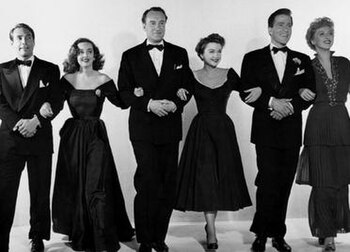
All About Eve is an essay by intelligent film people in Hollywood about intelligent theater people on Broadway. That as raw material alone has the potential for a film that will at the very least keep you awake in the theater. But when you add elements like a biting, razor sharp script, pitch perfect direction and an impeccably talented cast, you've got a film that not only keeps you out of slumber land, but picks you up by the collar and gives you a heavyweight championship once over. And that's what All About Eve does.

In 1950, director Joseph L. Mankiewicz was riding a wave of acclaim after his double Oscar coup (Direction and Screenplay) the previous year for A Letter to Three Wives. After Wives, Mankiewicz had the idea for a story about an aging actress and when he read a Cosmopolitan magazine piece called "The Wisdom of Eve" he knew he'd found his inspiration. Then under contract at Twentieth Century Fox, Mankiewicz contacted studio boss Darryl Zanuck about the idea and Zanuck assigned him to the picture for both script and direction. Originally a vehicle for Fox star Susan Hayward, it was determined she was too young for the role of forty-ish Margo Channing, grande dame of the New York stage. After batting about the names of Barbara Stanwyck and Marlene Dietrich, veteran actress Claudette Colbert was signed to play the part.

Fox resident girl next door, Jeanne Crain had also given an Oscar nominated performance the previous year in the racial themed drama Pinky. Zanuck wanted the key role of Eve to go to Crain, one of the studio's top stars at the time. But Mankiewicz, who had directed the actress in A Letter to Three Wives, didn't think she had the chops to play the cold hearted, conniving Eve. He wanted Anne Baxter, who had won a Best Supported Actress Oscar as the tragic Sophie in 1946's The Razor's Edge. Besides feeling she could handle the part, he noted a distinct resemblance to Claudette Colbert, accentuating the characters desire to be like her mentor. Nature resolved the issue when Jeanne Crain discovered she was pregnant and Baxter was cast in the part.


Meanwhile Claudette Colbert injured her back on the set of Three Came Home, another film she was starring in and had to withdraw from the role of Margo. Now Mankiewicz and Zanuck were in a quandary. Mankiewicz' script was written with Colbert in mind. Then he thought of Bette Davis. Davis was in a career slump. Her nineteen year career at Warner Brothers had just ended with the tepid Beyond the Forest ("What a dump"?), She was past forty in Hollywood and her prospects weren't promising. Mankiewicz thought she would bring worldly wisdom tempered with vulnerability to the character of Margo. Davis read the script and jumped at the chance.

Filling in the rest of the cast were George Sanders (magnificent as rogue critic Addison deWitt), Thelma Ritter, Hugh Marlowe and as Bill Sampson and Karen Richards, Gary Merrill and Celeste Holm (one pre production casting suggestion was Ronald Reagan as Sampson and his soon-to-be wife Nancy Davis as Karen). All About Eve was Mankiewicz piece de resistance, earning him Oscars for Direction and Screenplay for the second consecutive year. All told, Eve won six Academy Awards and was nominated for fourteen, an achievement not matched until 1997's Titanic.

Thursday, April 9, 2009

Leave Her To Heaven: Heaven Help Her!


OK, if you've never seen 20th Century-Fox's Leave Her To Heaven (1945) what are the best words to try and describe it to you. Glossy, colorful, sinister, noir (yes, a colorful noir), gripping, Oscar nominated. I know! GENE TIERNEY. This is without a doubt Gene Tierney's movie. Sure Cornel Wilde is her co-star and the male lead but Fox could have just as well put Dana Andrews or any of their other male contract players in the role and the film would still be Tierney's (Tyrone Power would probably be the exception) but that's as it should be. The story revolves around Tierney's character Ellen Berent, an extremely beautiful but extremely controlling, some would say psychotic woman who has her sites set on writer Wilde.

Coming on the heels of her big breakthrough role in Laura (1944), Tierney garnered her only Academy Award nomination for the role (she lost to Joan Crawford for Mildred Pierce). The lush sets, both interior and exterior are gorgeous, shot in brilliant Technicolor, and the supporting cast is tops including Jeanne Crain as Tierney's pretty, down to earth sister, Vincent Price as spurned sweetheart/district attorney and Darryl Hickman as Wilde's invalid brother who falls victim to Tierney's black, twisted view of devotion to her husband.

LinkWithin

Related Posts with Thumbnails