Showing posts with label Louis B. Mayer. Show all posts
Friday, January 11, 2013
Paid (1930): Joan Goes to Jail
One of the first names that comes to mind when thinking of classic Hollywood is Joan Crawford. Her amazing career spanned six decades and the longer she made films, the more iconic she became. As an icon, she sometimes morphed into a caricature of her own screen image. The eyes bulging under uber heavy, arched brows and lips painted deep crimson, twisted into a melodramatic snarl. But long before she was Mildred Pierce, Harriet Craig or even Crystal Allen, displaying her learned screen affectations and perfect diction, she was a burgeoning MGM starlet, a movie queen in training. Her pre-code shop girl was a box office bonanza. In 1930, after years of being everyone's favorite flapper, Joan made the film Paid, her first real dramatic attempt and it was both a personal and professional success, ranking her in the top tier at Metro.
In Paid, Crawford plays Mary Turner, a young shop clerk who is falsely accused of theft by her department store boss. As she is literally dragged off to prison, she dramatically declares vengeance against her heartless oppressor. While in the pokey, she studies law books and meets up with a tough talkin' toots named Agnes Lynch (Marie Prevost). Upon her release she joins up with "Aggie", who introduces her to Joe Garson (Robert Armstrong), a longtime crook with a smart mouth. With these two seedy characters, Mary uses what she learned in jail and plans a scam called the "heart balm" racket, where unsuspecting older men are sued for breach of promise, a legal form of blackmail. The bitter lass carries her revenge even further and closer to home by marrying the son of her former boss, who was responsible for her imprisonment.
Directed by Sam Wood, who had joined MGM just a few years earlier, the movie was based on the play Within the Law by Bayard Veiller. It was originally slated to star Norma Shearer, the queen of the Metro lot, but when she became pregnant, the role was open. Crawford pleaded with her bosses to give her the part and Irving Thalberg (Shearer's husband and second in command at the studio) gave her the chance she needed to put her "Dancing Daughter" days behind her.
Paid was a hit and to show his gratitude, head honcho Louis B. Mayer gave Joan a financial boost. She received a $10,000 bonus with a note that read: "In appreciation of the co-operation and excellent services rendered by you, we take great pleasure in handing you your check made payable to your order in the amount of $10,000...this does not affect the terms of your contract dated November 2, 1928." Not bad for a shopgirl.
The film also marked the debut of Douglass Montgomery, billed here as Kent Douglass, who played Bob, the innocent who Mary Turner weds to get her ultimate revenge. It's fun to watch Crawford here, honing her craft and giving a good performance before she would ultimately become JOAN CRAWFORD. She and co-star Marie Prevost would become friends during the filming of Paid and remain so until Prevost's untimely death in 1937 of acute alcoholism. Among a collection of empty liquor bottles detectives found a promisory note of $110 to Crawford and it was reported that it was Joan who paid for the funeral.
Labels:
Douglas Montgomery,
Irving Thalberg,
Joan Crawford,
Louis B. Mayer,
MGM,
Norma Shearer,
Paid,
prison
Thursday, February 18, 2010
100 Blog Posts: How About 101?

When I started writing Classic Movies Digest last spring, I had no idea I would eventually write 100 posts. I had no idea how many posts I would write, I just wanted to share my love of classic movies with anyone who wanted to read what I had to say and share that love with me. Well, I am happy to say the response has been tremendous and I have enjoyed meeting a wide variety of fellow classic movie enthusiasts. To celebrate the milestone, I requested your input, what readers wanted to see for the 100th article, and based on comments, e-mails and various messages and requests, the following is the response of the masses. Thanks to everyone who participated and to all readers of CMD.
Silent Transition: Can You Hear Me Now?

"Wait a minute, wait a minute, you ain't heard nothin' yet!" Those were the first words spoken in The Jazz Singer (1927), the first "talkie" movie, partially anyway. It was the first feature film that bridged the gap from silents, the only films the world had known, to the sound era of filmmaking. Released by Warner Brothers in fall of 1927, the studio would release Lights of New York, the first all-talking feature film, the following year and with that, there was no turning back. Audiences flocked to the new kind of movie and box office takes were too profitable to ignore, even by those who at first called the concept a "fad". It was a transition famously ~ and creatively ~ lampooned in the classic musical Singin' in the Rain (1952), but the conversion to sound didn't come without its casualties. Talent went to the wayside in droves, some, superstars of their time.
Many of the most celebrated stars of the silent era were of foreign birth and thick accents were given as the major reason for their fall from box office grace. Pola Negri, notable paramour of Chaplin and Valentino, was one such case. Her Polish accent apparently so thick it was deemed practically inaudible. Poor sound technology didn't help these situations surely, nonetheless, Paramount declined to renew her contract. Swedish icon Greta Garbo, on the other hand, not only made the transition successfully but thrived in sound films. Her Anna Christie (1930) actually heralded her sound debut with banner headers screaming "GARBO TALKS!" to movie-goers. Her reign at MGM was only strengthened, and her famed low profile only caused audiences and fans to want to hear her talk all the more.

As for paramours, Garbo's lover and would be husband, John Gilbert, was one of the sound era's most beleaguered victims. Once rivaled only by Rudolph Valentino as the ultimate male sex symbol of the silent period, the problems with his post silent career went far further than mere sound mechanics. As the story goes, his predicament began with his proposed marriage to the elusive Miss Garbo. In 1926, he and Greta were to take part in a double wedding ceremony with director King Vidor and actress Eleanor Boardman. Garbo was a no show. MGM head honcho and Gilbert and Garbo's boss, Louis B. Mayer, attending the nuptials, made a nasty crack about John's bride-to-be and Gilbert socked him. According to Miss Boardman, Mayer swore to wreck the actor's career. There was no love lost between these two men even before the incident, so the skirmish only brought to a head the tension between them. When Gilbert made his talking debut in This Glorious Night (1929), his voice came across as too high pitched to make him a viable screen lover. Also, his constant use of the phrase "I love you" was sniggered at by audiences and parodied in the afore mentioned Singin' in the Rain. Legend is that Mayer had the sound manipulated in the film to make Gilbert's voice less than suitable. Lack of support from his studio, heartbreak over his failed romance and alcohol all played a part in his demise.

As for paramours, Garbo's lover and would be husband, John Gilbert, was one of the sound era's most beleaguered victims. Once rivaled only by Rudolph Valentino as the ultimate male sex symbol of the silent period, the problems with his post silent career went far further than mere sound mechanics. As the story goes, his predicament began with his proposed marriage to the elusive Miss Garbo. In 1926, he and Greta were to take part in a double wedding ceremony with director King Vidor and actress Eleanor Boardman. Garbo was a no show. MGM head honcho and Gilbert and Garbo's boss, Louis B. Mayer, attending the nuptials, made a nasty crack about John's bride-to-be and Gilbert socked him. According to Miss Boardman, Mayer swore to wreck the actor's career. There was no love lost between these two men even before the incident, so the skirmish only brought to a head the tension between them. When Gilbert made his talking debut in This Glorious Night (1929), his voice came across as too high pitched to make him a viable screen lover. Also, his constant use of the phrase "I love you" was sniggered at by audiences and parodied in the afore mentioned Singin' in the Rain. Legend is that Mayer had the sound manipulated in the film to make Gilbert's voice less than suitable. Lack of support from his studio, heartbreak over his failed romance and alcohol all played a part in his demise.

Others who didn't withstand the test of time were superstar Clara Bow (above). The "It" Girl had a Brooklyn accent which supposedly the public didn't readily identify with their beloved sex goddess. Bow's voice actually wasn't much different from any of her contemporaries who also came from the New York borough, Barbara Stanwyck for instance, and time has shown that her career problems stemmed more from her personal demons than public acceptance. Some, like Bow, crossed over but didn't sustain their stardom. Ramon Navarro, Mary Pickford and Gloria Swanson to name a few (Swanson would gloriously mock her own decline in her classic "comeback", Sunset Boulevard (1950) ). Chaplin didn't even bother until 1940.


Then there were those who, like Garbo, crossed over and blossomed in the age of talkies. Joan Crawford (left), everybody's favorite flapper, not only made the successful transition but reinvented herself numerous times to sustain her career for decades to come. She went from 20's flapper, to 30's working girl, to 40's noir dame to 50's hardcore queen bee to 60's campy horror icon. Norma Shearer, Ronald Colman and Janet Gaynor are great examples of those who excelled on both sides of the celluloid fence. But with the onset of sound, the time was right for change regardless. Stage actors came on the scene, those who had both faces and voices that they knew how to use. Of this crop, those who moved in to stay included Bette Davis, Katherine Hepburn, Humphrey Bogart, James Cagney and a slew of others. The chase was on and the newbies were ahead of the game.
Whether he knew he was being prophetic or not in The Jazz Singer, Al Jolson was right, we hadn't heard nothin' yet. Paging Lina Lamont.
Labels:
Greta Garbo,
Joan Crawford,
John Gilbert,
Louis B. Mayer,
silents,
Warner Brothers
Wednesday, June 10, 2009
Judy Garland: Before the Yellow Brick Road

Today, Frances Gumm, or Judy Garland as she is better known, would have been 87 years old. So much has been written about her life, films, songs, marriages, addictions and death. Volumes have been written about The Wizard of Oz (1939), her most famous film, alone. But the time in Garland's life just before she became a superstar, just before she hit the big time in Oz, is the one most fascinating to this blogger.
Garland joined the MGM family as contract player in 1935. Before that she was "Baby" Frances, the youngest member of a singing vaudeville act with her two sisters called The Gumm Sisters, which had been performing since the mid 1920's. After changing their name to The Garland Sisters (supposedly by famed comedian George Jessel) and Baby Frances to Judy (supposedly after a Hoagy Carmichael song), the group started to wind down by the mid 30's and Garland's mother, Ethel, a notorious stage parent, focused all of her attention on her youngest child, who was by far the most talented. After several auditions at various studios in Hollywood, Judy sang "Zing Went the Strings of My Heart" for MGM head Louis B. Mayer and was signed by that studio in September 1935, to a contract that paid her $100 per week. Her excitement was short lived when her father, Frank, died in November. Judy was heartbroken, having been closer to her father than anyone else. She and Frank would be separated for long periods of time when Ethel would take the singing trio on the road to tour.
Though a contract player at the biggest studio in town, MGM was at odds as to how best to fit the 13 year old into its stable of stars. She wasn't a child and she wasn't a woman. She wasn't even a child/woman like her peer Lana Turner, who would join the studio two years later. With nothing set for her at Metro, Judy made her feature film debut on loan-out to 20th Century-Fox for a football folly called Pigskin Parade (1936). When she returned to her home studio, she was scheduled to sing "You Made Me Love You" to Clark Gable for his 36th birthday party, given to him at the studio. A special version of the song had been reworked by Garland's MGM mentor, musical arranger Roger Edens, as "Dear Mr. Gable." The performance and song were such a hit, a segment was integrated into the film Broadway Melody of 1938 (1937) with Judy singing the song to a framed photograph of the heartthrob.
Next she was teamed for the first time with child actor Mickey Rooney, who would become her frequent co-star and lifelong friend. The film was Thoroughbreds Don't Cry (1937) and sparked a certain on screen chemistry between the two youngsters that would be expanded on by the studio for several years. They were first re-teamed the next year in Love Finds Andy Hardy, one of the best installments of the family oriented Andy Hardy series. As her popularity and work schedule grew, medication began being prescribed for all aspects of her life. Uppers to wake her up for long and laborious days on the set, downers to help her sleep at night and amphetamines to control her tendency for weight gain. Louis B. Mayer would call the poorly postured, chubby and awkward teenager, "my little hunchback." All this went on with the approval and full cooperation of Ethel who wasn't going to rock the boat (in later years, Garland would call her mother the "real Wicked Witch of the West"). It was the impetus to her lifelong dependence on drugs and alcohol.
Garland's on screen persona became the plain and dumpy girl next door, the heartsick teen whose crush on a boy could be mortifyingly painful. Not exactly star making qualities. But when she opened her mouth to sing, which she inevitably did in most all her films, that was when the screen came to life and what MGM wanted to cash in on with the right film project. The soul wrenching voice which emanated such vulnerability and pathos, would wow audiences every time and the electrifying talent that was Judy Garland was on it way.
In 1937, Metro had bought the film rights to The Wizard of Oz, a children's story by L. Frank Baum. As pre production began, the top studio brass was set on getting child star Shirley Temple to play the heroine Dorothy for the $2 million + production. Temple, who was under contract to rival 20th Century-Fox, had been the #1 box office star in 1935, 1936 and 1937. It would have been quite a coup for MGM to be able to borrow her, but Fox refused. It wasn't going to share the bounty of its top star. So Metro went with its plan B: Judy Garland. Much more mature physically than Temple (at pre production, Temple was 9, Garland 16), Judy's budding breasts were bound with tape, her hair pigtailed and her make up very minimal, in an attempt to make her younger looking for the role of the Kansas farm girl.
Though not an immediate financial success (it would be many years before the film would recoup its production costs), The Wizard of Oz was a classic and made Garland a star. The film's Academy Award winning song "Over the Rainbow" would forever be associated with the actress. With all the trials and tribulations she would face in her tumultuous life, Judy Garland continued to sing and along with her massive repertoire of songs, she would always be remembered as Dorothy.
Wednesday, June 3, 2009
Notes on Norma: The Royal Thalbergs

In its heyday, Metro Goldwyn Mayer claimed its studio had "more stars than there are in heaven" due to the number of top quality, extremely popular actors and actresses it had under contract at any given time. Other studios had a handful of really big A-list stars but MGM had its stable full. Groomed from the time a contract was signed, its actors were pampered, supported, baby sat (you don't think they were all mature acting adults do you?), and trained to act, sing, dance or speak correctly. Overseeing all this regalia was the studio's head honcho, Louis B. Mayer but his production chief, the head creative administrator, was a frail, Brooklyn born genius named Irving Thalberg.
Due to problems with his heart, Thalberg was a very sickly and weak child and wasn't expected by doctor's to live past age thirty. While still a teenager, he started his career as an assistant to Carl Laemmle, who ran Universal studios. After a few years and a falling out with Laemmle, the young executive moved to head creative production as vice president to Mayer at what would become MGM in 1923. He was meticulous in his craft, personally overseeing every Metro production from 1924 to 1932. His perfectionism and high level of quality film making at such a young age (he was under 25) earned him the title "Boy Wonder" in Hollywood. In 1923, he met a young actress named Norma Shearer.
Born in Canada, Norma Shearer made her way to Hollywood via New York City, where she had been working as a model and had been rejected by impresario Florenz Ziegfeld for his acclaimed Follies. Besides modeling, Shearer would also play occasional bit parts in New York based films. In one such film, The Stealers (1920), she was spotted by Irving Thalberg and brought to Hollywood as star potential. Signed by MGM to a long term contract, she was groomed for stardom by Thalberg personally. In September 1927, the two were married in a lavish spectacle at the home of actress and mistress of publisher William Randolph Hearst, Marion Davies in Beverly Hills. The marriage cemented Norma's place at Metro and she even began being billed by the studio as "The First Lady of the Screen." Under Thalberg's watchful eye, she had the choicest roles and directors at the studio. It was a point in later years that didn't go unnoticed by fellow MGM contractee Joan Crawford. The rivalry between Crawford and Shearer was well known around the set. Crawford, having clawed her way to stardom, resented Norma's position as "Queen of the Lot" at Metro. The feud culminated in grand performances by both as marital rivals in the classic comedy The Women (1939). A humorous side note, when Shearer was a young model in New York she was known as "Miss Lotta Miles" in an advertising campaign for Springfield Tires. Years later Crawford would throw jabs at her fellow diva by calling her "Miss Lotta Miles."
Although being married to the boss didn't hurt, Thalberg's guidance wasn't Shearer's only asset. Not classically beautiful, the actress had a graceful elegance, poise, and talent enough to rack up six Academy Award nominations, including a win for The Divorcee, all by 1938. As well as being at their peak professionally, the Thalbergs shared a glittering social life as toast of the Hollywood set. One of their weekend parties was the basis for the F. Scott Fitzgerald story "Crazy Sunday." But the pressure of such a demanding schedule took its toll on Irving. In 1932 he suffered a major heart attack. He and Shearer went to Europe for his convalescence. Louis B. Mayer had grown resentful of the power and stature obtained by his "right hand" and took Thalberg's absence as an opportunity to strip him of some of his responsibilities at the studio. When Irving returned to work at MGM in mid 1933, he returned merely as a unit producer, quite a step down from his previous lofty position. Nevertheless, he was instrumental in the creation of many classic films in the next few years.
Even after his illness, Thalberg was a very dominant force in the direction of his wife's career. After seeing a New York staging of Shakespeare's Romeo and Juliet, he set about a filmization with Norma as Juliet. The film was released in August 1936, and three weeks after its New York premiere, Thalberg died of pneumonia. Even after his death, his hand was guiding Shearer's roles. He had begun work on her next project, Marie Antoinette, before he died, though it wouldn't be completed until 1938. Without her husband's influence and discretion in helping her choose appropriate parts, Shearer's career floundered. She would finish out the decade with two high profile films, Idiot's Delight and The Women but the tides had turned. Younger actresses were taking the torch from the carry overs from the silent days. She, along with Joan Crawford and Greta Garbo were being pushed to the background by newcomers like Judy Garland, Lana Turner and Greer Garson. After a few more films at MGM in the early 1940's Shearer retired, married a ski instructor several years her junior and enjoyed the luxurious lifestyle of Old Hollywood aristocracy. As a power couple in Hollywood circa 1930's the Thalbergs had no match. There's was a world of privilege and achievement and though Shearer may not have the notoriety today of some of her much ballyhooed counterparts, in her day, she was queen of the lot.
Labels:
Joan Crawford,
Louis B. Mayer,
Marie Antoinette,
MGM,
The Women
Sunday, May 10, 2009
Lana Turner, Birth of a Starlet, Part 1

Lana Turner became one of the most glamorous, most talked about, most married and most courted stars ever to hit Hollywood. The killing of her then boyfriend, Johnny Stompanato in 1958, by her daughter was one of the most sensational stories of the entire decade. It was the kind of story that fit perfectly into Lana Turner's very colorful and eventful life. Her persona was one of smouldering sex appeal, both on screen and off. But the life and career that exuded so much glamour and fame began quite differently.
It is Hollywood legend how Lana Turner was "discovered" by a talent scout inside Schwab's drugstore in Hollywood in the mid 1930's. As a matter of fact, Schwab's would become synonymous with Turner as a result of the famed fable. Although the legend is similar to the real events that led to Lana Turner's discovery, it was not Schwab's, but the Top Hat Cafe where the future star was sitting that fateful day.
Julia Jean Mildred Frances Turner was born in Wallace, Idaho on February 8, 1921 (although many sources say 1920, Turner in her autobiography claims this is a mistake and she was actually born a year later). Her father was a gambler and sometimes bootlegger. Her mother, practically a child bride. The family moved to San Francisco when little Judy, as she was called, was still very young. In 1930, when she was nine, her father was murdered and robbed after winning big in a crap game. Her mother, Mildred, unable to give her daughter full time care, put her with several foster families. Mildred found work as a hairdresser and she and Judy eventually moved back in together. When Judy was fifteen, mother and daughter moved south to Los Angeles. There the already developed teenager enrolled at Hollywood High School, which was located across the street from the Top Hat Cafe and that was where fate smiled on young Judy Turner.
Cutting a typing class at Hollywood High, the precocious teen was sipping a Coke at the Top Hat soda fountain when she was spotted by Billy Wilkerson, publisher of the Hollywood Reporter, who noted her pretty face and shapely figure. He referred her to comedian cum agent Zeppo Marx (the fourth Marx Brother), which in turn led to a meeting with director Mervyn LeRoy. LeRoy signed Turner to a personal contract and placed his new protege in his upcoming film They Won't Forget (1937). at Warner Brothers. She had the small but pivotal role of Mary Clay, the young victim, who sashays down the street of a small southern town in a tight sweater which showcases her natural endowments. The role earned her the moniker of "The Sweater Girl", a title she kept well into the war years. She and LeRoy decided to change her name to the more glamorous Lana and the legend was born. She was loaned out to Samuel Goldwyn to play an Oriental handmaiden in the epic The Adventures of Marco Polo (1938), starring Gary Cooper. The role required that the starlet's eyebrows be shaved and a higher arch be drawn in by the makeup department. They never grew back and she would have to draw them in for the rest of her life.
When her mentor, LeRoy, moved from Warners to Metro Goldwyn Mayer, Turner followed, signing a contract with the top rate studio in early 1938 for $100 per week. Still a teenager, she joined fellow contract juveniles Mickey Rooney and Judy Garland in Metro's famed Little Red School House where they were tutored on the set. Early on she was given the glamour build up, despite her young age. Even among her contemporaries in her first film at MGM, Love Finds Andy Hardy (1938), it is Lana who is given the role of the glamorous teen aged vamp. Under LeRoy's tutelage she thrived at her new studio. She also thrived socially. Besides Rooney and Garland, her circle included young MGM hopefuls Robert Stack and Ann Rutherford. It also included handsome young men aplenty. Columnist began calling her the "Nightclub Queen". Out late and up early on the set, the underage starlet was burning the candle at both ends. It got to the point that a concerned Louis B. Mayer, head of MGM, called a meeting with Turner and her mother. The meeting climaxed with Mayer shouting, "The only thing you're interested in is....", as he pointed to his crotch.
The whirlwind of men and nightlife would finally culminate in the first of her seven marriages and numerous affairs. On February 8, 1940, her nineteenth birthday, she and bandleader Artie Shaw eloped on their first date. They would divorce four months later.
Labels:
divorce,
Lana Turner,
Louis B. Mayer,
Mervyn LeRoy,
MGM,
They Won't Forget,
Warner Brothers
Sunday, April 19, 2009
Clark Gable: The Punishment That Backfired

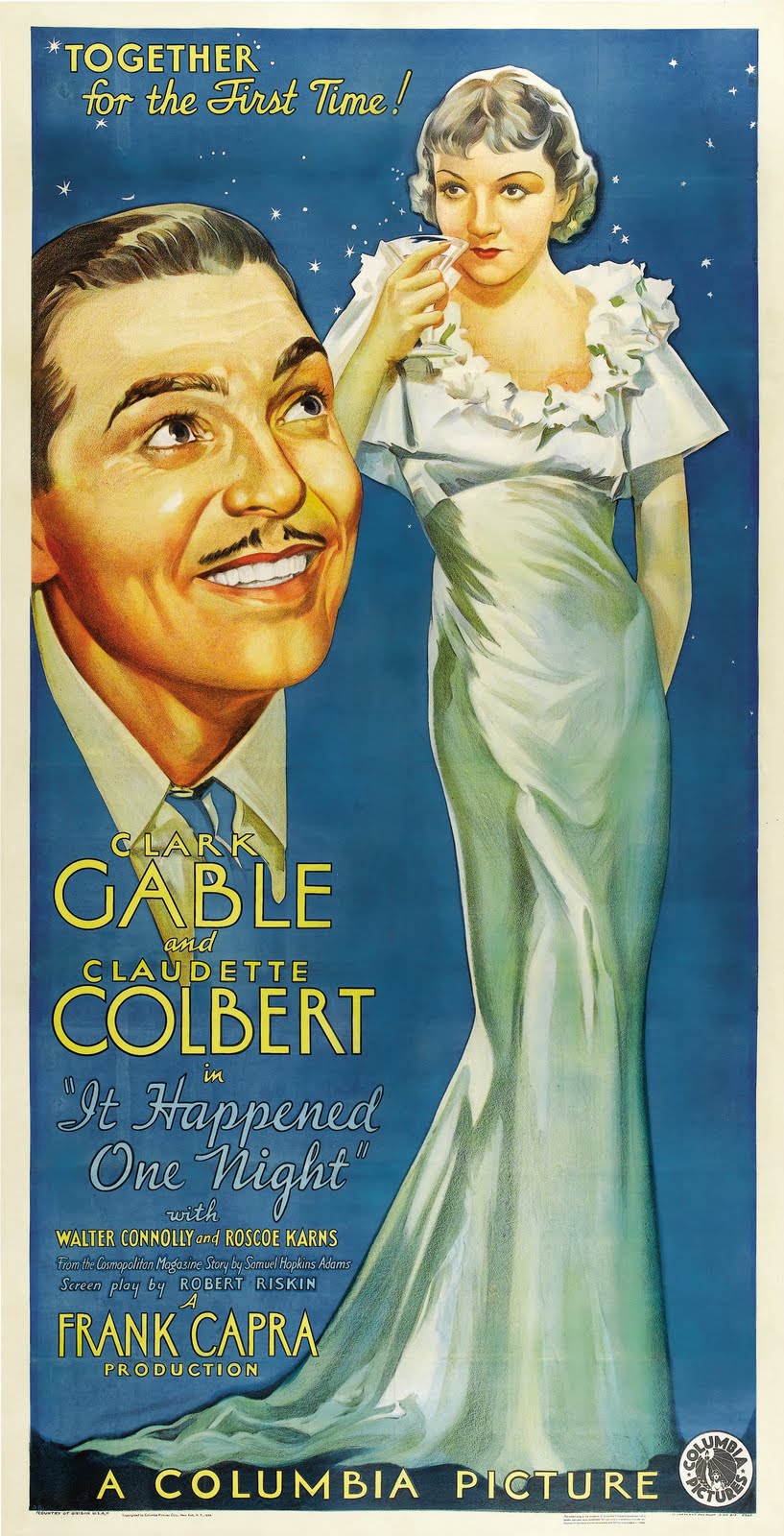
In 1933, Columbia Pictures was considered a "Poverty Row" studio in Hollywood, relegated to low budgets and B pictures. Not being able to afford a host of contract stars, Columbia would borrow from other studios when the need arose. So when director Frank Capra bought the rights for a magazine story called Night Bus, Columbia boss Harry Cohn tried to borrow MGM star Robert Montgomery for the male lead and change the name to It Happened One Night. Louis B. Mayer, head of MGM, refused (MGM turned down the rights to the Night Bus, having lost money on a "bus picture" called Fugitive Lovers, which, ironically, had starred Montgomery). Instead he offered the services of up and comer Clark Gable, as punishment to the rising star for demanding a higher salary. Mayer wanted to humble Gable by showing him the comparison of working at the lowly Columbia as opposed to the pristine Metro Goldwyn Mayer where there were "more stars than there are in Heaven".
Gable was not happy about the arrangement arriving on his first day drunk and angry. He also had doubts about his ability to play a light, comedic role, as he had spent his early years at MGM playing heavy handed thugs and he-men. Capra was also wary on this point. Gable would play Peter Warne, a hard boiled, down t0 earth newspaperman who meets runaway heiress Claudette Colbert. The story follows their misadventures and eventual romance on board a New York bound bus in Florida. After a shaky start with Capra, Gable read the script, relaxed and settled into the part, actually enjoying his time on the set.
It Happened One Night became a sleeper hit and one of the classic screwball comedies. The success of the film actually raised the status and financial viability of Columbia Pictures. When Oscar night rolled around in February 1935 all the headaches paid off. The film was not only a success with the public, it became the first in history to win all 5 major prized: Best Picture, Director, Screenplay, Actress (Colbert) and as Best Actor, Clark Gable.
Subscribe to:
Posts (Atom)