Showing posts with label Frank Capra. Show all posts

Wednesday, July 14, 2010

Pre-Code Barbara Stanwyck: You've Got the Cutest Little "Baby Face"


Raw, gutsy and independent, Barbara Stanwyck was a “brawd” in the truest sense of the word and one of the best examples that Hollywood had to offer. This tough dame persona, which ran rampant in classics like Double Indemnity (1944), The Strange Love of Martha Ivers (1946) and a variety of westerns in the 1950’s, found its roots in the actress’ pre-code movies of the early 1930’s. While many of her contemporaries tried to speak with a pseudo-British accent, a common trait as part of actor's film diction training by various studios (MGM was the worst), Stanwyck not only spoke in her native Brooklyn-ese, but wore it as a badge of honor. Among other things it made her stand out from the pack of young actresses who seemed bound for stardom in the early days of talkies.

In the period of Hollywood history known as the pre-code era (the time in the early 1930’s before the Production Censorship Code was put into strict enforcement), Stanwyck’s roles stood out as some of the most notable and brazen. Along with Mae West’s early cinematic romps, Stanwyck’s racy Baby Face (1933), helped pave the way for a tighter hold by Hollywood censors later in the decade. Her husky, knowing voice not only betrayed her Brooklyn roots, but revealed in her roles of this period, an earthy, wanton past. Her characters had been around the block, and if they hadn’t, they wanted to.


Her screen image in the Thirties was that of a self-sacrificing mother or a tramp, either with a heart of gold or cold and hard, with the capacity of redemption. Some of her film’s plots during this interval were contrived and hard to swallow, such as The Purchase Price (1932) and Ladies They Talk About (1933), but Stanwyck’s performance always shined and made otherwise unbelievable situations extremely entertaining. She possessed similar screen traits to one of her screen peers at MGM during the same time, Joan Crawford. Like Crawford, she was often cast as a lower class young woman scraping her way in a man’s world. Just as Joan was the eternal shopworn shopgirl in her pre-code films, Barbara actually starred in a film titled Shopworn (1932). But unlike Crawford, Stanwyck was more hard boiled. She could play not only a gangster’s moll but the gangster, and she had no qualms when it came to revenge. Also unlike Crawford, who was, and wanted to be, iron clad contracted with her studio, Stanwyck had non-exclusive contracts with both Columbia AND Warner Brothers during a time when the studio ruled. Talk about gutsy.

Barbara Stanwyck’s real life past lent a certain credence to her onscreen performances. Born in Brooklyn in 1907 as Ruby Stevens, she was orphaned at a very young age and was cast about in several foster homes until eventually hitting the stage as a teen and becoming a chorus girl. Mind you, a chorus girl in the 1920’s was not exactly a Little Bo Peep existence. She met and married Frank Fay, a popular vaudeville star and followed him to Hollywood, where she got a less than auspicious start in movies. Her first two features were duds, and discouraged and distraught, she went, on recommendation of Columbia Studio boss Harry Cohn, to see director Frank Capra about a picture he was casting called Ladies of Leisure (1930). Capra thought Stanwyck “sullen” and she left the interview prematurely. But after viewing a test she had made for another film, the director wanted her in his picture and the two became great friends with Capra saying of the actress in his autobiography, “In a Hollywood popularity contest, she would win first prize hands down.” A notion shared my many in the film community for years to come.

In Ladies of Leisure, the actress plays a “party girl”. In her next film, Illicit (1930), as if the title wasn’t titillating enough, she plays a girl who wants to live with her lover outside of marriage (this is 1930 we’re talking here). Forbidden (1932), shows her as a sexually repressed librarian who throws caution to the wind and becomes the mistress of a married man, even having his child out of wedlock. Ladies They Talk About (1933), she winds up in a women’s prison. These kinds of roles and ones similar to them, were a prevailing theme in Stanwyck’s early work. Bouncing back and forth between Columbia with roles in early Capra films and Warner Brothers, the actress made great career strides eventually gaining full fledged stardom. The culmination of this bad girl image arguably came in the form of Baby Face, the deliciously decadent diatribe which helped push Hollywood censors over the edge.

Baby Face features Stanwyck as Lily Powers, product of a grimy factory town where her bootlegging father has been pimping her out since she was 14. When he is killed she heads for the big city to make her mark. Starting from the ground floor, she literally sleeps her way to the top in a large metro bank, where she eventually becomes the mistress of the vice president then marries the banks newly elected president (George Brent). The film’s imagery of Stanwyck’s ascent to material wealth is priceless. With each corporate conquest (one of which is played by young pre-stardom John Wayne, pictured above), the camera pans further upward the exterior of a New York skyscraper, which represents the bank in which she intends to prevail, all to the sound of St. Louis Blues on the saxophone. How pre-code is that.
Even in her more tame film efforts after the enforcement of the censorship code, Barbara Stanwyck’s tenacity and vitality shined through. She went on to make better known and glossier pictures, but the seed had been planted in her early days. In these pre-code offerings of sin, seduction and self-sacrifice, Stanwyck showed she not only had what it took, but knew exactly how to use it.
If you are interested in these or any other merchandise, please help support this blog by purchasing them through the Amazon portal at the top of this page. By accessing Amazon through this site, you help me maintain resource material and continue to share my love of classic film. Thank you very much.

Tuesday, November 10, 2009

Meet John Doe (1941): Frank Capra Takes On Facism


Gary Cooper. Barbara Stanwyck. Frank Capra. All in their prime. What's not to like? Meet John Doe (1941) was made at a time when Hitler's reach was spreading throughout Europe and Capra, always the idealist, spoke to that reach through his film. With Mr. Smith Goes to Washington, made in 1939, the director ended his long term relationship with Columbia Pictures, a relationship which raised Columbia's standing in Hollywood significantly. Along with Mr. Deeds Goes to Town (1936), Mr. Smith formed the two legs of an unofficial trilogy which represented Capra's signature filmmaking during this period. Meet John Doe formed the third leg, with Gary Cooper in the role of the common, every-man, aptly given the moniker John Doe. Barbara Stanwyck has the role played in the previous films by Jean Arthur, the cynical career gal who is eventually won over by the honest, innocent rube.


The movie tells the story of Long John Willoughby (Cooper), a down on his luck bush league baseball pitcher with a bum arm. He is plucked from hoboville to personify the fictional irate citizen John Doe, created by newspaper columnist Ann Mitchell (Stanwyck). Per Ann's column, Doe, frustrated and disenchanted with society, threatens to jump off a high rise roof on Christmas Eve. After a deluge of response from those wanting to save/help Doe, Cooper is drafted as the disillusioned wretch incarnate. What starts out as a publicity stunt becomes a dark cloud over Cooper's conscience, when John Doe clubs are formed across the nation to spread his mantra of "Love Thy Neighbor" and the whole movement is threatened by a dark and ominous influence.

Cooper, relishing the opportunity of working with Capra again after their success with Deeds, signed onto the picture without seeing a script. This decision said alot for his enthusiasm to work with the director, as Cooper was riding high with a succession of recent hits and his Oscar winning Sergeant York, would be made the same year as John Doe. In turn, Capra wanted Cooper specifically for the lead role. The Capra-Cooper magic hit again with Doe, but not without a few snags. The film tends to get a little talky at times, such as when Cooper's eccentric hobo sidekick (Walter Brennan) goes on a tirade about the helots, his word for those who seek security and creature comforts and get caught up in the soft life. Capra gets a bit heavy handed with the lectures as well as with his classic "Capra-corn" sentiment, but what's wrong with a little sentiment, it hits all on some level.


As a Warner Brothers production being directed by Capra, the studio's reigning bombshell, Ann Sheridan was tagged for the Stanwyck role. Contract entanglements nixed the idea so thoughts roamed to Olivia de Havilland. When she didn't work out either, Stanwyck was cast. Always a good combination with Frank Capra, the gutsy Brooklyn born actress made several pre-Code films with the director at Columbia. Although not her best work, she and Cooper click and her obvious and immediate attraction to his character when they first meet is convincingly carried through the film. There is foreshadowed evidence of Elizabeth Lane, Stanwyck's character in 1945's Christmas in Connecticut, in her performance. As Lane's driving force is ownership of a stunning fur coat, the ambition of Stanwyck's Ann Mitchell is also grounded in material gain, much to her chagrin when her superficial desires interfere with her relationship with Cooper.


The supporting players are a veritable who's who of Hollywood's second tier. James Gleason as Stanwyck's cigar chomping, hard boiled newspaper boss. Walter Brennan as Cooper's crabby, harmonica playing side kick. Edward Arnold, wonderfully menacing as the power hungry Mussolini wannabe. Spring Byington as Stanwyck's good Samaritan mother. Regis Toomey as a small town soda-jerk, who with his wife, Ann Doran (oddly uncredited in a sweet and substantial performance) head one of the newly formed John Doe clubs. Even future cast members of Capra's classic It's a Wonderful Life (1946), Harry Holman and Sarah Edwards are on hand as Mayor and Mrs. Hawkins.


With no satisfactory ending agreed upon, several were filmed. Essentially this is one of the films flaws but doesn't detract from the overall quality of the movie. Though a tad overlong, Meet John Doe provides both an idealistic punch, as well as a great showcase for both its stars , particularly Gary Cooper. His quiet and simple approach to acting was used to perfect advantage and is a great complement to Stanwyck's brash city girl. Originally one of my "13 classic movies I've never seen but want to", I can happily say it is marked off my list in a most satisfactory way.

Saturday, July 11, 2009

Lost Horizon: Frank Capra's Shangri-La


When director Frank Capra read James Hilton's best-selling fantasy adventure novel Lost Horizon, about a Utopian valley high in the Himalayas, he took it to Columbia boss Harry Cohn, as a potential vehicle for the studio. On Cohn's approval production began and the roles started to be cast. Capra wanted sophisticated and urbane actor Ronald Colman to play the lead role. From the beginning, the director felt Colman was born to play the intelligent and deep thinking Robert Conway. Indeed, just as many felt Clark Gable was the perfect fit for Rhett Butler in Gone With The Wind, Colman wore the role of Conway like a glove.

Lost Horizon (1937) is an enchanting and mesmerizing film. Even if you have no idea what the film is about, the beginning sucks you in with a scene of total chaos somewhere in the Orient. Turns out all the hub bub is a revolution in the war-torn Chinese city of Baskul and the British diplomat to the area, Robert Conway is trying to evacuate all people of western origin by airplane. He and his brother, George (John Howard), board the last plane out with the remaining three refugees; a stuffy paleontologist (Edward Everett Horton), a crooked industrialist who's running from the law (Thomas Mitchell) and a tuberculosis plagued American prostitute (Isabel Jewel) who's living on borrowed time.

Little do they know they are being kidnapped until they are well on their way. They are taken higher into the Himalayas and it is there that their plane crashes, their pilot/kidnapper killed. Before they have a chance to devise a plan for survival in the snowy, frozen mountain range, a small party approaches the plane, led by an Asian fellow named Chang. He announces that he is from a valley, not too far, but a very arduous journey away. The group makes the treacherous trek and is stunned when they finally reach their destination. They literally go from the bitter, blinding wind and snow, through a chasm in the mountain, into a gorgeous valley where the sun is shining, birds fly in droves and beautiful bodies of water abound. In total amazement, they are led to a grand white building, its architecture of large scale and clean design, which they find later to be a lamasery, a place of spiritual enlightenment.

With Chang acting as their host, they are offered rich comforts in the form of exquisite foods, comfortable oriental style clothing and luxurious lodgings within the lamasery. As their mysterious circumstances for being there have yet to be revealed, all but the elder Conway, who is intrigued by the adventure, get antsy to get back to "civilization." The distinguished diplomat is then taken to see the High Lama (Sam Jaffe), the kind and aged spiritualist who oversees everything Shangri-La. Conway learns that he has been brought to the mountain Eden to take over for the ancient Lama. He also learns the Lama is more ancient than he realized being 200 years old! It seems lack of stress and the overall purity of the paradise is conducive to extremely long life there, a virtual fountain of youth.

As Robert Conway, Colman gives an elegant and poetic portrayal, one of the many highlights of his career. Young actress Jane Wyatt, best known for her role as Margaret Anderson in the popular TV series Father Knows Best (sadly, fewer and fewer know her from this show as more years go by) is cast as the enlightened young woman who is the impetus for Conway's presence in Shangri-La and his love interest once he arrives there. As one of the film's (and book's) more compelling though lesser characters is Mexican actress Margo (Mrs. Eddie Albert). She plays Maria, who by all outward appearances is a young Russian woman, no more than 20 years old, who falls for the younger Conway, George. Hers is a pivotal role in the history of the Utopian community and she does well with her part.

Lost Horizon was one of the most expensive films "poverty row" Columbia Studios had produced up to that time. But along with other Frank Capra/Columbia collaborations, it would help that organization rise above its lowly status. Alot was riding on its success, including Capra's reputation. Its anti-war sentiment got some flack by certain political view points and some of its footage hit the editing room floor upon its re-release but after all was said and done and a semi-complete restoration in more recent years, Lost Horizon has stood the test of time to become a bonafide classic in Hollywood annals.

Tuesday, June 16, 2009

13 Classic Movies I've Never Seen...But Really Want To

Through the years when discussing classic movies with friends and fellow film lovers, inevitably I've been asked numerous times who and what my favorites actors, actresses and films are. I have had discussions on what my favorite Hitchcock films are, my favorite Bette Davis movies and so on. Then the other day I was chatting with an online friend and we started discussing the films we had always wanted to see but hadn't, either by lack of opportunity or as is often in my case, just let the opportunity slip by. So I thought I would share 13 such films. These are by no means the only movies that meet this criteria for me or even necessarily the ones I want to see the most, but it is a good overall example. When perusing this lineup one may ask "Why in the world is THAT on here?". We are all different, with our own likes and dislikes and our own special reasoning for those preferences. Some of the films listed are very famous, most are not.


(NOTE: These are listed neither alphabetically, chronologically nor in order of importance)


They Won't Forget (1937) Claude Rains, a red hot murder/rape trial in the deep South and Lana Turner in a tight sweater. Tell me that's not a combination for a swell sounding film.

Trade Winds (1938) Joan Bennett is one of my favorite actresses (hence her appearance more than once on this list) and this film changed the course of her career with a simple hair color change. Plus it sounds cute and has the irresistible Ann Sothern.

Citizen Kane (1941) I know what you're thinking, "A fellow writes about classic movies and he's never seen one of the MOST classic!." What can I say, I was never a huge Orson Welles fan, but I've heard so much about it, I'm intrigued.

Meet John Doe (1941) Two of my favorite stars, Gary Cooper and Barbara Stanwyck at their peak with Frank Capra along for direction.

Forbidden (1932) Pre-Code Stanwyck directed by Capra and a really attention catching title.

Hotel for Women (1939) So elusive I've never even seen evidence of a television screening. This was Linda Darnell's film debut. Though no award winning classic, it sounds like fun with two long time favorites Ann Sothern and Lynn Bari in tow.

The Sign of the Cross (1932) Cecil B. DeMille directing a Pre-Code epic set in decadent, ancient Rome in which Claudette Colbert bathes in a giant pool of asses milk (no joke!).

House Across the Bay (1940) Joan Bennett again, this time in a drama with George Raft, whose usually very watchable.

Hound of the Baskervilles (1939) Classic film version of a classic tale. Basil Rathbone's first offering as the famous British sleuth, Sherlock Holmes. Lead to the long running movie series.

All Through the Night (1942) I like early 40's Bogart, but somehow missed this one. Also, my aunt, a big Bogie fan, had this poster in her home when I was a little tot. Good memories.

Hands Across the Table (1935) 1930's screwball comedy with Carole Lombard and Fred MacMurray. Sounds great to me.

Trail of the Lonesome Pine (1936) Another Fred MacMurray flick that from what I understand, is similar in atmosphere to Shepherd of the Hills, one of my favorite movies. Henry Hathaway directed both. I also feel that MacMurray was a much underrated actor.

Mandalay (1934) I like a good Kay Francis flick, though I haven't seen that many of them. From what I've been told, this is a perfect example of Kay at her pinnacle.


Some of these films are from Paramount Studios before 1948 and the MCA company bought this library with little distribution in recent years, therefore my lack of viewing opportunities. But others have been televised often or have been released on VHS and DVD for years now and I, alas, have just not taken the opportunity to fit them in to a busy and tight film viewing schedule. Whether you like the films on this log or in some cases don't, I hope you find it of some interest.

Tuesday, May 19, 2009

When Frank Met Jean: Sparkling Cinema


Jean Arthur had beat around Hollywood a long time by late 1935, when she was thirty-five years old. She had started out in silents beginning in 1923, featured in several low budget westerns and comedies. When sound came into play, late in the decade, she had a great asset in her husky, nasal voice, distinctive among her peers. But even though she made the transition to talkies smoothly, true stardom continued to elude her. In 1935, she appeared in John Ford's delightful comedy The Whole Town's Talking, starring Edward G. Robinson, where she displayed a flair for comedy that she hadn't shown on screen before. Her wisecracking defender of milquetoast Robinson was a refreshing change of pace.


The same year The Whole Town's Talking was released, Arthur's home studio, Columbia Pictures, was starting production of a film called Mr. Deeds Goes to Town. Frank Capra, fresh from his huge success with It Happened One Night, was the film's director. Set to play the leads were Gary Cooper and Carole Lombard, in a homespun tale of a small town idealist who inherits a fortune and moves to the big city, only to find cynicism and corruption. Three days before production began Lombard withdrew to take the lead in My Man Godfrey. Shooting on Deeds began without a female lead. Then, in what was to be the turning point of her career, Jean Arthur was chosen by Capra to take over the Lombard role. According to Capra's autobiography, he spotted Arthur in the daily rushes of another film she was working on. He then tried to persuade Columbia boss Harry Cohn to give her the part. Cohn was against it but Capra convinced him by having Cohn listen to her voice only and not look at her face (Cohn said Arthur's face was "half angel and half horse", a reference to the star's claim she had a good side and a bad side to be photographed).


The film ended up winning Capra his second Best Director Oscar and making Jean Arthur a full fledged star. After making the classic fantasy drama Lost Horizon (1937), Capra was back at screwball comedy again with You Can't Take It With You (1938). For the female lead in his latest comedy, Capra again wanted Arthur. He called her "his favorite actress." Yet again, his Midas touch struck movie gold with a third directorial Oscar for You Can't Take It With You, as well as the film winning the year's Best Picture (a rare feat for a comedy feature, although Capra's It Happened One Night also reached this pinnacle).


With his fortunes riding high, Capra and Columbia wanted to make a sequel to Mr. Deeds Goes to Town with Gary Cooper and Jean Arthur called Mr. Deeds Goes to Washington. Cooper, however, was unavailable and the story instead became Mr. Smith Goes to Washington (1939) with Arthur and James Stewart, who was borrowed from MGM. Arthur sparkled as Saunders, the cynical secretary who is slowly bowled over by Stewart's idealistic, completely incorruptible Jefferson Smith. Through her exposure in Capra's films, along with other non-Capra films like Easy Living (1937) and Only Angels Have Wings (1939), Jean Arthur one of the queens of the screwball comedy. Mr. Smith Goes to Washington would be the actress and the director's last film together, and Capra's last at Columbia, the studio where they both made their mark in Hollywood.

Sunday, April 19, 2009

Clark Gable: The Punishment That Backfired


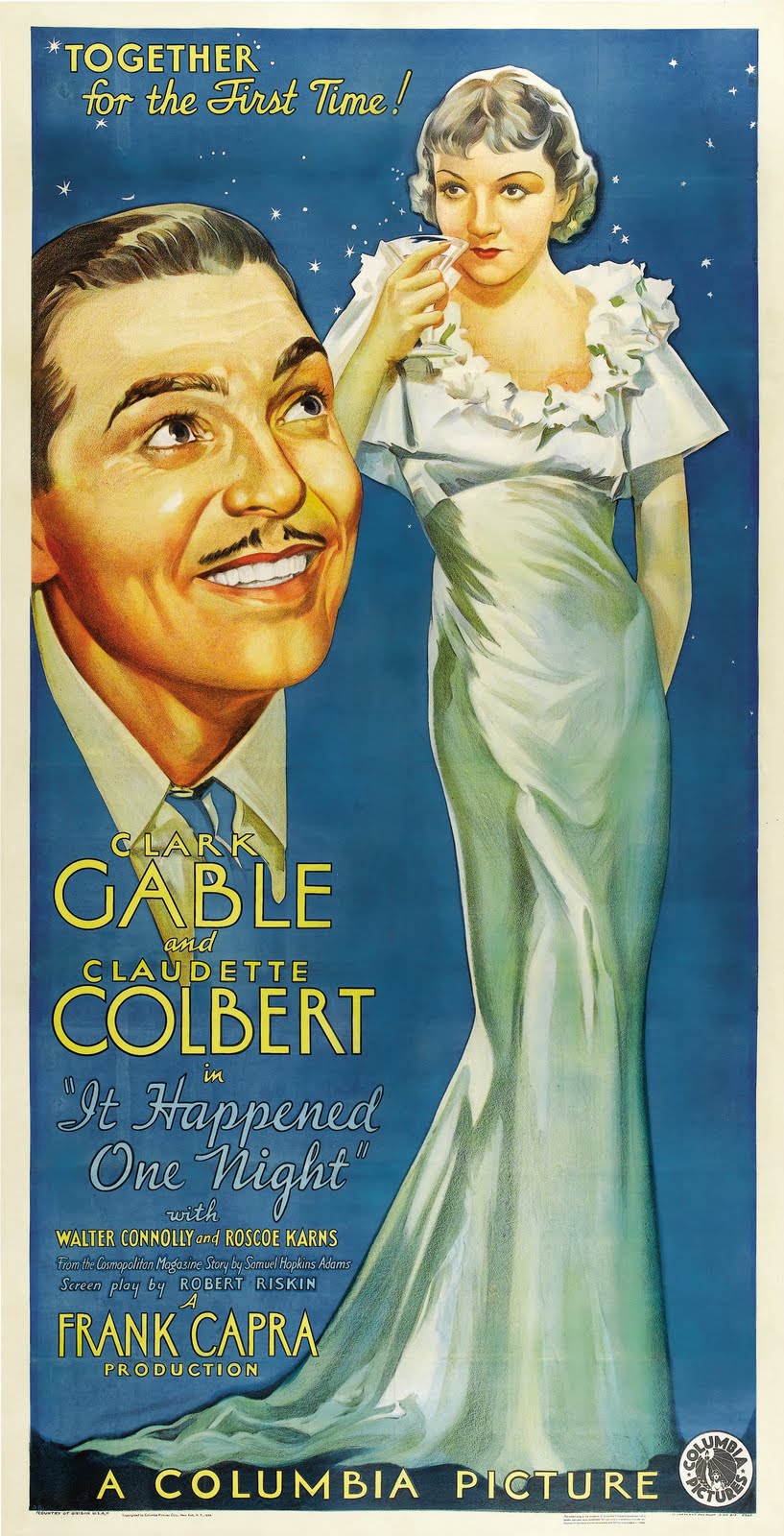
In 1933, Columbia Pictures was considered a "Poverty Row" studio in Hollywood, relegated to low budgets and B pictures. Not being able to afford a host of contract stars, Columbia would borrow from other studios when the need arose. So when director Frank Capra bought the rights for a magazine story called Night Bus, Columbia boss Harry Cohn tried to borrow MGM star Robert Montgomery for the male lead and change the name to It Happened One Night. Louis B. Mayer, head of MGM, refused (MGM turned down the rights to the Night Bus, having lost money on a "bus picture" called Fugitive Lovers, which, ironically, had starred Montgomery). Instead he offered the services of up and comer Clark Gable, as punishment to the rising star for demanding a higher salary. Mayer wanted to humble Gable by showing him the comparison of working at the lowly Columbia as opposed to the pristine Metro Goldwyn Mayer where there were "more stars than there are in Heaven".


Gable was not happy about the arrangement arriving on his first day drunk and angry. He also had doubts about his ability to play a light, comedic role, as he had spent his early years at MGM playing heavy handed thugs and he-men. Capra was also wary on this point. Gable would play Peter Warne, a hard boiled, down t0 earth newspaperman who meets runaway heiress Claudette Colbert. The story follows their misadventures and eventual romance on board a New York bound bus in Florida. After a shaky start with Capra, Gable read the script, relaxed and settled into the part, actually enjoying his time on the set.


It Happened One Night became a sleeper hit and one of the classic screwball comedies. The success of the film actually raised the status and financial viability of Columbia Pictures. When Oscar night rolled around in February 1935 all the headaches paid off. The film was not only a success with the public, it became the first in history to win all 5 major prized: Best Picture, Director, Screenplay, Actress (Colbert) and as Best Actor, Clark Gable.

LinkWithin

Related Posts with Thumbnails