Showing posts with label Clark Gable. Show all posts
Tuesday, February 12, 2013
No Man of Her Own (1932): Gable & Lombard, Love [NOT] at First Sight
The love story of screen stars Clark Gable and Carole Lombard is legendary. A physically beautiful couple, who fell in love and married at the peak of their careers, reigned as one of Hollywood's highest profile couples and eventually met with tragedy upon Lombard's death in a 1942 plane crash at the age of 33. No Man of Her Own, filmed and released in late 1932, is famous as the only film in which the appealing duo starred together. Yet the irony is that they weren't a couple at the time, nor did they want to be.
Getting the film onto the screen was a story in itself. The original script was based on a bestselling 1932 pulp novel, written by none other than RKO horror producer Val Lewton, when he was a struggling commercial hack. It was called No Bed of Her Own and bought by Paramount Pictures as a potential vehicle for studio newbie George Raft and its reigning diva Miriam Hopkins. With loose living and prostitution as some of the general themes in No Bed of Her Own, an adaption to film was problematic, even in pre-Code years, and Paramount decided to keep the title but go with a completely different story written by Edmund Goulding and Benjamin Glazer. By the time the proverbial dust settled the title was also found unpassable to the Will Hays office and it too was changed, albeit only slightly, to No Man of Her Own.
Who would have thought that fate would have chosen Marion Davies, film star wannabe and mistress of multi-gazillionaire William Randolph Hearst, to bring about the only screen pairing of Gable and Lombard (sources say they were extras in at least one picture during the 1920's). Davies was making a picture for MGM eventually called Going Hollywood and wanted the number one box office crooner at the time, Bing Crosby, as her co-star. Hearst persuaded studio boss Louis B. Mayer to make a trade with Paramount, where Crosby was under contract. For this illustrious switcheroo Mayer had to offer up big ticket star power and after 1932's Red Dust with Jean Harlow and Strange Interlude with Norma Shearer, Clark Gable was MGM's male star on the rise.
Meanwhile, back over at Paramount, Miriam Hopkins would have no part of the film if Gable received top billing (which was part of the deal) and Carole Lombard, a member of the studio's stable of up and coming stars was cast instead. Although he had been quite chummy with Crawford and Harlow back home at MGM, Gable was relatively indifferent to Lombard during filming and she reciprocated the feeling. She was still very much married to big man on campus William Powell and Gable to wealthy/older/less attractive Rhea Langham (not that that fact had hindered earlier indiscretions). When the film wrapped, Clark gave his blond co-star a pair of ballerina slippers with a note reading, "To a true primadonna." Carole, not to be outdone, presented him with a packaged ham with his photograph plastered on the front. It was all in good fun and caught on camera for everyone to see.
In this serio-comic pre-Code Gable plays Jerry "Babe" Stewart, a hot shot gambling cheat who can turn a card as well as a lady's head. When the law gets too close to his shenanigans, he lays low in podunk where he meets the local librarian, Connie Randall (Lombard). Connie has the small town blues and an itchin' to see what's out there. They get married on the flip of a coin and Connie goes back to the big city with her groom, unaware of his shady dealings (pardon the pun) and instead believing he works on Wall Street. Trouble steps in when the blonde bride discovers Babe's secret and tampers with his deck of cards. You know the old saying, lucky at cards unlucky in love. Well count it here in spades (pardon again).
Filmed in late 1932, more than a year before the Will Hays office would enforce tougher censorship restrictions, No Man of Her Own offered several opportunities for the risque in its dialogue. When his recent paramour clings to him like a vine on a tree, Gable's Babe responds, "Listen kid, that thing you've got on is pretty thin but I've got tough skin, see, and I don't feel it." Whew!
After filming was complete Gable went back to MGM and Lombard stayed on at Paramount for a while, her reputation as a gorgeous comedienne skyrocketing with each passing year. It wouldn't be until the mid to late 1930's until they began the affair that would eventually lead them to marriage and super couple status in Tinsel Town. As Clark Gable once said, "It is an extra dividend when you like the girl you've fallen in love with." No Man Of Her Own here.
Labels:
Carole Lombard,
Clark Gable,
MGM,
No Man Of Her Own,
Paramount,
Pre-Code
Friday, February 12, 2010
Red Dust (1932): Sex in the Tropics

Sex. It permeates almost every frame of the pre-Code classic Red Dust (1932), and why shouldn't it? It starred Clark Gable and Jean Harlow, both at their physical peak and professionally, well, this film shot them to superstardom. It was raw, it was wanton and, if audience attendance was any indicator, it was extremely entertaining. In the world of pre-Code Hollywood (the time before the Hollywood censors would banish any naughty behaviour onscreen), Red Dust fairly reeks of sex with nary a nude scene or onscreen intercourse. Who needed these things with Gable's virile masculinity and Harlow's open sensuality coming together with a charged electricity that crackles in front of the camera (and if rumour is correct, behind it as well).
Set on a rubber plantation in Indochina, Red Dust smells of rugged machismo, Gable and his cronies out in the middle of nowhere, cultivating raw rubber "so some old lady somewhere can take a hot water bottle to bed with her". Enter stage left, Harlow as Vantine, a fun loving harlot on the run from officials in Saigon, who shows plenty of leg, along with everything else. Just as she and Denny (Gable) are getting cosy, enter stage right, Gene Raymond (usually the partner to Ann Sothern in a series of lighthearted romps) and Mary Astor as Gary and Barbara "Babs" Willis, the plantation's new surveyor and his prim, proper and quite pulsating new wife. Gary is immediately stricken with malaria, giving Denny and Babs a chance to ignite a few sparks of their own. Vantine, not the kind of gal who takes a back seat quietly (not alone anyway), lashes out with wisecracks aplenty, making some of the snappiest dialogue this side of the Hays office.

Dialogue was one of the best ~and most brazen~ assets the film had going for it, second to its zesty stars. When Harlow's Vantine first encounters Gable's Denny and his male assistant, she playfully asks them, "What else do you do besides work? Do you play any games?". As her constant chatter irritates a grumpy Denny, he finally shouts, "Do you want me to slap you out of this room?", to which she retorts, "You and what man's army?", and of course this verbal sparring leads to eventual laughter and a seductive fade out. Harlow is ready for Gable. He manhandles her just the way she likes to be manhandled.
The film is not the typical fare produced by MGM at the time. The mega studio had no glamorous backdrop to present its stars and yet, it was immensely popular with the public. The film's director, Victor Fleming, was a "man's man" and a close friend to the macho Gable. Red Dust was the kind of film Fleming thrived on (he also directed Gable in 1939's Gone with the Wind). Gable's role as Denny was originally thought to be filled by silent film star John Gilbert, but studio politics and boss Louis B. Mayer nixed the idea and Gable came away famous.

The movie's tropical setting only adds to the heat already generated by its cast. As Barbara, Mary Astor is even more unwillingly libertine in her adulterous lust for Gable's Denny when one knows the background of the actress' torrid and infamous real life amours. The fireworks are in their scenes together as well. Early on when Astor slaps Gable hard for a verbal offense, he enjoys it, grinning that Gable grin from ear to ear. Then she can barely conceal her growing desire for him as she watches the strong, dark and commanding Denny hold her fair and weak husband, nursing him back to health from the fever. The comparison of the two is indeed notable to the tingly Astor. Then in the scene immediately following, Vantine happily and boldly watches Denny undress for bed, only to be told to go to her own, which she does in disappointment. These two ladies have it bad. The wise-cracking, off color dialogue continues when a disgruntled Harlow proclaims to the parrot, whose cage she is cleaning: "What you been eatin', cement?" The steamy shenanigans culminate in a carnal wrestling match between Denny and Vantine, which ends with our anti-hero being shot in the torso by a jealous Babs.
Jean Harlow was only 21 when Red Dust was released but her erotic, world wise persona is decades older. MGM slated their new cash cow couple into several popular money makers over the next five years. Harlow's last film before her untimely death in 1937 was Saratoga, again with Gable.
Labels:
Clark Gable,
Jean Harlow,
Mary Astor,
MGM,
Pre-Code,
Red Dust
Wednesday, June 10, 2009
Judy Garland: Before the Yellow Brick Road

Today, Frances Gumm, or Judy Garland as she is better known, would have been 87 years old. So much has been written about her life, films, songs, marriages, addictions and death. Volumes have been written about The Wizard of Oz (1939), her most famous film, alone. But the time in Garland's life just before she became a superstar, just before she hit the big time in Oz, is the one most fascinating to this blogger.
Garland joined the MGM family as contract player in 1935. Before that she was "Baby" Frances, the youngest member of a singing vaudeville act with her two sisters called The Gumm Sisters, which had been performing since the mid 1920's. After changing their name to The Garland Sisters (supposedly by famed comedian George Jessel) and Baby Frances to Judy (supposedly after a Hoagy Carmichael song), the group started to wind down by the mid 30's and Garland's mother, Ethel, a notorious stage parent, focused all of her attention on her youngest child, who was by far the most talented. After several auditions at various studios in Hollywood, Judy sang "Zing Went the Strings of My Heart" for MGM head Louis B. Mayer and was signed by that studio in September 1935, to a contract that paid her $100 per week. Her excitement was short lived when her father, Frank, died in November. Judy was heartbroken, having been closer to her father than anyone else. She and Frank would be separated for long periods of time when Ethel would take the singing trio on the road to tour.
Though a contract player at the biggest studio in town, MGM was at odds as to how best to fit the 13 year old into its stable of stars. She wasn't a child and she wasn't a woman. She wasn't even a child/woman like her peer Lana Turner, who would join the studio two years later. With nothing set for her at Metro, Judy made her feature film debut on loan-out to 20th Century-Fox for a football folly called Pigskin Parade (1936). When she returned to her home studio, she was scheduled to sing "You Made Me Love You" to Clark Gable for his 36th birthday party, given to him at the studio. A special version of the song had been reworked by Garland's MGM mentor, musical arranger Roger Edens, as "Dear Mr. Gable." The performance and song were such a hit, a segment was integrated into the film Broadway Melody of 1938 (1937) with Judy singing the song to a framed photograph of the heartthrob.
Next she was teamed for the first time with child actor Mickey Rooney, who would become her frequent co-star and lifelong friend. The film was Thoroughbreds Don't Cry (1937) and sparked a certain on screen chemistry between the two youngsters that would be expanded on by the studio for several years. They were first re-teamed the next year in Love Finds Andy Hardy, one of the best installments of the family oriented Andy Hardy series. As her popularity and work schedule grew, medication began being prescribed for all aspects of her life. Uppers to wake her up for long and laborious days on the set, downers to help her sleep at night and amphetamines to control her tendency for weight gain. Louis B. Mayer would call the poorly postured, chubby and awkward teenager, "my little hunchback." All this went on with the approval and full cooperation of Ethel who wasn't going to rock the boat (in later years, Garland would call her mother the "real Wicked Witch of the West"). It was the impetus to her lifelong dependence on drugs and alcohol.
Garland's on screen persona became the plain and dumpy girl next door, the heartsick teen whose crush on a boy could be mortifyingly painful. Not exactly star making qualities. But when she opened her mouth to sing, which she inevitably did in most all her films, that was when the screen came to life and what MGM wanted to cash in on with the right film project. The soul wrenching voice which emanated such vulnerability and pathos, would wow audiences every time and the electrifying talent that was Judy Garland was on it way.
In 1937, Metro had bought the film rights to The Wizard of Oz, a children's story by L. Frank Baum. As pre production began, the top studio brass was set on getting child star Shirley Temple to play the heroine Dorothy for the $2 million + production. Temple, who was under contract to rival 20th Century-Fox, had been the #1 box office star in 1935, 1936 and 1937. It would have been quite a coup for MGM to be able to borrow her, but Fox refused. It wasn't going to share the bounty of its top star. So Metro went with its plan B: Judy Garland. Much more mature physically than Temple (at pre production, Temple was 9, Garland 16), Judy's budding breasts were bound with tape, her hair pigtailed and her make up very minimal, in an attempt to make her younger looking for the role of the Kansas farm girl.
Though not an immediate financial success (it would be many years before the film would recoup its production costs), The Wizard of Oz was a classic and made Garland a star. The film's Academy Award winning song "Over the Rainbow" would forever be associated with the actress. With all the trials and tribulations she would face in her tumultuous life, Judy Garland continued to sing and along with her massive repertoire of songs, she would always be remembered as Dorothy.
Sunday, April 19, 2009
Clark Gable: The Punishment That Backfired

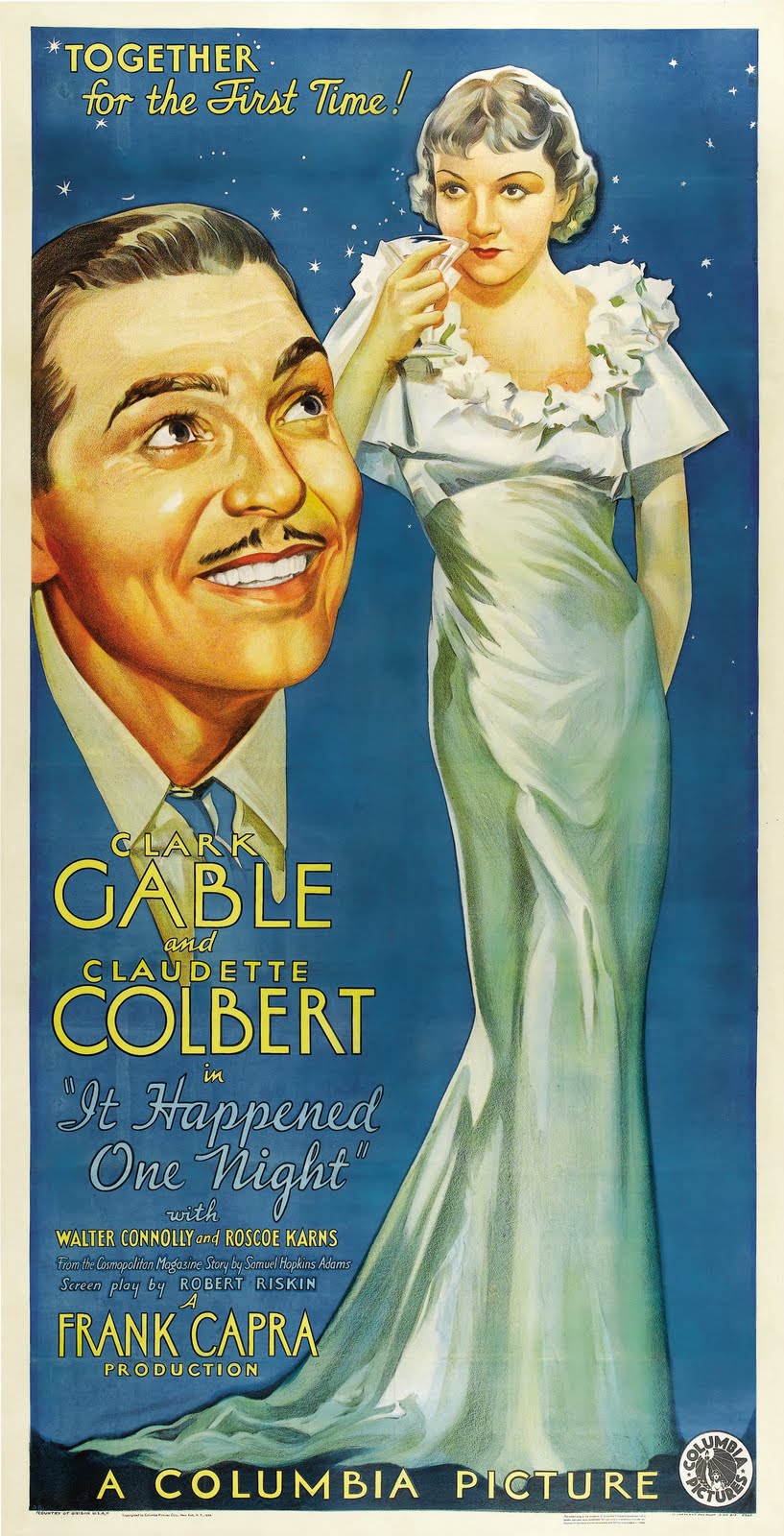
In 1933, Columbia Pictures was considered a "Poverty Row" studio in Hollywood, relegated to low budgets and B pictures. Not being able to afford a host of contract stars, Columbia would borrow from other studios when the need arose. So when director Frank Capra bought the rights for a magazine story called Night Bus, Columbia boss Harry Cohn tried to borrow MGM star Robert Montgomery for the male lead and change the name to It Happened One Night. Louis B. Mayer, head of MGM, refused (MGM turned down the rights to the Night Bus, having lost money on a "bus picture" called Fugitive Lovers, which, ironically, had starred Montgomery). Instead he offered the services of up and comer Clark Gable, as punishment to the rising star for demanding a higher salary. Mayer wanted to humble Gable by showing him the comparison of working at the lowly Columbia as opposed to the pristine Metro Goldwyn Mayer where there were "more stars than there are in Heaven".
Gable was not happy about the arrangement arriving on his first day drunk and angry. He also had doubts about his ability to play a light, comedic role, as he had spent his early years at MGM playing heavy handed thugs and he-men. Capra was also wary on this point. Gable would play Peter Warne, a hard boiled, down t0 earth newspaperman who meets runaway heiress Claudette Colbert. The story follows their misadventures and eventual romance on board a New York bound bus in Florida. After a shaky start with Capra, Gable read the script, relaxed and settled into the part, actually enjoying his time on the set.
It Happened One Night became a sleeper hit and one of the classic screwball comedies. The success of the film actually raised the status and financial viability of Columbia Pictures. When Oscar night rolled around in February 1935 all the headaches paid off. The film was not only a success with the public, it became the first in history to win all 5 major prized: Best Picture, Director, Screenplay, Actress (Colbert) and as Best Actor, Clark Gable.
Subscribe to:
Posts (Atom)