Showing posts with label All About Eve. Show all posts

Tuesday, June 30, 2009

A Letter to Three Wives: Is It Your Husband?


It started out as a Cosmopolitan magazine novel, A Letter to Five Wives, then as a studio film adaption, it was pared down to Four Wives. When production began in 1948, the final product from director Joseph L. Mankiewicz was a striking and highly sophisticated comedy-drama called A Letter to Three Wives (1949). From beginning to end, the dialogue sparkles. Mankiewicz won an Oscar for his witty script and his skilled direction and then he turned around and won the same two Oscars the very next year for his masterpiece, All About Eve.

The story is set in American suburbia circa 1948 ("just 28 minutes from the big city, 23 if you catch the morning express") and it revolves around three upper middle class wives (actually one is striving to be upper middle class). Just as they're boarding a boat, to act as chaperones of a day long children's charity picnic, they receive a letter (one letter addressed to all three) from their "friend", who is also the town flirt, saying she has run off with one of their husbands, but doesn't say which one. Caught between shock, disbelief and nagging suspicion, they board the boat and begin a journey that not only takes them up river but through the emotional status of their respective marriages. They reflect, via flashback, on the weaknesses in their unions and dwell on the fact that each of their husbands was friendly with the vampish letter writer, named Addie Ross, at some point in his life.

First up is Deborah Bishop (Jeanne Crain), who met her well-to-do husband Brad in the Navy. Born and raised on a farm, she thinks back to when she first married Brad (Jeffrey Lynn) and how socially inept she felt around his sophisticated friends, particularly ex-flame Addie. Next up is Rita Phipps (Ann Sothern), radio drama writer, who clashes with her idealistic, high school English teacher husband (Kirk Douglas) over household finances and their social standing. Lastly we meet Lora Mae Hollingsway (Linda Darnell), a gorgeous gold digger, who married the boss (Paul Douglas), owner of a chain of department stores bearing his name. Though she got what she wanted materially, the emotional walls built up by both she and her husband offer little hope for true love.

Though Miss Crain received top billing (and this blogger is personally crazy about her), her segment is by far the weakest of the three. Still engaging in the way it captures its characterizations through scintillating dialogue and great performances, the Crain segment doesn't have the spark that the other wives' slice of celluloid provide. Jeffrey Lynn as Brad Bishop is neither here nor there.

As Rita Phipps, Ann Sothern is as charming and fun to watch as ever. Her delectable voice and confident character can deliver a line of dialogue like a fast ball over home plate. While at a country club dinner dance, the three husbands are glowingly listing the many attributes of the absentee Addie when Rita pipes in, "also fog lights, white sidewalls and a heater?" Classic Sothern. Kirk Douglas, who plays husband George Phipps, was on the brink of stardom when cast in this role. Champion, released the same year as Wives, would put him there.

As screen time goes, Linda Darnell comes out on top, appearing in all three of the wives individual segments. Her Lora Mae shows a determined calculation in order to get everything she wants, including and especially marriage from her wealthy department store tycoon boss. In order to get the disdainful look he wanted out of Darnell, when she's looking at a framed portrait of Addie ( the front of which the audience can't see), Mankiewicz put a photo of director Otto Preminger in the frame during the scene. Preminger had given Darnell a tough time during the filming of Forever Amber(1947), which they made together, and their was no love lost on him by the beauty.

The supporting players in A Letter to Three Wives are just as good, if not better in some cases, as the stars. Thelma Ritter, in her first significant role, is hilarious as the Phipps' maid Sadie Duggan. Like Sothern, she really delivers the goods with Mankiewicz' great script and her strength in this role helped her land a plum part in Mankiewicz' Eve. Also in top form is Florence Bates as Rita's radio executive boss and Hobart Cavanaugh, her henpecked, milquetoast husband. The Phipps dinner party in front of the radio is hilarious, no one missing a beat. Much to Mankiewicz credit, he never actually shows Addie Ross throughout the film, we only hear her velveteen voice which is provided by actress Celeste Holm. Thus, Addie's air of mystery leaves it up to the audience interpretation of how she looks. The film put director Mankiewicz on the map in a big way and allowed him to go gung ho into All About Eve the following year with both creative barrels blazing.

Wednesday, May 27, 2009

George Sanders: A Scoundrel for All Seasons


Egomaniac. Heel. Rotter. Villain. Scoundrel. George Sanders has been called all of these and then some, and he took no offense. As a matter of fact, his autobiography is called Memoirs of a Professional Cad. Never was there a more decadent, delicious, deliberate bad egg in all filmdom than George Sanders. His voice, a deep, silky British accent, would carry lusciously to the ear, any number of cynacisms and indignities to any target he chose. Male, female, rich or poor, his verbal affronts knew no bounds. Oh but his verbal assaults were always carried out with style. His characters were always impeccably dressed, always slightly (and sometimes not so slightly) menacing, snobbish with a droll wit. These intrinsic elements of his persona were used to peak perfection in his portrayal of acid tongued critic Addison DeWitt in the film masterpiece All About Eve.

Sanders was born in Russia in 1906 to English parents. The family escaped to England in 1917 during the Russian Revolution. Entering the American cinema in the mid 1930's, Sanders didn't hit his stride until 1940 when Alfred Hitchcock cast him as the obnoxious and despicable Jack Favell in his classic Rebecca. Hitchcock used him again that same year in Foreign Correspondant. Then a string of Nazis and other nasty nellies followed including an unrecognizable turn as a red headed pirate (?) in the Tyrone Power swashbuckler The Black Swan (1942). Eventually Sanders began to find his groove, as an incomparable heel in Summer Storm (1944), The Picture of Dorian Gray (1945) and The Fan (1949). He was also an incorrigible King Charles II in the historical bed hopper Forever Amber (1947).

Then in 1950 came his pinnacle role, the one for which he is most closely identified, Addison DeWitt. For his performance as the theater critic with the poison pen, Sanders won an Academy Award as Best Supporting Actor. Among so many grand personalities and egos, he more than held his own, introducing Marilyn Monroe's buxom sexpot character, Miss Caswell, as "a graduate of the Copacabana School of Dramatic Art." Classic Sanders.

Of course there were his many marriages, including one to super celeb Zsa Zsa Gabor and later to Gabor's sister, Magda, but all ended in divorce. As Sanders aged, he went into decline. Plagued with health problems and fits of rage, he became weary of life itself. Finally in April 1972, he was found dead in a hotel room in Barcelona, Spain. Also found, five empty bottles of Nembutal and an infamous suicide note, which read: "Dear World, I am leaving because I am bored. I feel I have lived long enough. I am leaving you with your worries in this sweet cesspool. Good luck." The urbane cynic who sneered in the face of convention remained unrepentant to the very end.

Thursday, April 30, 2009

All About Eve: Colbert, Reagan and Jeanne Crain?

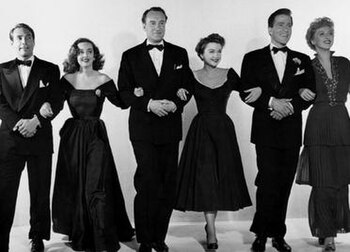
All About Eve is an essay by intelligent film people in Hollywood about intelligent theater people on Broadway. That as raw material alone has the potential for a film that will at the very least keep you awake in the theater. But when you add elements like a biting, razor sharp script, pitch perfect direction and an impeccably talented cast, you've got a film that not only keeps you out of slumber land, but picks you up by the collar and gives you a heavyweight championship once over. And that's what All About Eve does.

In 1950, director Joseph L. Mankiewicz was riding a wave of acclaim after his double Oscar coup (Direction and Screenplay) the previous year for A Letter to Three Wives. After Wives, Mankiewicz had the idea for a story about an aging actress and when he read a Cosmopolitan magazine piece called "The Wisdom of Eve" he knew he'd found his inspiration. Then under contract at Twentieth Century Fox, Mankiewicz contacted studio boss Darryl Zanuck about the idea and Zanuck assigned him to the picture for both script and direction. Originally a vehicle for Fox star Susan Hayward, it was determined she was too young for the role of forty-ish Margo Channing, grande dame of the New York stage. After batting about the names of Barbara Stanwyck and Marlene Dietrich, veteran actress Claudette Colbert was signed to play the part.

Fox resident girl next door, Jeanne Crain had also given an Oscar nominated performance the previous year in the racial themed drama Pinky. Zanuck wanted the key role of Eve to go to Crain, one of the studio's top stars at the time. But Mankiewicz, who had directed the actress in A Letter to Three Wives, didn't think she had the chops to play the cold hearted, conniving Eve. He wanted Anne Baxter, who had won a Best Supported Actress Oscar as the tragic Sophie in 1946's The Razor's Edge. Besides feeling she could handle the part, he noted a distinct resemblance to Claudette Colbert, accentuating the characters desire to be like her mentor. Nature resolved the issue when Jeanne Crain discovered she was pregnant and Baxter was cast in the part.


Meanwhile Claudette Colbert injured her back on the set of Three Came Home, another film she was starring in and had to withdraw from the role of Margo. Now Mankiewicz and Zanuck were in a quandary. Mankiewicz' script was written with Colbert in mind. Then he thought of Bette Davis. Davis was in a career slump. Her nineteen year career at Warner Brothers had just ended with the tepid Beyond the Forest ("What a dump"?), She was past forty in Hollywood and her prospects weren't promising. Mankiewicz thought she would bring worldly wisdom tempered with vulnerability to the character of Margo. Davis read the script and jumped at the chance.

Filling in the rest of the cast were George Sanders (magnificent as rogue critic Addison deWitt), Thelma Ritter, Hugh Marlowe and as Bill Sampson and Karen Richards, Gary Merrill and Celeste Holm (one pre production casting suggestion was Ronald Reagan as Sampson and his soon-to-be wife Nancy Davis as Karen). All About Eve was Mankiewicz piece de resistance, earning him Oscars for Direction and Screenplay for the second consecutive year. All told, Eve won six Academy Awards and was nominated for fourteen, an achievement not matched until 1997's Titanic.

LinkWithin

Related Posts with Thumbnails