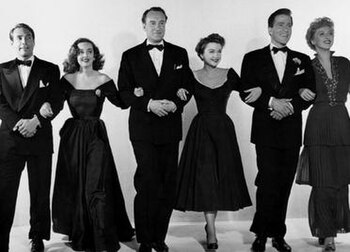
Showing posts with label Bette Davis. Show all posts

Sunday, March 16, 2014

That Certain Woman (1937): Bette is “Fonda” Henry


That Certain Woman
 is a quintessential 1930’s Warner Brothers soap opera. It is a definitive example of what was called in the day, a “woman’s picture.” Finally, it is a “Bette Davis” movie in the early stage of her career. Bette was just on the cusp of real stardom when this movie was made in 1937. She already had a couple of real dramatic winners under her belt with Of Human Bondage (1934) and The Petrified Forest (1936) and an actual winner with Dangerous (1935), for which she gained her first Academy Award. With this film and Marked Woman, made the same year, Davis was rapidly rising the ranks in Hollywood.

 Mary Donnell is the widow of a notorious gangster who was killed in the famed St. Valentine’s Day Massacre. She married her hoodlum at a very young age and when the picture begins, has avoided the press for years in an attempt to have a normal life. She finds some solace as the secretary of a very successful attorney, Lloyd Rogers (the always dependable Ian Hunter). The married Rogers has it bad for the dependable, soft-spoken Mary but she falls for the wealthy, young Jack Merrick (Henry Fonda).


When she and Jack marry, his snotty, upper-crust father (also always dependable Donald Crisp) follows them on their honeymoon and demands the marriage be annulled. While the two men thrash it out, Mary leaves, hoping Jack will follow. He does not, and when she has his son, she keeps the secret of who its father is, as not to hold Jack by that connection. Jack marries a pretty socialite named Flip (lovely Anita Louise) but a car accident leaves her wheel-chair bound. When it is discovered that little Jack is his father’s namesake, wealthy control-freak, Grandpa Merrick tries to take the child from Mary. It’s a big mess with lawyer Lloyd playing a big part as well.

That Certain Woman
has the flavor of Stella Dallas, Madame X and other “mother love” soapers of the era. Some might call it schmaltzy or melodramatic and it is, but in the best possible way. Don’t get me wrong. Key points in the story don’t make realistic sense or aren’t explained as to why they are there. For instance, the character of Amy (played by Mary Philips) is conveniently interjected into the story, I assume, as a sounding board for Davis’ thoughts and as nanny/babysitter for little Jack while Bette is out wringing her hands and sacrificing all she has in the most noble way. When times are lean, in the earlier part of the movie, how does she support herself? How does Bette’s Mary support them both? It is like Imitation of Life without the racial theme. Still, Amy’s presence is pleasant and almost essential for Mary’s mental and emotional well-being.

 Another point: WHY Mary and Flip would want Fonda’s Jack Merrick. Spineless he was against his father, against his loving crippled wife. Oh, he attempted a crack at a spine but half-heartedly and when the slightest wind of aggression came up, POOF!, gone spine. Yet, both these women, whom he had emotionally wronged, want his happiness at all cost. Thirties Hollywood tearjerker… go figure.

That Certain Woman
has all the elements to make it a great rainy day picture, real couch-potato and hot coffee material. Music by Max Steiner, direction by Edmund Goulding (who would also direct Davis in other Warners weepies, including The Old Maid), dress design by Orry-Kelly and a supporting cast of WB regulars. Though both Davis and Fonda weren’t quite at that superstar stage yet, it would only be a matter of months, when both re-teamed for the ante-bellum Southern sashay called Jezebel.

Wednesday, November 10, 2010

Claude Rains: A Man for All Seasons


London born and stage trained, Claude Rains was an exceptional actor equally adept at whimsical roles as he was in heavy drama. He made his mark in his very first Hollywood film, The Invisible Man (1933), his unmistakable voice doing most of the work. He signed on with Warner Brothers studio where his performances graced many of Hollywood’s greatest and best known classics. Warners cast him with its biggest stars at the peak of their careers and in many of their definitive films; The Adventures of Robin Hood (1938) with Errol Flynn, Now, Voyager (1942) with Bette Davis and Casablanca (1943) with Humphrey Bogart.

Although rarely the lead, his characters were pivotal and always unforgettable. As Prince John in Flynn’s Robin Hood, he created one of the screen’s great villains. Wearing a heavily banged page boy bob, Rains preening prince planned and plotted only to be foiled in the end by the Prince of Thieves. Along with his role as the wise and knowing Dr. Jackwith in Now, Voyager, he also starred with Davis in Mr. Skeffington (1944) and Deception (1946). The two actors complemented one another perfectly and Rains was one of the actress’ favorite co-stars. The grande dame of the Warners’ lot even went as far to say he was “He was a pip! The best!”


The actor gave a powerful performance as a corrupt senator opposite James Stewart in Frank Capra’s Mr. Smith Goes to Washington (1939) and yet another as a sinister Fascist leader in Alfred Hitchcock’s Notorious (1946), although it’s debatable whether he or his characters mother is more evil in the latter.

He continued working into the 1960’s and also continued his stage work, winning a Tony Award in 1951. Well respected by his peers, Rains was nominated for the Academy Award four times, though never winning the coveted prize.

Sunday, June 20, 2010

Bette vs. Miriam, Bout of the Divas: Meow


About a year ago, I wrote a short piece on the legendary feud of two legendary Hollywood actresses, Bette Davis and Miriam Hopkins. Since then, I have expanded this forum and also, delved deeper into the abyss that was the Davis/Hopkins relationship. Bette was infamous for her battles with certain co-stars, male (paging Mr. Flynn! Mr. Errol Flynn!) as well as female (calling Joan Crawford!), but they seemed to pale in comparison to her feeling for Miriam Hopkins. Their’s was a deep seeded, long standing rivalry, which began even before either woman made a single movie.

Round 1
In 1928 both young actresses were in a stage production on the east coast called Excess Baggage. Both were part of a repertory acting company headed by director George Cukor, although at this point, unlike their future film pairings, Miriam, not Bette, was the big cheese. Hopkins also made leading lady status in Hollywood long before Davis, with star turns in Dr. Jekyll and Mr. Hyde (1931) and Design for Living (1933), among other notable films of the early 30’s.


Round 2
In 1933, Hopkins starred in Jezebel on Broadway. It was the story of a tempestuous Southern belle (a part tailor made for the real life Southern spitfire) in the era before the Civil War, ala Scarlett O’Hara. The play was unsuccessful, running only a few dozen performances and closing after a month. Not only did Miriam star in the play, but she was part owner of the rights to it. When Warner Brothers studio showed interest in the story as a vehicle for its rising star, none other than Miss Bette Davis, Hopkins balked, refusing to sell the rights unless the deal included her in the lead role of Julie, which she had originated. In order to obtain the rights, she was given the impression that she would be cast, so when top brass gave the plum part to Davis, Miriam was livid. To add insult to injury, Bette won her second Oscar for her performance in Jezebel. The story goes that Miriam cried.

Round 3
In late 1938, with her career in somewhat limbo, Hopkins signed a two picture deal with Warner Brothers. The first film under her new contract was the historical melodrama The Old Maid (1939), based on an Edith Wharton story. In the film, she played second lead to guess who….Bette Davis, Warners reigning queen supreme. But neither actress was a shrinking violet and there was tension aplenty on the set, with director Edmund Goulding at the helm. A studio memo summed up the stressful situation when it relayed, “…Goulding has a tough job on this picture with these two girls. Not that they want to cause him any trouble or worry, but each one is fighting for a scene when they go into it…”

Davis had fought hard with the studio to get where she was professionally, and she wasn’t about to take guff from her rival. But Miriam certainly tried to get a rise out of her at any opportunity. On her first day on the set, Hopkins wore an exact duplicate of the dress Davis had worn in Jezebel. Davis reflected on this time with Hopkins in her autobiography with the following observations: “Miriam used and, I must give her credit, knew every trick in the book. I became fascinated watching them appear one by one…When she was supposed to be listening to me, her eyes would wander off into some other world in which she was the sweetest of them all. Her restless little spirit was impatiently awaiting her next line, her golden curls quivering with expectancy."


Warner Brothers publicity department took full advantage of the dueling divas and played up their feud to boost ticket sales for the upcoming film. They even went as far as to circulate a photo of the actresses in full costume with boxing gloves on, ready to duke it out, with director Goulding looking resigned between them. (above)

Round 4
During the making of The Old Maid, Hopkins was married to director Anatole Litvak. Litvak had directed Bette Davis in her follow up film to Jezebel called The Sisters (1938), and Miriam suspected the two were having an affair, but Davis was too taken with her Jezebel director, William Wyler, at the time to look at Litvak. However, reportedly Litvak and Davis DID have a short affair during the filming of All This and Heaven Too in 1940, but by that time the director and Hopkins had already divorced.

The Old Maid was excellent box office, and Warners signed Miriam on for another spin with her nemesis in 1943 to make Old Acquaintance, the story of two childhood friends/rivals who spar incessantly over men, career, and a child. The romantic yarn was perfect for the pair, but wasn’t without its backstage fireworks. Edmund Goulding was again slated to direct but had a heart attack shortly into the production. Knowing the emotional state of the set and the stress Goulding had been under with the two high maintenance queens, studio head Jack Warner jokingly accused him of having the heart attack on purpose. At 40, the dew was off the lily for Miriam, and when production wrapped on Old Acquaintance, she sold her house in California, packed her bags and went back east to the stage. When she returned to Hollywood, it would be in character roles over half a decade later.

Thursday, April 8, 2010

In This Our Life (1942): She's Got Bette Davis Eyes


Nobody could chew up some scenery like Bette Davis. Sure, she occasionally played it low key (check out All This and Heaven Too or The Great Lie, where she was virtually obliterated onscreen by the wonderfully raving Mary Astor!), but when it came to hamming it up to full dramatic effect, none of her pre- Baby Jane performances can touch her turn as Stanley Timberlake in In This Our Life (1942). Those infamous eyes, bulging their fullest, voice when soft, at it’s silkiest (especially while using her “southern” accent), voice when upset at it’s shrillest. But all this being said, In This Our Life is a hoot to watch and never disappoints for a melodramatic funfest.

The film is based on a Pulitzer Prize winning 1941 novel by Ellen Glasgow, and it is cast full tilt with some of Warner Brothers top players. Davis plays Stanley Timberlake, Olivia deHavilland, her sister Roy. It’s one of the oddest naming of characters, which puzzles most viewers, and is never explained or addressed in the film. However, names aside, Stanley is a spoiled, loose living mantrap in Richmond, Virginia, who steals Roy’s husband, Peter (Dennis Morgan), and dumps her attorney fiancee, Craig (George Brent). When Stanley and Peter run away and get married (after the final divorce decree of his union with Roy comes through of course), Peter finds that living with this self centered, fun seeking harridan is no slice of Heaven. When he can take the stress of living with her no more, he commits suicide, sending Stanley ~ never one to be very self sufficient ~ back to Richmond and the family home. Meanwhile, Roy and Craig have developed a special if not slow-moving romance of sorts, and you can only imagine how me-me-me Stanley reacts to this current turn of events.


The film also weaves African-Americans into the mix in a dramatic and respectable way, in contrast to so many films of the day, which go to the opposite extreme of stereotype. Black actor Ernest Anderson plays Parry, a young man who wants to become an attorney and is encouraged and mentored by deHavilland’s Roy. A less noble and downright strange angle on the film, presents Stanley and Roy’s wealthy uncle, William Fitzroy (Charles Coburn) as a greedy, conniving old man, who has an obviously incestuous attraction to Stanley, and equally as twisted is Stanley’s apparent realization of this fact and flirting with him to take full material advantage of it! She is a piece of work.

Davis reportedly wanted to play the role of Roy. When cast instead in the meatier part, newbie director John Huston, let her have her way in playing it. Huston had made only one picture prior to In This Our Life ~ The Maltese Falcon . DeHavilland plays Roy in an understated, dignified performance, which makes Bette’s histrionics stand out all the more (it’s as if Olivia is standing back to let Davis make a ninny of herself). Another strike against poor Bette….has anyone ever said “poor Bette”?….was the fact that preview audiences noted a distinct dislike for her uncharacteristic beestung lips and her hairstyle, which included oddly cut bangs. The actress herself never cared much for the movie and moved on from it later the same year to create one of her signature roles, as “Aunt” Charlotte Vale in Now, Voyager.


Dennis Morgan plays a darker role as Peter than his usual devil may care good guy on the Warner lot, but George Brent as Craig is George Brent through and through. Solid, stable and non threatening to his female counterparts. The terrific cast includes Billie Burke, also in an uncharacteristic role. As Lavinia Timberlake, the tempestuous Stanley’s mother, Burke frets and worries through the whole film in a dowdy shawl, almost in a shrewish way, a far cry from the featherbrained society ladies she is so accustomed to playing. Hattie McDaniel as the Timberlake’s maid and Parry’s mother, Minerva, gives pathos and dignity to her part and in a showy portrayal, Lee Patrick is fun as Stanley’s gaudy and obnoxious friend Betty. The whole thing is gaudy and obnoxious in a 1940’s Warner Brothers melodrama kind of way, but that’s what makes it so fun. Perhaps Davis’ 1962 film should have been called “Whatever Happened to Stanley and Roy?”

Friday, January 15, 2010

Three on a Match (1932): Everything a Pre-Code Should Be


Before Hollywood decided to censor itself in the mid 1930's with the Production code out of the Will Hayes office, vice ran rampant on the silver screen. Sex, violence, drugs, alcohol (even during Prohibition in the early 30's and before); all things tawdry and unseemly were displayed for the world to gawk at and enjoy with their popcorn. Of all studios, nobody showed the seedier side of pre-code films better than Warner Brothers. Paramount and MGM may have made sex and the post Jazz Age sparkle but Warners threw in grit and grime, and one of the best examples of their pre-code sizzle was Three on a Match (1932). The intriguing title is attributed to the notion during World War I that a single match lit long enough to light three soldiers' cigarettes could cause attack from enemy gunfire and the last to light up would be killed. However, it was later claimed that a match company started the superstition to increase its sales.

The three on a match are Joan Blondell, Ann Dvorak and Bette Davis, who play school girl acquaintances who meet up in adulthood having gone down very different paths. Mary (Blondell) was the girl who cut class to smoke with boys, went to reform school and is now a feisty showgirl (what else for the feisty Blondell). Vivien (Dvorak) was a stuck up priss who ended up in a swank boarding school and is now married to a wealthy attorney, Robert Kirkwood (Warren William). Lastly is Ruth (Davis), the studious one of the three who completes business college and is a career girl. There's alot of Valley of the Dolls in this story. The focus of the film remains on Vivien, a bored and spoiled wife of a rich man. When she rebuffs his amorous advances, he suggests she take a trip by herself (WHAT?). Instead she takes their young son Junior along and the two proceed on a European cruise. En route Vivien begins an affair with a slick and virile gambler, to whom she was introduced by school chum Mary. Viv leaves the ship with the thug, Junior in tow, at a European port. Frantic, Robert searches high and low for his family with no success until Mary gives him the information he needs to find them.


Third billed is 24 year-old Bette Davis, but don't be fooled, this is not a BD movie. Her diminutive role doesn't even rate the billing she receives. It's not her fault mind you, she does what she can with the weak material her character is given. Any accolades for acting must go to Ann Dvorak and Joan Blondell. Dvorak is rather lackluster in the first half of the film, as the spoiled, wandering wife of wealthy William, but as she descends into a pit of carnality and eventually drug addiction, she is splendid to watch. When she has hit rock bottom, with her illicit lothario, she is shown in the dingiest of flats, repeatedly wiping her cocaine addicted nose. Warren William plays the urbane, smooth character he did so well in films of the period. Forgotten by many today, both he and Dvorak offered interesting and dynamic characterizations in many pre and post code films.

In a small but forceful part is Humphrey Bogart. As one of the dozens of sinister hoodlums he portrayed before finally achieving stardom, Bogie doesn't disappoint. He leers and sneers and is just nasty through and through. Great stuff. Also in an early "heavy" role (pardon the pun) is the terrific Edward Arnold. Directed by the talented Mervyn LeRoy (I Am a Fugitive From a Chain Gang, The Wizard of Oz), one of the films greatest assets is its quick pacing and compactness. With a total running time of only 63 minutes, its short even for a picture of its period. But so much is packed into the 63 minutes that there is not time for a dull moment. Like other dramas of the pre-code era, the message is short but sweet ~ at least figuratively. A story could be told by cutting to the chase. The film's climax is powerful and chilling, a tour de force by Dvorak. There is nothing watered down here. No, I'm not going to spoil it for you , its something you must see for yourself.

Thursday, December 24, 2009

MERRY CHRISTMAS!

For all the readers of Classic Movies Digest and classic film fans everywhere, here are a few reminders of the magic and glamour of Christmas past with a few of filmdoms most magical and glamorous stars. Merry Christmas to you all.


A peek at Betty Grable's fabulously famous gams as she spreads Yuletide cheer


Judy Garland and choir at MGM getting in the Christmas spirt in 1937


Who knew Bette Davis could be so colorfully festive at the holidays?


Beautiful Paulette Goddard by her tree....say, where's the mistletoe?


Tuesday, June 16, 2009

13 Classic Movies I've Never Seen...But Really Want To

Through the years when discussing classic movies with friends and fellow film lovers, inevitably I've been asked numerous times who and what my favorites actors, actresses and films are. I have had discussions on what my favorite Hitchcock films are, my favorite Bette Davis movies and so on. Then the other day I was chatting with an online friend and we started discussing the films we had always wanted to see but hadn't, either by lack of opportunity or as is often in my case, just let the opportunity slip by. So I thought I would share 13 such films. These are by no means the only movies that meet this criteria for me or even necessarily the ones I want to see the most, but it is a good overall example. When perusing this lineup one may ask "Why in the world is THAT on here?". We are all different, with our own likes and dislikes and our own special reasoning for those preferences. Some of the films listed are very famous, most are not.


(NOTE: These are listed neither alphabetically, chronologically nor in order of importance)


They Won't Forget (1937) Claude Rains, a red hot murder/rape trial in the deep South and Lana Turner in a tight sweater. Tell me that's not a combination for a swell sounding film.

Trade Winds (1938) Joan Bennett is one of my favorite actresses (hence her appearance more than once on this list) and this film changed the course of her career with a simple hair color change. Plus it sounds cute and has the irresistible Ann Sothern.

Citizen Kane (1941) I know what you're thinking, "A fellow writes about classic movies and he's never seen one of the MOST classic!." What can I say, I was never a huge Orson Welles fan, but I've heard so much about it, I'm intrigued.

Meet John Doe (1941) Two of my favorite stars, Gary Cooper and Barbara Stanwyck at their peak with Frank Capra along for direction.

Forbidden (1932) Pre-Code Stanwyck directed by Capra and a really attention catching title.

Hotel for Women (1939) So elusive I've never even seen evidence of a television screening. This was Linda Darnell's film debut. Though no award winning classic, it sounds like fun with two long time favorites Ann Sothern and Lynn Bari in tow.

The Sign of the Cross (1932) Cecil B. DeMille directing a Pre-Code epic set in decadent, ancient Rome in which Claudette Colbert bathes in a giant pool of asses milk (no joke!).

House Across the Bay (1940) Joan Bennett again, this time in a drama with George Raft, whose usually very watchable.

Hound of the Baskervilles (1939) Classic film version of a classic tale. Basil Rathbone's first offering as the famous British sleuth, Sherlock Holmes. Lead to the long running movie series.

All Through the Night (1942) I like early 40's Bogart, but somehow missed this one. Also, my aunt, a big Bogie fan, had this poster in her home when I was a little tot. Good memories.

Hands Across the Table (1935) 1930's screwball comedy with Carole Lombard and Fred MacMurray. Sounds great to me.

Trail of the Lonesome Pine (1936) Another Fred MacMurray flick that from what I understand, is similar in atmosphere to Shepherd of the Hills, one of my favorite movies. Henry Hathaway directed both. I also feel that MacMurray was a much underrated actor.

Mandalay (1934) I like a good Kay Francis flick, though I haven't seen that many of them. From what I've been told, this is a perfect example of Kay at her pinnacle.


Some of these films are from Paramount Studios before 1948 and the MCA company bought this library with little distribution in recent years, therefore my lack of viewing opportunities. But others have been televised often or have been released on VHS and DVD for years now and I, alas, have just not taken the opportunity to fit them in to a busy and tight film viewing schedule. Whether you like the films on this log or in some cases don't, I hope you find it of some interest.

Friday, June 12, 2009

Review: The Great Lie

Whenever I want to watch a great old movie but don't have any specific one in mind or can't really decide which one would suit my mood, I can always count on The Great Lie (1941). It has it all. Actually, I take that back. It doesn't have murder, blood, slapstick comedy, interracial love, or even adultery (there's an argument for fornication but the participants were unknowing! You'll understand in a minute). What it does have is classic film soap. A love triangle of the most complicated order. A good girl, a bad girl, a sap in between. A great Max Steiner score. But most of all, it has Bette Davis and Mary Astor.
Opening scene, Madame Sandra Kovak's swank but disheveled New York City apartment. Disheveled due to mass merry-making in honor of its occupant's recent marriage to one Peter Van Allen, bon vivant, aviator and general man-about-town. Miss Kovack is a world renowned concert pianist and an uber diva. The monkey wrench in the works is the fact that due to a mix up in dates (and plenty of liquor), Kovak's divorce from her first husband wasn't yet final when she wed the dashing Van Allen. It doesn't help matters that the couple was completely toasted when the nuptials occurred. Enter Van Allen's previous fiancee, Maggie Patterson, whose ultimatum to her man, that he lay off the bottle or else, fell on deaf ears and caused their split. But a wiser, more sober Peter decides he wants a settled life with Maggie over the jet set lifestyle lived by Sandra, and her sort. Sounds all neat and tidy and leaves one saying "Is that all?" But that's far from all.

After our boy Pete and soft spoken Maggie tie the knot, Sandra, who still wants Pete, declares to Maggie that she has Pete's bun in the oven. Before she is able to spill the beans to the babe's father, he is called away on a government aviation mission and inevitably in a plane crash somewhere in South America (hey, you didn't expect it to be as cut and dry as "I'm pregnant, make your choice" did you, after all this is a Bette Davie picture). Maggie confronts Sandra with the question of whether or not she had been lying about the child. When the distraught grande dame, who only wanted the child as a way of holding on to Pete, confesses that she is indeed with child, Maggie hatches a scheme, where she would keep and raise the child as hers and relieve Sandra of the burden. No need to go further here. If that's not enough to whet your appetite, you're not interested in the first place.

Now if you've never seen The Great Lie and don't know anything about it, after reading the above passage you may strongly assume that the part of Madame Diva Sandra Kovak would be played by Madame Diva Bette Davis. But you would be way off base my friend because Sandra is stunningly brought to life by Mary Astor, who won a Best Supporting Actress Oscar for all her efforts. The first indication that the fun is about to begin is in our first few minutes with Astor's Kovak, when, as a male masseuse is rubbing the musicians ailing shoulder, she, with full force, slaps his face and yells "You hurt! Get out!" Yet her portrayal of the ultra bitch seems completely effortless to Miss Astor. Davis on the other hand is the more calm, even tempered Maggie, a striking contrast to Astor's vinegar and venom viper, but don't be fooled. The screen fairly crackles when she and Astor share it. Even if there were no great dialogue between these two, which there most definitely is ("Run along and catch your little train Maggie"), the characters can read, as can the audience, on one anothers face and mannerisms, everything that needs to be said, and some that needn't.

Always in the wings for this sort of role is George Brent as the much fought over Pete. Also on tap are Hattie McDaniel, Grant Withers and Lucille Watson for support. Max Steiner's fine score integrates a lush musical backdrop with the piano based background of Astor's character, giving the whole thing the grandiose high drama required to match the electrically charged performances of the two leads. As guilty pleasures go, The Great Lie is the real deal. If you've seen it before, go ahead and pop it in the player for another go around, you know you want to, and if you've never seen it, you're in for a real treat.

Saturday, May 16, 2009

Review: The Little Foxes

"Take us the foxes, the little foxes, that spoil the vines: for our vines have tender grapes". Song of Solomon, Chapter 2, verse 15. It was this biblical reference which acted as the on-screen prelude and general theme to one of the richest characterizations of avarice put to film. The Little Foxes tells the story of a prosperous family in the Deep South during the turn of the 20th Century, whose overwhelming greed and corruption, corrodes their already deteriorating clan.


The film was directed by legendary William Wyler, produced by legendary Samuel Goldwyn and starred legendary Bette Davis, who gives a masterful performance. But that being said, it's not necessarily a Bette Davis movie as say Dark Victory (1939) or Now, Voyager (1942) were. It's part Bette Davis movie, part William Wyler movie and part Samuel Goldwyn movie, all tied together with a screenplay by Lillian Hellman, authoress of the original play. Each of these creative powerhouses contributing his or her own expertise to conceive a film classic.

Hellman had brought her play to Broadway in 1939, starring the infamous stage actress Tallulah Bankhead in the juicy role of vicious Regina Giddens. The films director, William Wyler immediately wanted to cast Bette Davis as Regina. The two had worked together on two previous films, Jezabel (1938) and The Letter (1940), as well as allegedly having a torrid affair. Warner Brothers, Davis' home studio, never loaned their biggest star out to anybody. However, Jack Warner arranged to have her loaned out this one time as a trade for Gary Cooper, who he wanted to star in Warner's upcoming biopic Sergeant York (1941). It was the only time between 1934 and 1949, when her contract ended at Warners that the studio loaned her services out.

Davis, famous for tour de force, eye-popping, shoulder jerking performances, underplayed the role to great effect. Her Regina is cold and calculating as she and her equally greedy brothers (Charles Dingle and Carl Benton Reid) try to manipulate her gravely ill husband (Herbert Marshall) into investing money in a cotton mill venture that could make them all wealthy beyond their wildest dreams. She is a vision of controlled, steely determination, in the fine period dress and rice powder makeup provided for her by famed make-up artist Perc Westmore.

The film is visually sumptuous. Producer Samuel Goldwyn, well known for his use of high production values in his films, displayed these abundantly with lush interiors. Through architectural nuances, like bold archways and rich decor of dark wood and exquisitely upholstered furnishings, the old south aristocracy is brought vividly to life. As it does in many examples of director Wyler's work, the use of sweeping staircases creates a dramatic stage on which his actors perform, as well as a visual focal point, with much of the action taking place on or around the grand corridor. Master cameraman Gregg Toland uses deep focus photography to capture a sharp and realistic image, enhancing the intensity of the unfolding drama.

Besides Davis, the ensemble cast showcases some superb performances from Dan Duryea as Regina's lazy, imbecilic nephew Leo, Patricia Collinge as the pathetic, drunken Birdie and Teresa Wright, who, in her film debut, gives an Oscar nominated portrayal of Regina's naive but maturing daughter Zan. In all The Little Foxes received 9 Academy Award nominations, including Best Picture, Best Actress for Davis and Best Supporting Actress for both Wright and Collinge.

Thursday, April 30, 2009

All About Eve: Colbert, Reagan and Jeanne Crain?

All About Eve is an essay by intelligent film people in Hollywood about intelligent theater people on Broadway. That as raw material alone has the potential for a film that will at the very least keep you awake in the theater. But when you add elements like a biting, razor sharp script, pitch perfect direction and an impeccably talented cast, you've got a film that not only keeps you out of slumber land, but picks you up by the collar and gives you a heavyweight championship once over. And that's what All About Eve does.

In 1950, director Joseph L. Mankiewicz was riding a wave of acclaim after his double Oscar coup (Direction and Screenplay) the previous year for A Letter to Three Wives. After Wives, Mankiewicz had the idea for a story about an aging actress and when he read a Cosmopolitan magazine piece called "The Wisdom of Eve" he knew he'd found his inspiration. Then under contract at Twentieth Century Fox, Mankiewicz contacted studio boss Darryl Zanuck about the idea and Zanuck assigned him to the picture for both script and direction. Originally a vehicle for Fox star Susan Hayward, it was determined she was too young for the role of forty-ish Margo Channing, grande dame of the New York stage. After batting about the names of Barbara Stanwyck and Marlene Dietrich, veteran actress Claudette Colbert was signed to play the part.

Fox resident girl next door, Jeanne Crain had also given an Oscar nominated performance the previous year in the racial themed drama Pinky. Zanuck wanted the key role of Eve to go to Crain, one of the studio's top stars at the time. But Mankiewicz, who had directed the actress in A Letter to Three Wives, didn't think she had the chops to play the cold hearted, conniving Eve. He wanted Anne Baxter, who had won a Best Supported Actress Oscar as the tragic Sophie in 1946's The Razor's Edge. Besides feeling she could handle the part, he noted a distinct resemblance to Claudette Colbert, accentuating the characters desire to be like her mentor. Nature resolved the issue when Jeanne Crain discovered she was pregnant and Baxter was cast in the part.


Meanwhile Claudette Colbert injured her back on the set of Three Came Home, another film she was starring in and had to withdraw from the role of Margo. Now Mankiewicz and Zanuck were in a quandary. Mankiewicz' script was written with Colbert in mind. Then he thought of Bette Davis. Davis was in a career slump. Her nineteen year career at Warner Brothers had just ended with the tepid Beyond the Forest ("What a dump"?), She was past forty in Hollywood and her prospects weren't promising. Mankiewicz thought she would bring worldly wisdom tempered with vulnerability to the character of Margo. Davis read the script and jumped at the chance.

Filling in the rest of the cast were George Sanders (magnificent as rogue critic Addison deWitt), Thelma Ritter, Hugh Marlowe and as Bill Sampson and Karen Richards, Gary Merrill and Celeste Holm (one pre production casting suggestion was Ronald Reagan as Sampson and his soon-to-be wife Nancy Davis as Karen). All About Eve was Mankiewicz piece de resistance, earning him Oscars for Direction and Screenplay for the second consecutive year. All told, Eve won six Academy Awards and was nominated for fourteen, an achievement not matched until 1997's Titanic.

Thursday, April 23, 2009

Joan Crawford: The Phoenix from the Ashes


Love her or hate her, one thing that has to be said about Joan Crawford. She's a survivor. During her lengthy career, she fought to get to the top and stay at the top and when she was at the bottom, she fought her way up again.


Signed by Metro Goldwyn Mayer in 1925, Crawford carved her niche at the end of the Silent era as the eternal flapper in films like Our Dancing Daughters (1928). In the early and mid-1930's she became the working girl who makes good in Sadie McKee (1934) and other similar roles. By 1937, Life magazine named her "Queen of the Movies" but her films began losing money and the quality of the parts she was offered began to decline. By the end of the decade, Crawford, along with other veteran performers garnered the moniker "box office poison" in lieu of younger, newer stars like Lana Turner and Greer Garson. That's not to say that she didn't appear in some high profile films during this period. Her Crystal Allen spat verbal venom with her big name co-stars in The Women (1939) and her performance as a disfigured criminal in A Woman's Face (1941) reaped much praise from critics. But after A Woman's Face, the prestigious scripts dried up. When Carole Lombard was killed in a plane crash in 1942, Crawford replaced her in They All Kissed the Bride. After a couple more less than stellar pictures, she and Metro mutually decided to part ways. In June 1943 Joan Crawford's contract with MGM was terminated after 18 years.


Two days later she signed with rival studio Warner Brothers. Her Warners contract would pay her $500,000 to make three pictures. The beginning of her career at her new studio wasn't any better than the one she had left at MGM. She turned down several scripts she deemed inferior, appearing only in a cameo role in Hollywood Canteen (1944) her first 18 months there.


In late 1944, Warners bought the film rights to James M. Cain's noir novel Mildred Pierce. Studio heads wanted the reigning queen of the lot Bette Davis for the lead but Davis refused, not wanting to play the mother of a teen-aged daughter. Crawford wanted the part badly. But according to Crawford biographer Bob Thomas, Pierce director Michael Curtiz wanted no part of the former MGM flapper saying, "...why should I waste my time directing a has-been". Curtiz wanted Barbara Stanwyck in the role of Mildred. Crawford humbly offered to take a screen test for the part, a measure unheard of for an actress of her stature. After viewing the test Curtiz agreed to cast Joan. In Crawfords case, it was a fight worth taking on. For her role in Mildred Pierce, she was nominated for an Academy Award, a distinction she had never been honored with during her many years at MGM. Although facing stiff competition with the likes of younger actresses Jennifer Jones, Greer Garson, Ingrid Bergman and Gene Tierney, at the end of the night it was Joan Crawford who was named Best Actress of 1945. The role and her newly acquired Oscar bounced Crawford back to her former glory, gave her renewed confidence and let her retain her title as star.

Friday, April 3, 2009

The Bette Davis Feuds: Round 2, Hopkins


Bette Davis won a second Academy Award for her performance as a spoiled southern belle in Jezebel in 1938 and it is said that Miriam Hopkins cried. The southern born Hopkins had played the plum role of Julie on Broadway and had hoped to play it in the film version at Warner Brothers. Losing the part to Davis was only the tip of the iceberg.


The same year that Jezebel was released, Davis made The Sisters with Errol Flynn. The director was Anatole Litvak and he and leading lady Bette were reportedly having an affair. Mrs. Litvak at the time was none other than Miriam Hopkins. Never a shrinking violet, Hopkins was livid.


The following year the two rivals were cast together in The Old Maid, a story about, what else, two women in love with the same man. Hopkins, a notorious scene stealer, was constantly trying to upstage Davis. Warners played on the star studded cat fight to build publicity for the film. Four years later they would do it all again in Old Acquaintance, where they played professional and yet again romantic rivals. Talk about life imitating art.

Wednesday, April 1, 2009

The Bette Davis Feuds: Round 1, Flynn

At the Warner Brothers lot it was no secret that love was not lost between Bette Davis and Errol Flynn. She thought he was a no-talent ham and he thought she was an uptight bitch. Although she had been around the acting game years longer than he had, she had to fight for equal billing in their first film together, The Sisters (1938).

Warners was willing to loan Flynn and Davis out to David O. Selznick for the roles of Rhett Butler and Scarlett O'Hara in Gone with the Wind but Selznick had other plans. Instead the pair entered 1939 filming the story of Queen Elizabeth I of England and her lover, the Earl of Essex. Again set for battle over billing, Flynn wanted the title of the film to be The Knight and the Lady but Davis wouldn't hear of it and the final title was The Private Lives of Elizabeth and Essex and this time HER name came before his on the title card. To add insult to injury during one scene the Queen is supposed to slap Essex for his insolence toward her. Davis didn't hold back and gave Flynn a wallop. You can imagine how he took that.
Feuds were no stranger to Bette Davis. In an upcoming post, I'll discuss the infamous battle between Davis and costar Miriam Hopkins.

LinkWithin

Related Posts with Thumbnails