Thursday, April 30, 2009

All About Eve: Colbert, Reagan and Jeanne Crain?

All About Eve is an essay by intelligent film people in Hollywood about intelligent theater people on Broadway. That as raw material alone has the potential for a film that will at the very least keep you awake in the theater. But when you add elements like a biting, razor sharp script, pitch perfect direction and an impeccably talented cast, you've got a film that not only keeps you out of slumber land, but picks you up by the collar and gives you a heavyweight championship once over. And that's what All About Eve does.

In 1950, director Joseph L. Mankiewicz was riding a wave of acclaim after his double Oscar coup (Direction and Screenplay) the previous year for A Letter to Three Wives. After Wives, Mankiewicz had the idea for a story about an aging actress and when he read a Cosmopolitan magazine piece called "The Wisdom of Eve" he knew he'd found his inspiration. Then under contract at Twentieth Century Fox, Mankiewicz contacted studio boss Darryl Zanuck about the idea and Zanuck assigned him to the picture for both script and direction. Originally a vehicle for Fox star Susan Hayward, it was determined she was too young for the role of forty-ish Margo Channing, grande dame of the New York stage. After batting about the names of Barbara Stanwyck and Marlene Dietrich, veteran actress Claudette Colbert was signed to play the part.

Fox resident girl next door, Jeanne Crain had also given an Oscar nominated performance the previous year in the racial themed drama Pinky. Zanuck wanted the key role of Eve to go to Crain, one of the studio's top stars at the time. But Mankiewicz, who had directed the actress in A Letter to Three Wives, didn't think she had the chops to play the cold hearted, conniving Eve. He wanted Anne Baxter, who had won a Best Supported Actress Oscar as the tragic Sophie in 1946's The Razor's Edge. Besides feeling she could handle the part, he noted a distinct resemblance to Claudette Colbert, accentuating the characters desire to be like her mentor. Nature resolved the issue when Jeanne Crain discovered she was pregnant and Baxter was cast in the part.
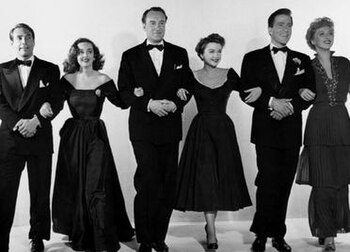


Meanwhile Claudette Colbert injured her back on the set of Three Came Home, another film she was starring in and had to withdraw from the role of Margo. Now Mankiewicz and Zanuck were in a quandary. Mankiewicz' script was written with Colbert in mind. Then he thought of Bette Davis. Davis was in a career slump. Her nineteen year career at Warner Brothers had just ended with the tepid Beyond the Forest ("What a dump"?), She was past forty in Hollywood and her prospects weren't promising. Mankiewicz thought she would bring worldly wisdom tempered with vulnerability to the character of Margo. Davis read the script and jumped at the chance.

Filling in the rest of the cast were George Sanders (magnificent as rogue critic Addison deWitt), Thelma Ritter, Hugh Marlowe and as Bill Sampson and Karen Richards, Gary Merrill and Celeste Holm (one pre production casting suggestion was Ronald Reagan as Sampson and his soon-to-be wife Nancy Davis as Karen). All About Eve was Mankiewicz piece de resistance, earning him Oscars for Direction and Screenplay for the second consecutive year. All told, Eve won six Academy Awards and was nominated for fourteen, an achievement not matched until 1997's Titanic.

Tuesday, April 28, 2009

Joan Bennett: Do BLONDES Have More Fun?


Remember pretty and pert Amy March in 1933's Little Women? Remember darkly seductive Kitty "Lazy Legs" March in the 1945 classic noir film Scarlet Street? Both were played by beautiful actress Joan Bennett. Bennett essentially had two phases in her nearly 50 year feature film career. The first as a pretty blonde in mostly lightweight fare during the 1930's and the second as a raven haired vamp in some of the best examples of the film noir genre of the 1940's. Surprisingly, the 180 degree career change took place quite by accident.


In 1938 Joan Bennett had been a popular blonde ingenue in Hollywood for a decade, already appearing in over 30 films, like Disraeli and George Cukor's Little Women. Her career had been steady if uneventful. In late summer she began work on a romantic comedy called Trade Winds with Fredric March. The films producer, Walter Wanger, had put Bennett under personal contract after seeing her in Little Women (Bennett and Wanger would marry in 1940). In the film, Joan's character changes her hair color from blonde to brunette as part of a disguise. Earlier that year Wanger had produced Algiers, which featured Austrian beauty Hedy Lamarr in her successful American debut. He and Trade Wind's director Tay Garnett noted the uncanny resemblance the brunette Joan had to Lamarr. The change was popular with film goers and according to Bennett she began getting better parts. Her new sultry look was so appealing she decided to keep it (Cole Porter even noted the hair change in the song "Let's Not Talk About Love" with the lyrics "Let's speak of Lamarr, that Hedy so fair; why does she let Joan Bennett wear all her old hair?" ).


One producer who took notice of the "new Joan" was friend David O. Selznick. He was so impressed with Bennett's new sultry look that he had her test for the highly coveted role of Scarlett O'Hara in Gone with the Wind. She became one of the four leading contenders for the role along with Paulette Goddard, Jean Arthur and Vivien Leigh, who eventually won the part.


Even though she continued in a few less than demanding roles in films like The Man in the Iron Mask (1939), eventually filmmakers began to appreciate Bennett's darker countenance and her career took a dramatic turn. In 1941 she was cast as a streetwalker in the espionage drama Man Hunt. It was the first of four films she would make for German director Fritz Lang. Her next two Lang films, The Woman in the Window (1944) and Scarlet Street (1945) were excellent examples of the film noir genre that had become popular with wartime and post war audiences and cemented Bennett's persona as a femme fatale. Joan Bennett never went back to being a blonde, either personally or professionally, and capped off her career as matriarch Elizabeth Collins Stoddard in the gothic vampire soap opera, Dark Shadows.

Sunday, April 26, 2009

And Then There Were None: Masterful Mystery

"One little Indian boy left all alone; he went and hanged himself and then there were none". So goes the final verse of an oft told nursery rhyme. It is also the impetus to the classic suspense chiller And Then There Were None, the oft filmed whodunit based on Agatha Christie's best selling mystery novel. This stylish, atmospheric movie premiered very aptly on Halloween 1945 and it was the first and arguably the best version of the many that were adapted to film ( all of which went under the alternative title Ten Little Indians).

Directed by Rene Clair, And Then There Were None features exactly eleven players and a cat. Ten of the eleven are the "little Indians", a motley crew who are taken by boat for a weekend house party on an isolated island off the coast of England. Their host, whom none of them have ever seen (their invitations came by way of a "mutual" friend) is Mr. U. N. Owen (unknown). Once there, the only evidence of U.N. Owen is his voice on a record, accusing each of unpunished murder at some point in their lives. They are then systematically bumped off, one by one. And who is the eleventh character you may ask? Why the boat driver who takes them to the island of course.

The film features an excellent ensemble cast with no big box office star at the helm, which works very successfully on two levels. First, since no major star was involved, the characters are able to be viewed independently and equally important to the storyline, to give a sense of balance, as opposed to two leads and a supporting cast. Second, if a top name celebrity was on board, the audience would have a much better idea of who would be left standing at the final curtain, diminishing the air of suspense and mystery. Included in the cast are Barry Fitzgerald as a judge who allowed an innocent man to be executed. Fitzgerald was in top form, having received a Best Supporting Actor Oscar the previous year for Going My Way. Walter Huston, always bringing distinction to his roles, played Dr. Armstrong, who, under the influence of alcohol, allowed a patient to die on the operating table. A romantic if suspicious chemistry develops between the two younger, more attractive characters played by Louis Hayward and June Duprez, who resembles a cross between Linda Darnell and Margo (Mrs. Eddie Albert of Lost Horizon fame). Rounding out the group is Judith Anderson, Roland Young, Mischa Auer, C. Aubrey Smith, Richard Haydn and Queenie Leonard.

Made with style and skill in the deft hands of French director Clair, And Then There Were None is full of black humor, though, mind you, it's no comedy. The who-in-the-heck-did-it ending differs from that of the novel, but not to act as spoiler, that difference goes undiscussed here.

Thursday, April 23, 2009

Joan Crawford: The Phoenix from the Ashes


Love her or hate her, one thing that has to be said about Joan Crawford. She's a survivor. During her lengthy career, she fought to get to the top and stay at the top and when she was at the bottom, she fought her way up again.


Signed by Metro Goldwyn Mayer in 1925, Crawford carved her niche at the end of the Silent era as the eternal flapper in films like Our Dancing Daughters (1928). In the early and mid-1930's she became the working girl who makes good in Sadie McKee (1934) and other similar roles. By 1937, Life magazine named her "Queen of the Movies" but her films began losing money and the quality of the parts she was offered began to decline. By the end of the decade, Crawford, along with other veteran performers garnered the moniker "box office poison" in lieu of younger, newer stars like Lana Turner and Greer Garson. That's not to say that she didn't appear in some high profile films during this period. Her Crystal Allen spat verbal venom with her big name co-stars in The Women (1939) and her performance as a disfigured criminal in A Woman's Face (1941) reaped much praise from critics. But after A Woman's Face, the prestigious scripts dried up. When Carole Lombard was killed in a plane crash in 1942, Crawford replaced her in They All Kissed the Bride. After a couple more less than stellar pictures, she and Metro mutually decided to part ways. In June 1943 Joan Crawford's contract with MGM was terminated after 18 years.


Two days later she signed with rival studio Warner Brothers. Her Warners contract would pay her $500,000 to make three pictures. The beginning of her career at her new studio wasn't any better than the one she had left at MGM. She turned down several scripts she deemed inferior, appearing only in a cameo role in Hollywood Canteen (1944) her first 18 months there.


In late 1944, Warners bought the film rights to James M. Cain's noir novel Mildred Pierce. Studio heads wanted the reigning queen of the lot Bette Davis for the lead but Davis refused, not wanting to play the mother of a teen-aged daughter. Crawford wanted the part badly. But according to Crawford biographer Bob Thomas, Pierce director Michael Curtiz wanted no part of the former MGM flapper saying, "...why should I waste my time directing a has-been". Curtiz wanted Barbara Stanwyck in the role of Mildred. Crawford humbly offered to take a screen test for the part, a measure unheard of for an actress of her stature. After viewing the test Curtiz agreed to cast Joan. In Crawfords case, it was a fight worth taking on. For her role in Mildred Pierce, she was nominated for an Academy Award, a distinction she had never been honored with during her many years at MGM. Although facing stiff competition with the likes of younger actresses Jennifer Jones, Greer Garson, Ingrid Bergman and Gene Tierney, at the end of the night it was Joan Crawford who was named Best Actress of 1945. The role and her newly acquired Oscar bounced Crawford back to her former glory, gave her renewed confidence and let her retain her title as star.

Wednesday, April 22, 2009

Bing, Bob and Dottie: The Road to Success


No relation to the 1931 melodrama of the same name, The Road to Singapore (1940) would launch one of the most popular and successful movie series in history and become a touchstone for the "buddy" film henceforth. Seven times Paramount contract stars Bing Crosby and Bob Hope headed to some far-reaching locale, either on the lam or touring their vaudeville act, inevitably meeting up with sarong beauty Dorothy Lamour.


The irony is the mega popular trio only developed after Fred MacMurray, Jack Oakie and comedy team Burns and Allen all turned down the film. Crooner Crosby and comedian Hope were then paired with exotic Lamour as the love interest. Road to Singapore became a huge hit for Paramount. Bob Hope was given third billing, being the least famous of the three stars but after his success in Singapore, along with the two hit comedy thrillers, The Cat and the Canary and The Ghost Breakers, he made with Paulette Goddard, he topped Lamour for the second spot in the forthcoming film, Road to Zanzibar(1941) and all those thereafter. Zanzibar was originally a jungle adventure script that the studio wasn't sure what to do with. When they changed the formula to comedy and cast Bing, Bob and Dottie (as Lamour was affectionately called) based on the success of Singapore, they knew they had struck gold.


The films always showcased both lively and romantic songs sifted in with the laughs. The third entry, Road to Morocco (1942) offered great musical examples with the balled "Moonlight Becomes You" and the raucous title tune, which displayed Hope and Crosby's flair for ad-libbing and using Hollywood insider jokes (as they sit atop a camel they sing the line "..For any villains we may meet, we haven't any fears; Paramount will protect us cause we're signed for 5 more years.."). Classic! Arguably the best in the series, Road to Morocco was nominated for two Academy Awards for Best Screenplay and Best Sound Recording.


The hits continued with Road to Utopia (with Dorothy Lamour giving a great rendition of "Personality") in 1946, Road to Rio (featuring the Andrew Sisters in one of their final film appearances) in 1947 and Road to Bali in 1952. Bali was the only "Road" picture to be filmed in color, and though it was still a profitable entry in the franchise, the original magic of the earlier films was lacking. The final "road" taken was Road to Hong Kong in 1962, but this time Dorothy Lamour was replaced with younger actress Joan Collins (Lamour received a small cameo role). It was also the only film of the group that was not released by Paramount. The public was lukewarm and it appeared that alas, the spark was gone.

Sunday, April 19, 2009

Clark Gable: The Punishment That Backfired


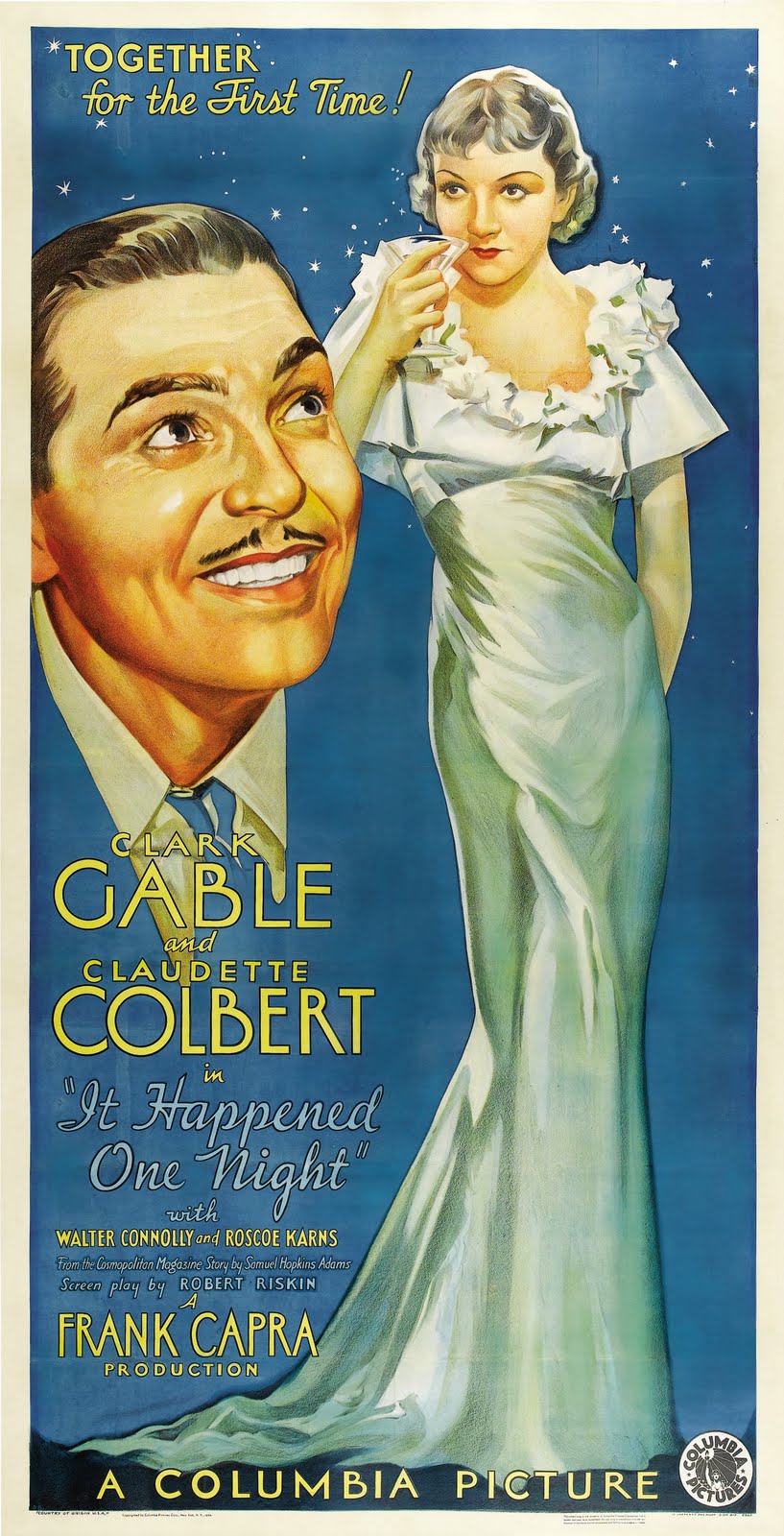
In 1933, Columbia Pictures was considered a "Poverty Row" studio in Hollywood, relegated to low budgets and B pictures. Not being able to afford a host of contract stars, Columbia would borrow from other studios when the need arose. So when director Frank Capra bought the rights for a magazine story called Night Bus, Columbia boss Harry Cohn tried to borrow MGM star Robert Montgomery for the male lead and change the name to It Happened One Night. Louis B. Mayer, head of MGM, refused (MGM turned down the rights to the Night Bus, having lost money on a "bus picture" called Fugitive Lovers, which, ironically, had starred Montgomery). Instead he offered the services of up and comer Clark Gable, as punishment to the rising star for demanding a higher salary. Mayer wanted to humble Gable by showing him the comparison of working at the lowly Columbia as opposed to the pristine Metro Goldwyn Mayer where there were "more stars than there are in Heaven".


Gable was not happy about the arrangement arriving on his first day drunk and angry. He also had doubts about his ability to play a light, comedic role, as he had spent his early years at MGM playing heavy handed thugs and he-men. Capra was also wary on this point. Gable would play Peter Warne, a hard boiled, down t0 earth newspaperman who meets runaway heiress Claudette Colbert. The story follows their misadventures and eventual romance on board a New York bound bus in Florida. After a shaky start with Capra, Gable read the script, relaxed and settled into the part, actually enjoying his time on the set.


It Happened One Night became a sleeper hit and one of the classic screwball comedies. The success of the film actually raised the status and financial viability of Columbia Pictures. When Oscar night rolled around in February 1935 all the headaches paid off. The film was not only a success with the public, it became the first in history to win all 5 major prized: Best Picture, Director, Screenplay, Actress (Colbert) and as Best Actor, Clark Gable.

Friday, April 17, 2009

Rebecca: Hitchcock vs. Selznick


"Last night, I dreamt I went to Manderley again". And thus began 130 minutes of intrigue, suspense, mystery and Gothic romance that we know as Rebecca (1940). Of all things Rebecca was or was not, it was definitely a collaboration of two of Hollywood's creative giants, director Alfred Hitchcock and producer David O. Selznick.

In 1939, while in the middle of producing his masterpiece, Gone with the Wind, Selznick signed Hitchcock to an exclusive contract and brought him over from England, where he had just completed Jamaica Inn. His first American picture would be Rebecca, based on the novel by fellow Brit Daphne du Maurier (who also wrote Jamaica Inn). It was the tale of a young gauche bride coming to live on a grand estate, still haunted by the memory of her predecessor, the beautiful and enchanting Rebecca.

But the Rebecca set was fraught with turmoil from the outset. First, there was the issue of casting. Hitchcock wanted Robert Donat for the role of Maxim de Winter. Selznick on the other hand wanted Leslie Howard or Melvyn Douglas among others. Finally, Laurence Olivier was cast, fresh from his first big American success, Wuthering Heights. Next was the plum role of the unnamed second Mrs. de Winter. Selznick tested dozens of actresses for the part (ala Search for Scarlett), including Margaret Sullivan, Loretta Young and Scarlett herself, Vivien Leigh (she and Olivier were in the midst of their torrid love affair and would marry later that year). In the end Joan Fontaine was given the role which was to garner her an Oscar nomination and make her a star.

During filming Selznick was constantly trying to take creative control from Hitchcock, much to the director's chagrin. When the smoke cleared, Rebecca won the Academy Award for Best Picture of 1940. This award went to Selznick as producer. Although nominated for Best Director, Hitchcock lost out to John Ford for The Grapes of Wrath. His was not the only disappointment. Joan Fontaine, who was seen as a favorite, lost the Best Actress award to Ginger Rogers for Kitty Foyle.

As consolation, Fontaine would indeed win her Oscar the following year in Suspicion, ironically another Hitchcock film. The acclaimed director would also try his hand at filming another Daphne du Maurier based story 22 years later........The Birds. This time David O. Selznick had no hand in the production.

Thursday, April 16, 2009

The Chaplin-Goddard Marriage: Was It Legal?


Today is the 120th birthday of comedian Charlie Chaplin. Famous for his tumultuous early marriages, his third "marriage" to actress Paulette Goddard has been the source of much scrutiny and doubt. Some say the issue even cost Goddard the role of Scarlett O'Hara in Gone With The Wind.


The pair met in 1932, when Goddard was still a chorus girl, and became fast friends and lovers, Paulette even moving into Chaplin's Beverly Hills home. He bought her contract from producer Hal Roach and cast her in his classic Modern Times, which took two years to develop and film. After the release of Modern Times in 1936 the couple went on a tour of the Orient where they supposedly married secretly aboard ship. However, no official paperwork was ever provided to substantiate the claim which had the potential to further harm Paulette Goddard's career. They went on to co-star in Chaplin's next film, The Great Dictator, but the relationship began to fizzle. When the two decided to part ways in 1942, Goddard obtained a quickie divorce in Mexico and allegedly received a handsome settlement.


Goddard went on to become a major star at Paramount and Chaplin (after a nasty paternity suit) married his final wife, Oona O'Neill in 1943.

Tuesday, April 14, 2009

Review: They Drive By Night


They Drive By Night is one of those classic movies that has all the right elements. An ensemble of popular, high caliber stars, which include George Raft, Humphrey Bogart, Ann Sheridan and Ida Lupino, a solid, fast moving storyline, action, romance and obsessive love (mmm..mmm.mmm). It is a partial remake of Bordertown (1935) with Paul Muni and Bette Davis.


The story follows brothers and wildcat truck drivers Raft and Bogart who struggle to make a success of their one truck business. Women and tragedy enter the picture, along with a great Warner Brothers score. What else do you need?


Raft's "acting" is as it always is, he's Raft, but that's great because his persona fits the part of tough but honest Joe Fabrini perfectly. Bogart has the lesser role as brother Paul but it would only be another year before his career really took off in High Sierra and The Maltese Falcon. Ann Sheridan plays Raft's love interest and they have that great tough yet loving gal for tough guy chemistry that is famous at Warner Brothers. But the real star is Ida Lupino. Her lustful, obsessive, glamorous Lana is over the top (she, with Susan Hayward, was called the "poor man's Bette Davis"). This film along with High Sierra pushed her higher on the movie star feeding chain.


They Drive By Night was a hit for the studio upon it's release in 1940 and didn't do it's cast any harm either.

Saturday, April 11, 2009

Fred MacMurray: All Around Good Guy


Most middle aged Americans remember Fred MacMurray as Steve Douglas, the ever patient, wise father of "My Three Sons." The long running television comedy, along with a string of light-hearted Disney films, breathed new life into MacMurray's sagging movie career. But Americans of a certain advanced age, along with those of us of all ages who enjoy classic movies, remember Fred MacMurray as the handsome, affable star of films (mostly at Paramount) during the 1930's and 1940's.

Usually playing the slightly bumbling comic foil of Claudette Colbert, Carole Lombard or Paulette Goddard, he made a 180 degree turn in 1944 to play adulterous murderer Walter Neff in the classic noir film Double Indemnity with Barbara Stanwyck. But it wasn't long until he was back at good-guy leads in Murder, He Says (1945) and The Egg and I (1948) again with Colbert.

In 1954 he married lovely blonde actress June Haver (his second marriage) who remained his wife until his death in 1991.

LinkWithin

Related Posts with Thumbnails