Wednesday, March 23, 2011

Elizabeth Taylor: In Memoriam


Movie legend Elizabeth Taylor has died at the age of 79. Arguably the biggest film icon, along with Marilyn Monroe, to come forth from the screen, Taylor was the much married, much publicized, much ridiculed and much loved star, known above all for her dark, sultry beauty.

Literal volumes have been written about Elizabeth Taylor, as there was a lot in her long and varied life to record. Born in Hampstead, England on February 27, 1932, she came to the United States and began her career as a child star. Her soft voice, violet eyes and dark good looks, set her apart from others and with National Velvet, made in 1944, she made a name for herself and a wad of dough for her studio, MGM. Unlike other child actors, she made the transition to adult roles almost seamlessly, due to her mature beauty at an early age (the girl looked like a goddess at 16 in A Date with Judy).

First married at 18 to hotel heir Nicky Hilton, she later married seven more times, twice to actor Richard Burton. Through them all, as well as her personal and public trials, tribulations and many health problems, the press followed her like a gossip hungry entourage. Heck, for an information hungry media, she was a veritable scandal buffet!


Not only a pretty face and name in the news, Taylor was also an Academy award winning actress. Her first Oscar came to her in 1960 for Butterfield 8 (some say as a consolation for nearly dying from pneumonia the previous year), her second for a much deserved performance with her then husband Burton in Who’s Afraid of Virginia Woolf in 1966. In 1999, La Liz was appointed Dame Commander of the Order of the British Empire. The title suited her.

Besides the afore mentioned films, Taylor appeared in such classics as Little Women (1948), the original Father of the Bride (1950), Giant (1956), Cat on a Hot Tin Roof (1958) and the massive Cleopatra (1963) the mega-bomb in which she met and fell in lust/love with Burton and became the first actress to be paid $1 million for a single film. (The thing about Cleopatra is, despite its woeful reception by critics, it was the highest grossing picture of 1963, but due to its enormous production costs ~ it was set to cost $2 million, but ended up with a $44 million price tag ~ it lost millions). Love her or hate her, Elizabeth Taylor was a true movie star.

Friday, January 14, 2011

The Forest Rangers (1942): What Do You Get When You Cross Smoky the Bear with Max Factor?


The Forest Rangers (1942) isn’t high drama, it isn’t supposed to be. It IS a sometimes comedy, sometimes action, always colorful yarn from Paramount with some of the studios top stars of the day, tromping around among mile high timbers, dodging the flames of a raging forest fire. Along with striking Technicolor, The Forest Rangers sports a catchy tune, “I’ve Got Spurs That Jingle Jangle Jingle”, written by Frank Loesser and Joseph J. Lilley, which became a big hit on the airwaves.

Fred MacMurray is the forest ranger, Susan Hayward is a fetching lumber mill owner, who has the hots for Freddie boy, while he meets, gets the hots for and marries even more fetching city girl Paulette Goddard. Redheaded wildcat Hayward doesn’t take too kindly to the new bride (like it’s any of her business) and gives girlie girl Goddard the wilderness once-over. Think along the lines of of Hayley Mill’s treatment of tenderfoot Joanna Barnes in The Parent Trap some twenty years later. Both remained perfectly coiffed and glossed while fighting fires and each other, and MacMurray remains his ever stoic, yet capable self.


According to the Hollywood Reporter, Madeline Carroll was originally to play Celia, the part Goddard ended up playing, and Goddard was to play Tana, the Hayward role. After seeing the film, and knowing the way Paramount worked such a treatment during this period, I could see the Carroll/Goddard combo working very nicely, even better than the finished product in fact, as Goddard had vivaciously conniving down pat (see Hold Back the Dawn (1941)).

Susan and Paulette had just come off the set of Cecil B. DeMille’s Reap the Wild Wind, so the two cuties were no strangers to sharing the screen and both did what was required of them in this lighthearted look at love in the lonesome pines. Also sharing the screen with the star trio was Eugene Pallette (always a rotund treat), Lynne Overman and Regis Toomey, who completes the love daisy chain as an airplane pilot who carries the torch (no pun intended….this time) for Hayward’s Tana.

Sunday, November 21, 2010

24 Hours (1931): A Full Day with Hopkins & Francis


Talented but temperamental actress Miriam Hopkins had the reputation of stealing scenes and chewing scenery throughout her prominent career. Her earliest days onscreen were no exception and as a bright and shiny new star at Paramount in the early 1930’s, she did not hide her light under a bushel. Making her film debut in 1930 in Fast and Loose with fellow Paramount pretty Carole Lombard ( Lombard had been in films for over half a decade by then), she had a hit in her second feature The Smiling Lieutenant (1931) co-starring movie novice Claudette Colbert. By her third film, she was the sure fire star of the show, even though Clive Brook and Kay Francis were billed above her. The film was called 24 Hours, and it was a prime example of pre-Code Paramount, with a great line-up of actors to boot.


Jim and Fanny Towner (Brook and Francis) are a wealthy yet bored couple who are each involved in an extramarital affair. Jim’s alcoholism doesn’t help the problem and he finds solace with his paramour Rosie Duggan (Hopkins), a brassy speak easy singer, who is married to a weak and neurotic small time hoodlum named Tony (Regis Toomey, whose 40 year screen career began the year before this film was made). Tony is on the skids after his wife has the bouncer at the club where she works, toss him out on his keyster. Later that evening, she carries the falling down drunk Jim home with her to see that he sleeps off his buzz. When Tony comes aknockin’ in the middle of the night, crazed look in his eyes, he accidentally kills the two-timing torch singer, while her sugar daddy is passed out in the other room. He beats it when he realizes what he’s done, as does Jim when he awakes the next morning and realizes he could be blamed for the chanteuse’s demise.


As much as a dramatic showcase 24 Hours is for Miriam Hopkins, Kay Francis has the tougher job of giving a more subtle yet still effective performance. To an extent she succeeds, but her character is written so that she has little more to do than look forlorn about the lack of love in both her marriage as well as her affair. Her dramatic glory days would come with her tenure at Warner Brothers a few years later, a working relationship that was both extremely profitable as well as turbulent for the raven haired star. British born Clive Brook worked in silent films for years and made the transition to sound successfully. He looks rather bored in the first half of this film, but I suppose that is his job, as he is bored with his life AND his wife. (Brook made a telling statement about his profession in America when he said: "Hollywood is a chain gang and we lose the will to escape. The links of the chain are not forged with cruelties but with luxuries."). Although given a small role, veteran stage actress Lucille LaVerne gives the audience a visual once-over as Tony’s slovenly and tough-as-nails landlady. I recognized immediately her voice as that of the old hag in Walt Disney’s animated masterpiece Snow White and the Seven Dwarfs (1937). It was the last performance of her very lengthy career, and the one for which she is most associated, as the animators actually used the actress as a visual model for the crone.

Based on the novel Twenty-Four Hours by Louis Bromfield, the film is a lost gem, a part of Paramount’s film library, owned by Universal/MCA, most of which are unreleased to the general public. Copies aren’t easy to find and when they are, the quality sometimes has much to be desired, but if you do get a chance to gander the charms of the young Mesdames Hopkins and Francis, I’d jump at it.

Thursday, November 18, 2010

What Am I Watching?: Well, I’ll Tell You


Classic movies are obviously one of my favorite things (hence this venue for my passion), and although I write about various films and classic stars, there are so many other personal viewings whose good or bad aspects, as the case may be, don’t get recorded on this blog. There just isn’t enough time to write about them all as in depth as I might like. Having said that, I’d like to pass along a few films, recently viewed, but not shared.


The Great Man's Lady (1942)
Starring Barbara Stanwyck and Joel McCrea, with second lead going to Brian Donlevy, The Great Man’s Lady has a cast who can always deliver the cinematic goods. McCrea is the Great Man, Stanwyck, his lady. Babs ages from 16 to over 100 (pictured above), and lives a lot of life in between. Director William Wellman leaves his signature masculine touch, with plenty of rough and tumble historics mixed with emotional histrionics.

Stanwyck was made for this kind of role. She is part Stella Dallas, part Victoria Barkley. Some may wonder why she sacrifices so much for her “great man”, but that’s the nature of old Hollywood. Catch it if you can.


Le Corbeau (The Raven; 1943)
Director Henri-Georges Clouzot was known as “the French Hitchcock” and with good reason. Most famous for 1955’s Les Diaboliques, Clouzot shot Le Corbeau during the war and its somber mood and very adult themes reflect the conditions of his nation at the time. More a mystery than a suspense, the latter characteristic is always present.

Le Corbeau or The Raven is the signature used by a poison pen letter writer in a small French burg, whose main aggression is directed at a local doctor (Pierre Fresnay). The letters accuse, among many other things, the doctor of being an abortionist. Pretty frank topic during World War II, or anytime before the new millennium for that fact. The entire film is frank and extremely well made. Even if you aren’t into sub-titles, if you like film noir at all, I suggest you give this foreign flick a try, as it is very noirish in feel.


Four Frightened People (1934)
I don’t usually write about films that I didn’t really enjoy, but with this particular post, one takes the good with the bad. It’s not that Four Frightened People is particularly bad, it’s just not all that good. Directed by the gargantuan filmmaker Cecil B. DeMille, it did not even make back its cost and DeMille counted it one of his box office turkeys.

The story tells of four completely different types from the western world, who evacuate a ship off the Malayan coast, which has been striken with bubonic plague. They make their way to land only to be lost in the deepest jungle, to be hunted by nasty natives and even nastier attitudes among themselves. Think Survivor 1934.


Starring Claudette Colbert and Herbert Marshall, with support by William Gargan and Mary Boland, and made at Paramount, the film looks more like one of the studios attempts at a low grade B flick than a Cecil B. DeMille mega-production. But the thing that really got this blogger, was Claudette Colbert, who never disappoints. As a mousy, high strung old maid teacher (can you imagine!), she is anything but classic Colbert. Then she blossoms into a jungle maiden, wearing a sarong of giant banana leaves or leopard print, in full make-up and coiffure. We are talking Fredrick's of Hollywood in the middle of a jungle folks. But the classic Colbert would appear directly after this film was released, because it was then that she played her career changing Oscar winning role in It Happened One Night. One bright spot is Mary Boland. Looking like Paula Deen’s grandmother, Boland is a comic relief of sorts, a toned down version of her Countess DeLave from The Women (1939). I wouldn’t say “Don’t watch this”, as it is watchable but don’t expect a lot either.


There you have it. Rupert’s recent roster of raves and rants. Which leads me to ask, have YOU seen anything delightful or deplorable of late?

Sunday, November 14, 2010

The Silver Cord (1933): Come to Mama


Ah, motherhood. From Madame X to Stella Dallas, Marmee March to Mrs. Judge Hardy (her movie husband, Lewis Stone, even called her “Mother”), the institution of motherhood in Hollywood during the golden age could verge on the sanctimonious and saccharine. That, however, was just one end of the maternal meter. If one goes to the other extreme, they find silly, self serving women, Mommies Dearest to the nth degree. The cinematic grandmaMA to these characters (or even great-grandmaMA, as our subject is an early talkie) would have to be Mother Phelps in RKO’s The Silver Cord (1933).

Based on a play which had a successful run on Broadway in 1926, The Silver Cord is the story of a woman who, by all outward appearances, adores her two grown sons (Joel McCrea and Eric Linden). But as we begin to realize, barely before Mrs. Phelps (her first name is never mentioned) gets her coat off in her first scene, this woman is a manipulative, conniving, self centered barracuda, who, upon meeting her new daughter-in-law (Irene Dunne) for the first time, marks her line in the sand as to where her son’s loyalties should lie! Also present is her younger son’s fiancee (Frances Dee). Matriarch Phelps is ready to devour Dunne, limbs and all, as the main course and finish off Dee, as the lighter, easier to digest dessert, albeit under the guise of sugar-laden maternal concern for her ”big young things.” Dunne’s character, Christina, is a scientist; bright, modern and intelligent and has no intention of giving up her new husband (McCrea) to “another woman” as she calls his mother.


The Silver Cord is a Freudian film fantasy. There is no end to Mrs. Phelps’ mouth kissing both her sons, cleaving them to her ample bosom and having them lay their heads in her always waiting lap. She even admits romantic attachment for them (though verbally falling short of declaring lust) after she discovered her marriage to their father was a loveless one. No woman will ever be good enough for them because no woman is her.

The entire cast is spot on in their portrayal of various members or potential members of this very dysfunctional tribe, headed by Mama Smother Me Not performed with great relish by stage veteran Laura Hope Crews. Crews played the role in the stage version and was a natural when the story came to the screen. Best known as the fluttery spinster Aunt Pittypat Hamilton in the epic Gone with the Wind, Crews channels the same fidgety anxiousness displayed in her Pittypat for Mrs. Phelps, only tempering her flamboyance with a steely resolve to have her own way regarding her offspring.

The apples of her eye, David and Robert, are played by handsome up and comer Joel McCrea and Eric Linden, respectively. The major lack of continuity in character seems to lie with McCrea, whose David makes light of his mother’s fussy cuddling and (wo)man-handling him in the film’s first half, yet defends her against his bride (unfounded, of course) in the second. Linden’s Robert is a spineless “effete” rounder who has no problem being tied tightly with his mothers apron strings. These mama’s boys are whooped! The lovely Frances Dee is splendid as his fiancee, Hester, whose defiance of her would-be viper-in-law brings cheers from the audience. She has one of the best lines in the picture. When asked what she will do by Robert after they have broken their engagement, Dee replies: “Marry an orphan.“ She and McCrea (pictured together below) would become romantically involved off screen during the making of the film, marry and remain so for 57 years until McCrea’s death in 1990.


Star billing went to the sublime Irene Dunne. As Christina, she gives as good as she gets, better in most cases, when going rounds with the monstrous dowager. The role was considered for both Katharine Hepburn and Ann Harding before RKO cast Dunne. Not the mega star she would be later in the decade, Dunne’s grace and sophistication shone through in this pre-code soaper. She would have several collaborations with the film’s director John Cromwell including 1946’s Anna and the King of Siam.

The Silver Cord is very much a filmed play, with lengthy stretches of dialogue by both Hope Crews and Dunne, but it packs quite a wallop in its 74 minute time frame. It would make a great double feature with Craig’s Wife.

Wednesday, November 10, 2010

Claude Rains: A Man for All Seasons


London born and stage trained, Claude Rains was an exceptional actor equally adept at whimsical roles as he was in heavy drama. He made his mark in his very first Hollywood film, The Invisible Man (1933), his unmistakable voice doing most of the work. He signed on with Warner Brothers studio where his performances graced many of Hollywood’s greatest and best known classics. Warners cast him with its biggest stars at the peak of their careers and in many of their definitive films; The Adventures of Robin Hood (1938) with Errol Flynn, Now, Voyager (1942) with Bette Davis and Casablanca (1943) with Humphrey Bogart.

Although rarely the lead, his characters were pivotal and always unforgettable. As Prince John in Flynn’s Robin Hood, he created one of the screen’s great villains. Wearing a heavily banged page boy bob, Rains preening prince planned and plotted only to be foiled in the end by the Prince of Thieves. Along with his role as the wise and knowing Dr. Jackwith in Now, Voyager, he also starred with Davis in Mr. Skeffington (1944) and Deception (1946). The two actors complemented one another perfectly and Rains was one of the actress’ favorite co-stars. The grande dame of the Warners’ lot even went as far to say he was “He was a pip! The best!”


The actor gave a powerful performance as a corrupt senator opposite James Stewart in Frank Capra’s Mr. Smith Goes to Washington (1939) and yet another as a sinister Fascist leader in Alfred Hitchcock’s Notorious (1946), although it’s debatable whether he or his characters mother is more evil in the latter.

He continued working into the 1960’s and also continued his stage work, winning a Tony Award in 1951. Well respected by his peers, Rains was nominated for the Academy Award four times, though never winning the coveted prize.

Sunday, October 31, 2010

Ann Rutherford: Polly Benedict and MORE!


“There was a quality about Metro-Goldwyn-Mayer that was so special . . . it was just the most exciting studio in the world. They looked after their people so perfectly. And then to go to a place [20th Century-Fox] where you don't know anybody and they don't know you and they don't give a rip, it was not a happy time. I got so ticked off, I got married!” ~ Ann Rutherford

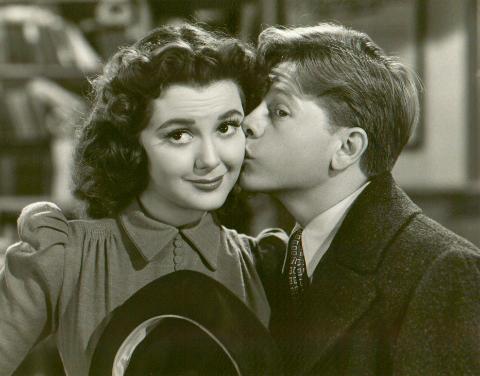
Ann Rutherford will be 90 on Tuesday! An elegant dark haired beauty who graced many classic movies from Hollywood’s hey day, Ann was a prime example of the old Hollywood star system. Making her first film at the age of twenty, she soon was signed to MGM, the glittering super studio of Hollywood at the time. Groomed as one of its prime starlets, she appeared as the Ghost of Christmas Past in Metro’s holiday favorite, A Christmas Carol alongside Reginald Owen and Gene Lockhart. But it was as Polly Benedict in the studio’s wildly popular “Andy Hardy” series, that she became famous and steadily employed for nearly half a decade. As Polly, Andy’s (Mickey Rooney) best girlfriend, Ann had to often share Andy, and screen time, with other up and coming starlets who were being promoted by the studio. These comely lasses included Lana Turner, Esther Williams, Kathryn Grayson and Donna Reed.


Landing juicy roles in youth oriented films at MGM in the late 30’s (most noticeably Dramatic School (1938) and These Glamour Girls (1939), Rutherford was cast by David O. Selznick in his mega hit, Gone with the Wind (1939), as Scarlett O’Hara’s baby sister Careen. The role was briefly considered to be offered to teen-aged Judy Garland, but her light was about to shine very brightly in The Wizard of Oz later that same year.


In the early 1940’s, Rutherford left Metro and worked as a freelance actress, with some success at 20th Century-Fox. In Orchestra Wives (1942), she played Connie, who falls in love and marries trumpet player Bill Abbott (George Montgomery) much to the chagrin of his fellow band member and lead singer Jaynie (the lovely and ever conniving Lynn Bari). She went on to even more memorable roles particularly in the “Whistling” series with Red Skelton back at MGM and as Danny Kaye’s fiancee in The Secret Life of Walter Mitty (1947), but retired from films in 1950. She returned in the 1970’s for a couple more big screen roles and was considered for the role of older Rose in James Cameron’s huge cinematic spectacle Titanic (1997), a role that eventually was played by Gloria Stuart.

Friday, September 24, 2010

Footlight Parade (1933): Jimmy Cagney, the Hoofer


With 42nd Street and Gold Diggers of 1933 (both 1933), Warner Brothers studio had tapped into a treasure trove of entertainment for Depression weary audiences, longing for escapist fare of the highest caliber. With these fluffy film musicals, they had just that, lots of singing, lots of dancing and spectacular kaleidoscopic choreography by master showman Busby Berkley. Striking while the iron was red hot, Warners produced Footlight Parade, a cookie cutter copy of the previous shows, before the year was out. Although not exactly the same plot, the similarities were enough to continue the successful streak for Berkley and the studio.

The plot, such as it is, revolves around the flailing career of New York stage director Chester Kent (movie tough guy James Cagney), who, in an attempt to save his struggling production company, develops “prologues”, live musical introductions to the newly popular talking pictures. As his financial woes mount, his shrewish, shallow wife demands a divorce, his competitor steals his ideas (with the help of an insider from his troupe), and his partners are swindling him of his share of the profits; add to this mix a gold-digging tootsie who latches on to his coattails when it appears he is on his way up again and you have a whirlwind of screen activity with Cagney chewing it up like it was a steak and baked potato. By his side the entire time and helping him at every turn, is his devoted and enamored secretary Nan (the incomparable Joan Blondell, at her cutest and wise-cracking snappiest).


Cagney had become a big star at Warners, along with Edward G. Robinson, as the resident grande gangster, after his breakthrough hit The Public Enemy two years earlier. But the actor had started out on the stage as a song and dance man and took this opportunity to flaunt his hoofing skills to great success. It is in this capacity and genre that he would win an Academy Award nine years later as George M. Cohan in Yankee Doodle Dandy. In Footlight Parade, Cagney is a firecracker of activity, shooting rapid fire dialogue as quickly as he does a machine gun in his gangster/hoodlum pictures.

Blondell, also a Warners staple, is a scene stealer as Nan. Standing by her man throughout the whole film (even when Cagney doesn’t realize he’s her man), she sticks up for the underdog/good guy (encouraging Chester to hire talented dancer/stenographer Ruby Keeler) and protects those she loves from harm (ie: pretty but conniving Claire Dodd from bossman Cagney). Along with the two leads, Footlight Parade features the fresh faces of crooner Dick Powell and the afore mentioned Keeler, who made a dynamic duo in the year’s previous two Berkley hits.


The film is pre-Code, the time before Hollywood censorship took a stronghold, and some of its racier dialogue was sliced and diced from re-release dates after the Code took effect. However, it was restored in 1970, so today, we can enjoy a classic Blondell sniping to her gold-digging rival for Cagney’s affections: “Out countess…as long as there are sidewalks, you’ll have a job.” Other elements that post-Code films wouldn’t have gotten away with were scantily clad chorines in a the bathing beauty extravaganza “By a Waterfall.” As a matter of fact, all the musical numbers in the film’s finale have daring themes to say the least. The charming “Honeymoon Hotel” routine shows a newlywed couple (Powell and Keeler) trying to enjoy their matrimonial amour without the constant interruptions that ensue, including an odd and ribald baby played by dwarf Billy Barty. In the final number, “Shanghai Lil”, Cagney is a sailor, looking for his lost love in the bordellos and opium dens of the Orient. It is a bizarre and surreal concept and even more unusual is the introduction of Keeler’s Lil. Unlike the debauchery and wanton behavior going on around her, Keeler, as Cagney’s Asian gal pal, is cute and perky. From the rest of the performers in the bit, one would expect Marlene Dietrich to show up as the infamous Lil. However, it is nonetheless a fabulous piece of film extravagance set to music.

Fast, furious and complete fun, Footlight Parade, like its toe tapping cousins, 42nd Street and Gold Diggers, was a success and continued the trend at Warners fondly known as the “backstage musical”. The string would continue the following year with another installment of the “Gold Diggers” films, Dames and Wonder Bar.

Want to know more?
Here are some recommendations regarding the article above:
Footlight Parade (1933) DVD
Joan Blondell: A Life Between Takes ~ Matthew Kennedy

If you are interested in these or any other merchandise, please help support this blog by purchasing them through the Amazon portal at the top of this page. By accessing Amazon through this site, you help me maintain resource material and continue to share my love of classic film. Thank you very much.

Thursday, September 9, 2010

Fallen Angel (1945): Fox Film Noir


With Laura (1944), 20th-Century Fox had a certified hit, both commercially and critically. Stylish and sexy, it also certified full fledged stardom for it’s leading lady, Gene Tierney, and propelled the status of it’s director, Otto Preminger. As always in Hollywood, the studio was eager to build on and duplicate the success of a film by using similar elements to potentially create a new one. This was the case with Fallen Angel, produced the year after the Tierney success. Laura’s male star, Dana Andrews was cast in the lead and Preminger assigned as it’s director.

Unlike Laura, the characters in Fallen Angel aren’t glamorous and wealthy eastern urbanites with razor sharp wit. They are denizens of a small podunk hamlet on the California coast. Although the characters reside on both sides of the tracks, the main focus is on the seedier “wrong” side. Down on his luck drifter Eric Stanton (Andrews) is kicked off a night bus bound for San Francisco, for lack of payment, landing in the burg of Walton, population 23 (an exaggeration, but it is a small, slow moving town). Drowning his sorrows in a cuppa joe at a late night diner, he happens upon Stella (luscious Linda Darnell); waitress, leggy lovely and local slut. As mercenary as she is beautiful, Stella, as Eric discovers within ten minutes of film footage, has a penchant for picking up admirers as quickly and handily as she does the day’s blue plate special.

Impetuous boy that Eric is, 24 hours later, he finds that he’s fallen head over heels with our girl Stella. She on the other hand has other plans. Being burned by Johnny-Come-Latelys before, she wants more than a chop suey dinner and a good time. Determined to give the sultry hash slinger the material possessions she craves, Eric sets his sights on local spinster June Mills (Alice Faye), attractive and financially well off. The plan: Marry June, grab her dough and take off with his viperous vixen. But when Stella is found murdered, Eric finds a target on his back.

Not only was Fallen Angel supposed to follow in the successful, noir-ish footsteps of Laura, but it was also supposed to be the dramatic debut of film songstress, Alice Faye. Longtime Fox musical star, Faye wanted to take her career in a different direction and was excited when her boss, head of Fox, Darryl F. Zanuck, chose this for her dramatic break-out (Olivia de Havilland and new Fox lovely Jeanne Crain were also considered for the role. DeHavilland specifically might have done well in it, as she successfully played a similar role in Paramount’s Hold Back the Dawn, two years earlier). Although not a flop, the film didn’t come close to the box-office powerhouse, Laura had been, and Faye was very unhappy with the way the film had been edited. After visiting the screening room to see the final product, she reportedly left the studio and retired from films (she would return to both films and Fox in 1962 for a remake of State Fair, in a secondary mother role).

Dana Andrews was riding a career high, starring in the aforementioned Laura, the hugely popular ‘45 version of State Fair, and headlined the following year’s Oscar winning Best Picture, The Best Years of Our Lives. But the big winner in Fallen Angel was Linda Darnell. Based on her strong performance in Hangover Square, also released in 1945, she was cast yet again as a dark vamp and the persona suited her. Her early roles had consisted of very young and virginal ingenue parts, but as the middle of the decade approached, she began being cast as naughty girls and her dark good looks only enhanced her burgeoning sexpot image. Stella can actually be viewed as a precursor to her acclaimed role as beautiful gold-digger, Lora Mae Hollingsway in the highly successful A Letter to Three Wives (1949). According to Darnell biographer Ronald L. Davis, there was even talk about an Oscar nomination for her performance in Angel.

Famed playwright Tennessee Williams recommended the movie, albeit denouncing the “awful” title, but the overall impression was that it just didn’t live up to it’s expectations. The fast pace of the relationships were inane, with Andrew’s character falling madly in love with a loose woman, meeting and marrying an upstanding lady and attempting to bilk her of her fortune, all in a very small town, and all in less than a week. But the noir elements, overall good performances by not only the three principals but also fine character actors, Charles Bickford, Anne Revere, Bruce Cabot and Percy Kilbride, and striking cinematography by Joseph LaShelle, make for a film from the golden age that can be enjoyed, if not wholly believed.
Want to know more?

Thursday, August 5, 2010

Lana Turner: Birth of a Starlet, Part 2


Note: The first part of this two part article can be found here.

As far as party girls go, Lindsay Lohan had nothing on Lana Turner in the early 1940’s (well, accept arrests and rehab time). With her perky nose, dancing dimples and honey blonde hair, the gorgeous “Sweater Girl” was on the top of the Hollywood heap, both socially and professionally. Although she was still technically a starlet, her career was on the rise, which only heated up her love life all the more.

Her wild woman reputation would only be enhanced by her whirlwind four month marriage to bandleader Artie Shaw (pictured below), a notorious ladies man, who jilted both Betty Grable and a young and impressionable Judy Garland for Turner. Eloping after their first date, the 29 year-old lothario and the sweater girl (who had just turned 19 earlier that week) had a tumultuous time of it and Lana famously called her tenure with Shaw her “college education.” The irony is that Turner claims that she married Shaw on the rebound from yet another infamous Hollywood wolf, attorney Greg Bautzer. Bautzer ditched her for Joan Crawford (Bautzer would be portrayed by actor Steve Forrest in 1981’s Mommie Dearest). He would not only represent her in her divorce from Shaw, but also in her split from second husband, restaurateur Stephen Crane. And so goes the fast and furious Hollywood sexual Merry-Go-Round.


With her divorce came a new crop of men and nightclub rounds. Victor Mature and singer Tony Martin were just a few who squired the blonde beauty around town. MGM took the opportunity of Turner’s burgeoning notoriety to cast her in Ziegfeld Girl (1941) with fellow studio beauty Hedy Lamarr and fellow studio cutie Garland. As Sheila Hale, top banana in a sea of legs and sequins that only the great showman Florenz Ziegfeld could display properly, Lana tumbled and stumbled in yet another kind of sea…..booze and men. The hit film played as a precursor of sorts to 1967’s Valley of the Dolls, and allowed Turner melodramatic training which, not only boosted her career at the time, but would hold her in good stead twenty some odd years later in her middle aged diva stage (ie: Peyton Place (1957), Imitation of Life (1959) and Madame X (1966)).

Her next picture was the big budget remake of Dr. Jekyll and Mr. Hyde, which placed her at third billing after Spencer Tracy and Ingrid Bergman. Originally slated to play the slutty victim of Mr. Hyde, she was cast as the good girl in love with Dr. Jekyll, when Miss Bergman, set to play that role, wanted a change of pace and requested their parts be switched. With the success of Ziegfeld Girl, Metro cast her with the studio’s top male star, the King himself, Clark Gable, in a western/romance called Honky Tonk (1941). Mrs. Gable, aka Carole Lombard, reportedly didn’t like the film pairing, believing the kisses during the fade out might linger after the cameras stopped rolling. Rumors swirled to that notion, though Turner stated, both in a Ladies Home Journal article, as well as her autobiography, that no such affair took place.


Yet another case of alleged extramarital cuddling occurred during the filming of Johnny Eager (1942) with another MGM heavyweight heartthrob, Robert Taylor. The films promotional ads read: "Taylor's Johnny, Turner's eager." Married to actress Barbara Stanwyck at the time, Taylor reportedly was so smitten with Turner that he asked Stanwyck for a divorce. As with the rumored Gable affair, Lana also denied any wrongdoing with Bob Taylor. The onscreen chemistry was definitely there, as it was with Gable and tongues continued to wag when she and Gable were cast yet again in Somewhere I’ll Find You (1942), and it was during the filming of this picture that Carole Lombard was killed in a plane crash while on a war bond selling tour. The following year, Turner starred in a picture called Slightly Dangerous.

By the end of the war, Lana Turner was a hot property, both on and off screen. No film could display this sexy femme fatale persona better than the one for which the actress would become most famous, The Postman Always Rings Twice (1946). As a tanned and tempting married waitress on the make, she would forever brand her image, wearing a stark white two piece short set and matching turban. She would have several more husbands in the next 25 years and many other big roles, but this part defined her sex goddess persona for the rest of the decade and most of the next one. The starlet had become a star.

LinkWithin

Related Posts with Thumbnails