Showing posts with label screwball comedy. Show all posts

Thursday, December 31, 2009

Ringing Out the Old: 15 Posts from 2009


Classic Movies Digest went online in late March of 2009 and in the nine months since its inception, much has been covered in the way of classic movies, so much more has not....yet. Great response has been given by the blogs readers and as a reflection on the past year as it concerns CMD, I wish to offer you the highlights from 2009.

The following are 15 posts which were deemed some of the more popular, by way of feedback through blog comments, Facebook and/or Twitter comments, notes sent via e-mail and page hits. They also include some of my personal favorites. The order in which they are listed is random and each title is clickable in order for you to easily catch any post you may have missed.


  • The Adventures of Robin Hood (1938): In Like Flynn
    One of the most memorable films since its release in 1938, The Adventures of Robin Hood cemented the stardom of Errol Flynn and made a bundle for Warner Brothers. Technicolor extraordinaire!

  • The Glass Key (1942): Lake and Ladd in Hardboiled Hammett
    A classic crime drama from Paramount, the film re-teamed Alan Ladd and Veronica Lake, a red hot pairing who became an iconic Hollywood on-screen couple.

  • The Many Faces of Those Glorious Character Actors
    By far one of the most popular posts of the year, Character Actors showcases some of the marvelous supporting players who make the films from Hollywood's Golden Age, the well rounded, multi faceted stories they should be.

  • Black Narcissus: Technicolor Masterpiece
    A cinematic masterpiece from British filmmakers Michael Powell and Emeric Pressburger, Black Narcissus is brilliant in almost every way. Even if nuns in a remote convent aren't your cup of tea, you might be surprised.

  • 42nd Street: Brother, Can You Spare a Dame
    "You're going out there a youngster, but you've got to come back a star." That's the famous line Warner Baxter said to dancer Ruby Keeler in this classic Depression-era musical, and she did! Both on screen and off.

  • George Sanders: A Scoundrel for All Seasons
    Readers either love to hate this suave cad or hate to love him but regardless they made this post spotlighting the urbane actor very popular.

  • Bride of Frankenstein: A Toast to Gods and Monsters
    Boris Karloff and Elsa Lanchester make electricity of the most morbid sort in this classic horror flick from Universal Studios. One of the most creative and intriguing films of its genre.

  • 13 Classic Movies I've Never Seen ...But Really Want To
    A post with a personal slant, it arguably got the most response than any other Classic Movies Digest entry in 2009. A final update on this post is planned for January 2010.

  • Scarlet Street (1945): Classic Film Noir
    Film noir at its finest. A femme fatale, murder, sex and Edward G. Robinson in a frilly apron. You gotta see this one.

  • My Darling Clementine: An American Classic
    John Ford's poetic western, climaxing at the legendary OK Corral. Fonda, Mature and Darnell are great but Ford's direction and the gorgeous photography are the stars here.

  • Laura (1944): Sophisticated Murder
    Gene Tierney became synonymous with her title character in Laura. The most stylish murder mystery of the 1940's, it made a star of Tierney and didn't hurt Dana Andrews or Clifton Webb either.

  • Judy Garland: Before the Yellow Brick Road
    With all that's been written about the superstar, this post touches on her early innocent days, before booze and pills took their toll. A young girl on the cusp of stardom.

  • A Letter to Three Wives: Is It Your Husband?
    With A Letter to Three Wives, master screenwriter Joseph L. Mankiewicz put dialogue and direction together to create a sublime slice of middle class Americana. Sharp and witty, Mankiewicz' Wives set the stage for his greatest work the following year, All About Eve.

  • The Innocents (1961): Spectres of Complexity
    The classic ghost story based on Henry James' novel. Deborah Kerr gives one of her finest performances as a timid governess who may or may not be seeing spirits. Classy and spooky in every respect.

  • The Awful Truth: Grant, Dunne and a Dog Named Smith
    One of the funniest and most clever screwball comedies to come out of the genre, The Awful Truth stars comedic greats Cary Grant and Irene Dunne as perfect foils for one anothers mishaps. As a divorcing couple still in love, they are A #1.


There you have it. It's been a fun year (or should I say nine months) here at Classic Movies Digest and I hope the coming year will be even more so. Check out the next post to find out some great stuff CMD has in store for 2010. Happy New Year!

Tuesday, July 28, 2009

UPDATE: 13 Classic Movies I've Never Seen....But Really Want To


Several weeks ago, I posted a list of 13 classic films that had always intrigued me for one reason or another but which had eluded me over time, either by my own fault or merely the lack of access to the film. Thanks to a terrific friend, I am happy to say that I have now had the opportunity to watch some of the elusive movies on my list and thought I might share some of my thoughts pertaining to these swell flicks. This post is dedicated to that super classic film loving pal.


The Trail of the Lonesome Pine (1936) Sylvia Sidney, Henry Fonda, Fred MacMurray.
The Trail of the Lonesome Pine was the first film to be shot outdoors in full Technicolor. It focuses on the centuries old feud between two mountain families and how an outsider from the city, who comes to buy part of their lands for coal mining, affects their feud.

Initial appeal for me: I am attracted to Paramount films (which this is) from this era because unlike MGM and Warner Brothers productions, they are harder to find and the ones I have seen (many years ago on commercial television or AMC back in the day when it was a real "classics" channel) I enjoyed no end. Also, I am a fan of young Fred MacMurray, who I feel is underrated and overlooked in the movie actor market. Lastly, having known the backwoods theme of the film, I assumed it would have similarities to one of my alltime favorite movies, Shepherd of the Hills (1941), another Technicolor drama based on hillbilly lore.

My opinion: I really enjoyed The Trail of the Lonesome Pine. The color cinematography is gorgeous and the entire cast did a fine job. Having little knowledge of the films of Sylvia Sidney, the female star, her role as June was enough to ignite an interest in seeing more of her.


Hands Across the Table (1935) Carole Lombard, Fred MacMurray, Ralph Bellamy.

Queen of the Screwball Comedy, Lombard stars along with MacMurray in this fine example of the genre. Carole plays a gold digging manicurist who latches onto playboy Fred, the hitch is, she doesn't know he's broke.

Initial appeal for me: As with Sylvia Sidney, I have only seen a handful of Lombard's films in my time (through lack of access) and as earlier stated, I like the performances of young Fred MacMurray (Maid of Salem, Remember the Night). From the things I'd heard and read, Hands Across the Table seemed like a solid comedy and a good example of Lombard's work.

My opinion: The film was good. Not as good as other screwball classics but better than adequate for sure. I was glad to see Ralph Bellamy in a more sympathetic role rather than his usual buffoon second lead. MacMurray was charming as expected and Lombard was just great. Some of their comic antics were a little strained but overall a film that I'm glad I was able to see.

Mandalay (1934) Kay Francis, Ricardo Cortez, Lyle Talbot

Mandalay is a Kay Francis film through and through. Lurid melodrama which has Kay suffering and wringing her hands with costume changes galore for it's glamorous star (though Francis' character is anything but glamorous, Kay could be nothing but!). Francis plays a gal abandoned by her low life lover into what is essentially white slavery at a brothel/nightclub in Rangoon, Burma. When she decides to leave said life, it's not as easy as she may think. Just getting into distribution under the wire before the Production Code hit big time in Hollywood, it's a racy and risque bit of Kay Francis fun.

Initial appeal for me: I had heard of Mandalay for years as an excellent showcase for the always interesting Francis.

My opinion: The film was everything I expected and then some. Kay is great as Tanya/Spot White and Mandalay is a great example of what a Warner Brothers melodrama could be before the Production Code watered things down.


Forbidden (1932) Barbara Stanwyck, Adolph Menjou, Ralph Bellamy.

Like Mandalay, Forbidden is a pre-Code gem with one of that periods most solid performers, Barbara Stanwyck (Stanwyck would be a solid performer for decades). She plays a dowdy librarian (can you imagine!) who takes her life savings to go on a cruise and meets a married man whom she falls for....permanently.

Initial appeal for me: Always a big Stanwyck fan, her early 30's roles are some of the most compelling of the era. The film was directed by Frank Capra, who always puts on a good show and whose early pairings with Stanwyck were always interesting to me (Ladies of Leisure, The Miracle Woman). Add these elements to the fabulous pre-Code title of Forbidden and I was hooked.
My opinion: Forbidden, like Mandalay, had the adult subject matter and atmosphere that I assumed it would and I enjoyed it thoroughly. Not as much as some of Stanwyck's sassier early roles in films such as Ladies They Talk About or Baby Face, but very watchable nonetheless. Never a big Adolph Menjou fan, that opinion carries through here. I cannot understand Stanwyck's character's attraction to him, as I cannot understand the public's attraction to him as an actor. However, his casting is what it is and taking that fact with a grain of salt, he doesn't hurt the overall picture.


I still have the remaining 9 movies on my initial posting list to discover but I have high hopes for them as well as the many many other films that I yearn to see but fate has yet to allow me. Perhaps after I see a few more on this list I will post another with hard to find gems I can't wait to get my peepers on.

Tuesday, July 7, 2009

Christmas in July: Sturges' Forgotten Gem


Not nearly as revered or even remembered as Sullivan's Travels or The Lady Eve (both 1941), Christmas in July was nonetheless a classic Preston Sturges comedy. Only his second film as writer/director (The Great McGinty (1940) was his first), it sparkles with charm and wit just as his other films but unlike them has been lost to the viewing public over time.

Dick Powell stars as Jimmy MacDonald, a small time office clerk who has big dreams in winning a $25,000 slogan contest for a national coffee company. His contest contribution ~ "If you can't sleep at night, It isn't the coffee, It's the bunk" ~ makes its way around the film often. As a gag, some of his none too bright co-workers send him a fake telegram stating that he has won the much coveted prize. Based on this misinformation, Jimmy announces to the whole office that he has won and takes his best girl, Betty (Ellen Drew) out for a shopping spree like the town's never seen, including a diamond ring and fur for Betty and a brand new dream davenport (ie sofa) that unfolds into a double bed for his unsuspecting mother. Also, gifts for every man, woman and child who lives on his tenement block (25K went ALOT farther in 1940 than it does today!). His boss even gives him a large promotion to the company's advertising department based on the false document! Hmm, hmm, hmm.

Jimmy and Betty take the telegram to the coffee contest company and the befuddled curmudgeon of a company president (Raymond Walburn) coughs up the 25 thousand simoleans. Jimmy is treated like a king everywhere he goes, including his poor neighborhood, where based on his new found fortune (so he thinks), everything is a free for all, food, fun, dancing in the streets. Then the mistake is realized by those in the know at the "Maxford House Coffee Company" and chaos ensues. As with so many films of Preston Sturges, his theme in Christmas in July is based on the common man. Like Frank Capra, he extols the values and virtues of those honest men and women who are trying to pull themselves up and retain their dignity under less than perfect circumstances. However, Christmas in July isn't sappy or saccharine, it's a very genuine film.

Powell is very likeable as Jimmy MacDonald, as he was in most of his pre- Murder, My Sweet (1944) roles. This was one of his first films under a new contract he had signed with Paramount, after leaving Warner Brothers, where he had spent years playing juvenile leads in that studio's "backstage musicals" 42nd Street, Dames, et al. The supporting cast is spot on as well, with William Demarest particularly notable, especially in the films humorous and ironic ending.

I wouldn't say Sturges' classic is underrated because I don't believe enough people have seen it to have an opinion. Like many films that make their way around the Yuletide schedule, Christmas in July, though not set in December, offers all the charm and warm feelings of human kindness as any other. Better than that, it can be viewed January thru December.

Friday, June 26, 2009

The Awful Truth: Grant, Dunne and a Dog Named Smith


"The Road to Reno is paved with suspicions" ~ Cary Grant as Jerry Warriner

I saw My Favorite Wife (1940) with Cary Grant and Irene Dunne, years before I saw The Awful Truth, the classic comedy the star duo made together three years earlier. I remember thinking, how could the 1937 movie be better than Wife. When I eventually saw The Awful Truth, I realized, as good as My Favorite Wife was, the stars' original venture was that much better. The witty sophistication that sparkles throughout the film never lets up, but moves seamlessly from scene to scene, gag to gag and isn't afraid to let its guard down on occasion to let slapstick make a cameo appearance.


Cary Grant and Irene Dunne are an ideal screwball team (this blogger prefers Grant's pairing with Miss Dunne to similar screen outings with Katherine Hepburn any day). Grant, at his most dapper, is in top form in The Awful Truth. It was one of the first films he made as an independent, non-studio bound actor and along with Topper (1937) and Bringing Up Baby (1938), pushed him to super stardom. In retrospect, Dunne is an actress who has been underrated and underappreciated by many and completely forgotten by even more. She is an absolute comic treasure in The Awful Truth, her facial expressions and timing are perfection. She had just finished her first big comedy Theodora Goes Wild the previous year and like Grant, was hitting her stride with this film.

The film begins with Jerry Warriner (Grant) at a New York City spa getting a tan underneath a sun lamp (for those of a certain youthful age, these were the precursors to tanning beds) as evidence to his wife, Lucy (Dunne), of his recent solo trip to Florida, which he never actually made. He arrives at his swank abode just minutes before Lucy appears, still dressed in her shimmering evening gown from the night before, accompanied by her handsome and debonair singing teacher (Alexander D'arcy). The situation is wrought with innuendo and doubt, on both sides as Lucy reads the stamp on one of the oranges Jerry brought her back from his Florida "trip" that reads ~ ORANGE GROWERS ASSOCIATION, CALIFORNIA. Words are exchanged and they decide to divorce, though the shenanigans each gets involved with to thwart the others potential post marital plans, proves their love for one another is as strong as ever.

Ralph Bellamy plays the rich rube from Oklahoma with whom Lucy gets involved, only to make Jerry jealous. The nightclub scene where the three of them accidentally meet up is a hoot, with a special nod going to Grant's date, Dixie Belle Lee (Joyce Compton), who performs a tacky and risque singing number at the club with hilarious reactions from Grant, Dunne and Bellamy. Joyce Compton, with her scatter brained persona and sweet-as-sugah-southun accent, is always a delight to watch. Molly Lamont plays Jerry's rebound main squeeze, a madcap heiress (didn't every 30's screwball comedy have to have one?) who's not only not madcap, she hardly ever smiles!

The couple's beloved dog, Mr. Smith (aka Asta of the Thin Man series fame) shares some of the films key comedic moments. The custody of Mr. Smith, Mr. Smith's piano duet with Jerry and Mr. Smith plays hide and seek with a hat are absolute classic bits of classic comedy. One of the funniest laugh out loud scenes involves Jerry bursting into Lucy's singing recital, expecting her to be in a clinch with her music teacher. Instead he's greeted with the stares of a room full of attendees and he begins wreaking havoc with a chair and side table while his wife not only holds her composure to finish her song but gets a little laugh at his antics while still on key.

The film's director, Leo McCarey, who produced My Favorite Wife, won an Academy Award and six other nominations were garnered including Best Picture, Best Actress for Dunne and Best Supporting Actor for Bellamy. Fun from beginning to end.

Tuesday, May 19, 2009

When Frank Met Jean: Sparkling Cinema


Jean Arthur had beat around Hollywood a long time by late 1935, when she was thirty-five years old. She had started out in silents beginning in 1923, featured in several low budget westerns and comedies. When sound came into play, late in the decade, she had a great asset in her husky, nasal voice, distinctive among her peers. But even though she made the transition to talkies smoothly, true stardom continued to elude her. In 1935, she appeared in John Ford's delightful comedy The Whole Town's Talking, starring Edward G. Robinson, where she displayed a flair for comedy that she hadn't shown on screen before. Her wisecracking defender of milquetoast Robinson was a refreshing change of pace.


The same year The Whole Town's Talking was released, Arthur's home studio, Columbia Pictures, was starting production of a film called Mr. Deeds Goes to Town. Frank Capra, fresh from his huge success with It Happened One Night, was the film's director. Set to play the leads were Gary Cooper and Carole Lombard, in a homespun tale of a small town idealist who inherits a fortune and moves to the big city, only to find cynicism and corruption. Three days before production began Lombard withdrew to take the lead in My Man Godfrey. Shooting on Deeds began without a female lead. Then, in what was to be the turning point of her career, Jean Arthur was chosen by Capra to take over the Lombard role. According to Capra's autobiography, he spotted Arthur in the daily rushes of another film she was working on. He then tried to persuade Columbia boss Harry Cohn to give her the part. Cohn was against it but Capra convinced him by having Cohn listen to her voice only and not look at her face (Cohn said Arthur's face was "half angel and half horse", a reference to the star's claim she had a good side and a bad side to be photographed).


The film ended up winning Capra his second Best Director Oscar and making Jean Arthur a full fledged star. After making the classic fantasy drama Lost Horizon (1937), Capra was back at screwball comedy again with You Can't Take It With You (1938). For the female lead in his latest comedy, Capra again wanted Arthur. He called her "his favorite actress." Yet again, his Midas touch struck movie gold with a third directorial Oscar for You Can't Take It With You, as well as the film winning the year's Best Picture (a rare feat for a comedy feature, although Capra's It Happened One Night also reached this pinnacle).


With his fortunes riding high, Capra and Columbia wanted to make a sequel to Mr. Deeds Goes to Town with Gary Cooper and Jean Arthur called Mr. Deeds Goes to Washington. Cooper, however, was unavailable and the story instead became Mr. Smith Goes to Washington (1939) with Arthur and James Stewart, who was borrowed from MGM. Arthur sparkled as Saunders, the cynical secretary who is slowly bowled over by Stewart's idealistic, completely incorruptible Jefferson Smith. Through her exposure in Capra's films, along with other non-Capra films like Easy Living (1937) and Only Angels Have Wings (1939), Jean Arthur one of the queens of the screwball comedy. Mr. Smith Goes to Washington would be the actress and the director's last film together, and Capra's last at Columbia, the studio where they both made their mark in Hollywood.

Sunday, April 19, 2009

Clark Gable: The Punishment That Backfired


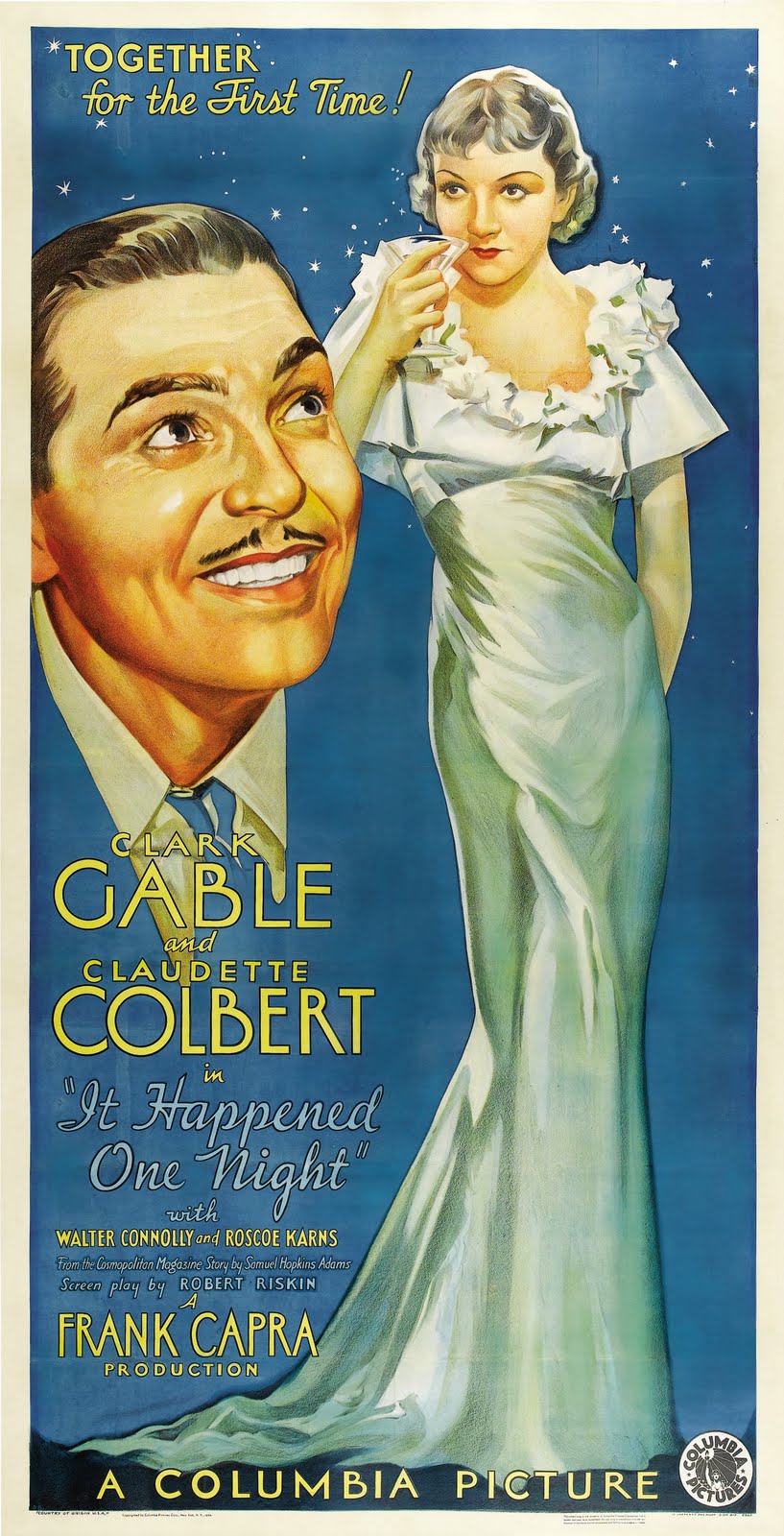
In 1933, Columbia Pictures was considered a "Poverty Row" studio in Hollywood, relegated to low budgets and B pictures. Not being able to afford a host of contract stars, Columbia would borrow from other studios when the need arose. So when director Frank Capra bought the rights for a magazine story called Night Bus, Columbia boss Harry Cohn tried to borrow MGM star Robert Montgomery for the male lead and change the name to It Happened One Night. Louis B. Mayer, head of MGM, refused (MGM turned down the rights to the Night Bus, having lost money on a "bus picture" called Fugitive Lovers, which, ironically, had starred Montgomery). Instead he offered the services of up and comer Clark Gable, as punishment to the rising star for demanding a higher salary. Mayer wanted to humble Gable by showing him the comparison of working at the lowly Columbia as opposed to the pristine Metro Goldwyn Mayer where there were "more stars than there are in Heaven".


Gable was not happy about the arrangement arriving on his first day drunk and angry. He also had doubts about his ability to play a light, comedic role, as he had spent his early years at MGM playing heavy handed thugs and he-men. Capra was also wary on this point. Gable would play Peter Warne, a hard boiled, down t0 earth newspaperman who meets runaway heiress Claudette Colbert. The story follows their misadventures and eventual romance on board a New York bound bus in Florida. After a shaky start with Capra, Gable read the script, relaxed and settled into the part, actually enjoying his time on the set.


It Happened One Night became a sleeper hit and one of the classic screwball comedies. The success of the film actually raised the status and financial viability of Columbia Pictures. When Oscar night rolled around in February 1935 all the headaches paid off. The film was not only a success with the public, it became the first in history to win all 5 major prized: Best Picture, Director, Screenplay, Actress (Colbert) and as Best Actor, Clark Gable.

LinkWithin

Related Posts with Thumbnails