Showing posts with label Claudette Colbert. Show all posts

Tuesday, March 17, 2015

Private Worlds (1935): Have You Seen It?


Mental illness wasn’t exactly the kind of subject matter that had audiences flocking to darkened theaters during Hollywood’s golden age.  It was on rare occasions that a studio would delve into the complicated world of psychosis but when it did, it was usually interesting and respected if not extremely popular.  The Snake Pit, produced by 20th Century-Fox in 1948, was one of the best-known and finest examples of the sensitive subject matter on celluloid.  Thirteen years earlier, however, Paramount had made Private Worlds, which starred Claudette Colbert and Joel McCrea and examined the administrative aspect of a mental hospital with romantic elements thrown in to add spice.

Drs. Jane Everest and Alex MacGregor (Colbert and McCrea) are psychiatrists; colleagues who work very closely together at the Brentwood clinic, a facility for those with mental illness.  Although they are close, there is no hanky-panky between the two professionals, just mutual respect and camaraderie.  Alex is married to Sally (Joan Bennett), an innocent, young woman who loves her husband deeply and is emotionally dependent on him.  Jane has no romantic entanglements, instead carrying a burning torch for her love, lost years ago during World War I.  When a new superintendent arrives at Brentwood, he finds bitterness and animosity from MacGregor, who had hoped to gain the position himself.  The new head honcho, Dr. Charles Monet (Charles Boyer), is of the belief that women should not hold such lofty positions in the medical field, as Dr. Jane has for some time, and reassigns her to lesser responsibilities at the hospital.

The problems really begin when Monet’s flighty and flirtatious sister, who has a shady past, sets her sights on the handsome MacGregor.  While the young doctor begins to see this piece of work “socially,” his emotionally fragile wife slowly begins to sink into a mental decline.  Jane also finds drama when she begins to be drawn to Monet and vice versa.


Joan Bennett and Claudette Colbert

Claudette Colbert was riding a career high in the mid-Thirties.  While filming Private Worlds, Colbert won an Academy Award for the famed screwball comedy It Happened One Night, released the previous year.  1934 also saw her star turns in the original version of Imitation of Life and the exotic lead in Cecil B. De Mille’s Cleopatra.  Fresh off this win she was nominated for her work in Private Worlds.  As Dr. Monet, Charles Boyer gives an interesting performance, though not definitive.  New to Hollywood, Boyer had a heavy, very distinctive French accent, which would be an extreme liability for most actors but for Boyer it became his trademark (the same could be said of fellow Frenchman Maurice Chevalier) and would be imitated by celebrity impersonators often.

Private Worlds was based on a novel by authoress Phyllis Bottom, who had a number of her books translated to the screen, the most famous being The Mortal Storm at MGM in 1940.  According to Joan Bennett, her future husband Walter Wanger, who produced the movie, was offered the film rights to the Phyllis Bottom book, after he had read it, while in England.  Although initially refusing, the producer changed his mind when he realized the book was a bestseller.  When Paramount obtained the rights to Bottom’s story, Gregory La Cava was chosen to direct what was basically uncharted film territory.  La Cava got his start in the early days of motion pictures in charge of an animation unit for newspaper mogul William Randolph Hearst and creating animated shorts with famed cartoonist Walter Lantz.  When he made Private Worlds, his best-known films, My Man Godfrey and Stage Door, had yet to be made.

In her supporting role, Joan Bennett was able to stretch her acting wings more than she ever had before, bringing in one of her most dramatic parts to that date.  In her memoir, The Bennett Playbill, the actress called her part as Sally “the first really challenging and the most dramatic role I’d played up to that time.”  She named Private Worlds as one of six films out of her entire career of seventy movies that she felt was “acceptable.”

As part of the MCA/Universal library, which houses the Paramount collection of movies from this era, Private Worlds is a rarity for modern classic movie lovers.  It is, however, worth the view if ever you get the chance to catch it.

Thursday, November 18, 2010

What Am I Watching?: Well, I’ll Tell You


Classic movies are obviously one of my favorite things (hence this venue for my passion), and although I write about various films and classic stars, there are so many other personal viewings whose good or bad aspects, as the case may be, don’t get recorded on this blog. There just isn’t enough time to write about them all as in depth as I might like. Having said that, I’d like to pass along a few films, recently viewed, but not shared.


The Great Man's Lady (1942)
Starring Barbara Stanwyck and Joel McCrea, with second lead going to Brian Donlevy, The Great Man’s Lady has a cast who can always deliver the cinematic goods. McCrea is the Great Man, Stanwyck, his lady. Babs ages from 16 to over 100 (pictured above), and lives a lot of life in between. Director William Wellman leaves his signature masculine touch, with plenty of rough and tumble historics mixed with emotional histrionics.

Stanwyck was made for this kind of role. She is part Stella Dallas, part Victoria Barkley. Some may wonder why she sacrifices so much for her “great man”, but that’s the nature of old Hollywood. Catch it if you can.


Le Corbeau (The Raven; 1943)
Director Henri-Georges Clouzot was known as “the French Hitchcock” and with good reason. Most famous for 1955’s Les Diaboliques, Clouzot shot Le Corbeau during the war and its somber mood and very adult themes reflect the conditions of his nation at the time. More a mystery than a suspense, the latter characteristic is always present.

Le Corbeau or The Raven is the signature used by a poison pen letter writer in a small French burg, whose main aggression is directed at a local doctor (Pierre Fresnay). The letters accuse, among many other things, the doctor of being an abortionist. Pretty frank topic during World War II, or anytime before the new millennium for that fact. The entire film is frank and extremely well made. Even if you aren’t into sub-titles, if you like film noir at all, I suggest you give this foreign flick a try, as it is very noirish in feel.


Four Frightened People (1934)
I don’t usually write about films that I didn’t really enjoy, but with this particular post, one takes the good with the bad. It’s not that Four Frightened People is particularly bad, it’s just not all that good. Directed by the gargantuan filmmaker Cecil B. DeMille, it did not even make back its cost and DeMille counted it one of his box office turkeys.

The story tells of four completely different types from the western world, who evacuate a ship off the Malayan coast, which has been striken with bubonic plague. They make their way to land only to be lost in the deepest jungle, to be hunted by nasty natives and even nastier attitudes among themselves. Think Survivor 1934.


Starring Claudette Colbert and Herbert Marshall, with support by William Gargan and Mary Boland, and made at Paramount, the film looks more like one of the studios attempts at a low grade B flick than a Cecil B. DeMille mega-production. But the thing that really got this blogger, was Claudette Colbert, who never disappoints. As a mousy, high strung old maid teacher (can you imagine!), she is anything but classic Colbert. Then she blossoms into a jungle maiden, wearing a sarong of giant banana leaves or leopard print, in full make-up and coiffure. We are talking Fredrick's of Hollywood in the middle of a jungle folks. But the classic Colbert would appear directly after this film was released, because it was then that she played her career changing Oscar winning role in It Happened One Night. One bright spot is Mary Boland. Looking like Paula Deen’s grandmother, Boland is a comic relief of sorts, a toned down version of her Countess DeLave from The Women (1939). I wouldn’t say “Don’t watch this”, as it is watchable but don’t expect a lot either.


There you have it. Rupert’s recent roster of raves and rants. Which leads me to ask, have YOU seen anything delightful or deplorable of late?

Sunday, September 13, 2009

Midnight (1939): Happy Birthday Claudette Colbert


Classic and classy Claudette Colbert would have been 106 today. In her long and impressive career as a Hollywood actress, she gave one quality performance after another, covering multiple genres. She could handle heavy drama or dark suspense just as adroitly as she could high comedy. Midnight is one such comedy that Colbert handled to perfection. Yet another gem from 1939, the Paramount production is handled to perfection by all involved, including its other stars Don Ameche, John Barrymore and Mary Astor.

Colbert plays gold digging American chorine Eve Peabody, who finds herself down and out without a nickel to her name in Paris, wearing only a gold lame evening gown. She meets Parisian cabbie Tibor Czerney (pronounced Chair' ney; Don Ameche) and a mutual attraction is felt almost immediately. Afraid of where her feelings for Czerney might lead and out to follow the scent of money, Eve ditches the good looking taxi driver and crashes a swanky party loaded with well-to-dos. Posing as a Hungarian baroness (called Czerney), Eve meets wealthy Georges Flammarion (John Barrymore), his socialite wife Helene (Mary Astor) and Helene's lover Jacques Picot (Francis Lederer). When Jacques shows interest in Eve/Baroness Czerney, Georges seizes the opportunity to engage the down on her luck impostor to help him lure the gigolo away from his wife.

Much to Helene's chagrin, her husband invites the "Baroness" to a weekend party at their country estate. Meanwhile, Tibor has set up a dragnet with his fellow cabbies to search the streets of Paris for his lady fair. When one of them spots Eve in the limousine provided for her via Georges Flammarion, lovelorn Tibor discovers that she is at the Flammarion's plush chateau and follows in pursuit, with hilarious results.

Thanks to director Mitchell Leisen, who began his Hollywood career as an art director and costume designer, Midnight has a lush, luxurious feel with gorgeous sets and exquisitely tailored suits and gowns. The aura of old world aristocracy with its extravagant elegance is abundant which makes Colbert's charming freeloader's appearance there all the more delightful. Thanks to master screenwriting team Charles Brackett and Billy Wilder, the dialogue tossed about in and around that world sparkles and shines with biting wit. One scene has romantic rivals Colbert and Astor in a Parisian hat salon when Claudette quips to Mary: "That hat does something for you...It gives you a chin". It's not just the dialogue itself that works alone, but also the fantastic delivery by the film's stars. Colbert doesn't just spout out the "chin" line as a gag one-liner, but tosses it subtly as in normal conversation to make its sting even more potent.

Originally meant for Barbara Stanwyck, who would have done equally well using her own Stanwyck style in such a part, the role of Eve Peabody was a cinch for Claudette Colbert. One of four roles she played in 1939, her natural fun and sophistication are used to her great advantage in this film. Don Ameche, on a rare loan out from 20th Century-Fox, always seems to enjoy himself in romantic comedy and he and Colbert make a fine duo. As two of the five sides of the glorious comedic menagerie are John Barrymore and Mary Astor. Midnight was filmed late in Barrymore's tumultuous career and it shows on his face but his performance is amazingly funny. Most of his later roles were self-parodying drunks and madcap manics. He looks as if he may be tipsy as Flammarion but it gives the role all the more flair. Astor, who was pregnant during the shooting, isn't as bitchy as Helene as she has proved in other roles that she can be. She is merely catty when the situation calls for it. She is the perfect Hollywood example of the idle European rich at the time. Rounding out the cast are Czech born Francis Lederer, gossip columnist and part-time actress Hedda Hopper and in an early role, brusque and bearded Monty Wooley.

Not as well known as other Colbert comedies (everyone immediately thinks of It Happened One Night, The Palm Beach Story or The Egg and I), Midnight is an excellent film, not to be missed. It is brisk and breezy with a solid plot and tons of great humor. If the opportunity arises, catch it.

Thursday, April 30, 2009

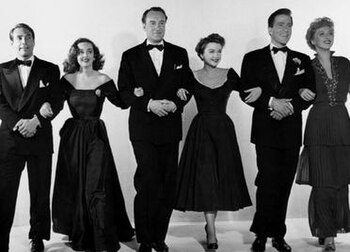
All About Eve: Colbert, Reagan and Jeanne Crain?

All About Eve is an essay by intelligent film people in Hollywood about intelligent theater people on Broadway. That as raw material alone has the potential for a film that will at the very least keep you awake in the theater. But when you add elements like a biting, razor sharp script, pitch perfect direction and an impeccably talented cast, you've got a film that not only keeps you out of slumber land, but picks you up by the collar and gives you a heavyweight championship once over. And that's what All About Eve does.

In 1950, director Joseph L. Mankiewicz was riding a wave of acclaim after his double Oscar coup (Direction and Screenplay) the previous year for A Letter to Three Wives. After Wives, Mankiewicz had the idea for a story about an aging actress and when he read a Cosmopolitan magazine piece called "The Wisdom of Eve" he knew he'd found his inspiration. Then under contract at Twentieth Century Fox, Mankiewicz contacted studio boss Darryl Zanuck about the idea and Zanuck assigned him to the picture for both script and direction. Originally a vehicle for Fox star Susan Hayward, it was determined she was too young for the role of forty-ish Margo Channing, grande dame of the New York stage. After batting about the names of Barbara Stanwyck and Marlene Dietrich, veteran actress Claudette Colbert was signed to play the part.

Fox resident girl next door, Jeanne Crain had also given an Oscar nominated performance the previous year in the racial themed drama Pinky. Zanuck wanted the key role of Eve to go to Crain, one of the studio's top stars at the time. But Mankiewicz, who had directed the actress in A Letter to Three Wives, didn't think she had the chops to play the cold hearted, conniving Eve. He wanted Anne Baxter, who had won a Best Supported Actress Oscar as the tragic Sophie in 1946's The Razor's Edge. Besides feeling she could handle the part, he noted a distinct resemblance to Claudette Colbert, accentuating the characters desire to be like her mentor. Nature resolved the issue when Jeanne Crain discovered she was pregnant and Baxter was cast in the part.


Meanwhile Claudette Colbert injured her back on the set of Three Came Home, another film she was starring in and had to withdraw from the role of Margo. Now Mankiewicz and Zanuck were in a quandary. Mankiewicz' script was written with Colbert in mind. Then he thought of Bette Davis. Davis was in a career slump. Her nineteen year career at Warner Brothers had just ended with the tepid Beyond the Forest ("What a dump"?), She was past forty in Hollywood and her prospects weren't promising. Mankiewicz thought she would bring worldly wisdom tempered with vulnerability to the character of Margo. Davis read the script and jumped at the chance.

Filling in the rest of the cast were George Sanders (magnificent as rogue critic Addison deWitt), Thelma Ritter, Hugh Marlowe and as Bill Sampson and Karen Richards, Gary Merrill and Celeste Holm (one pre production casting suggestion was Ronald Reagan as Sampson and his soon-to-be wife Nancy Davis as Karen). All About Eve was Mankiewicz piece de resistance, earning him Oscars for Direction and Screenplay for the second consecutive year. All told, Eve won six Academy Awards and was nominated for fourteen, an achievement not matched until 1997's Titanic.

LinkWithin

Related Posts with Thumbnails